
August 13, 2023 - PBS News Weekend full episode
8/13/2023 | 24m 8sVideo has Closed Captions
August 13, 2023 - PBS News Weekend full episode
Sunday on PBS News Weekend, why recruiting and Americans’ confidence in the U.S. military are both lagging. Then, how the closure of a small city’s sugar beet processing plant is disrupting farmers and the community. Plus, the fight over Oklahoma’s approval of the nation’s first publicly funded religious school.
Problems playing video? | Closed Captioning Feedback
Problems playing video? | Closed Captioning Feedback
Major corporate funding for the PBS News Hour is provided by BDO, BNSF, Consumer Cellular, American Cruise Lines, and Raymond James. Funding for the PBS NewsHour Weekend is provided by...
August 13, 2023 - PBS News Weekend full episode
8/13/2023 | 24m 8sVideo has Closed Captions
Sunday on PBS News Weekend, why recruiting and Americans’ confidence in the U.S. military are both lagging. Then, how the closure of a small city’s sugar beet processing plant is disrupting farmers and the community. Plus, the fight over Oklahoma’s approval of the nation’s first publicly funded religious school.
Problems playing video? | Closed Captioning Feedback
How to Watch PBS News Hour
PBS News Hour is available to stream on pbs.org and the free PBS App, available on iPhone, Apple TV, Android TV, Android smartphones, Amazon Fire TV, Amazon Fire Tablet, Roku, Samsung Smart TV, and Vizio.
Providing Support for PBS.org
Learn Moreabout PBS online sponsorshipJOHN YANG: Tonight on PBS News Weekend, why recruiting an America's confidence in the U.S. military are both lagging.
Then the fight over Oklahoma's approval of the nation's first publicly funded religious school.
And how the closure of a small cities sugar beet processing plant is disrupting farmers and the community.
MAN: There ain't much you can do about it.
It's a corporate decision and crappy corporate decision.
But that's just the way life works.
My biggest fan service employs everybody that works there.
(BREAK) JOHN YANG: Good evening, I'm John Yang.
The death toll from the Maui wildfire keeps climbing it now stands at 93.
That's the most people killed by any U.S. wildfire in more than a century.
Hawaii Governor Josh Green surveyed the damage with FEMA head Deanne Criswell, the governor warned that the number of dead will grow.
He said the search for bodies will take time.
GOV.
JOSH GREEN (D) Hawaii: We have to go with caution.
There are heavy metals there.
There are toxic states where the houses have come down.
Businesses have come down.
The recommendations are to avoid those structures because they can still fall on people.
And we've lost too much life already.
JOHN YANG: The Maui chief of police said that so far, only 3 percent of the burned area has been searched.
He said the pace should pick up as more help arrives.
Amid the search for the dead there are tales of survival and trauma.
One family escaped the flames by jumping into the ocean and staying there for five hours.
And survivors told of their ordeals the pain of not being able to save others was evident.
DAVID, Lahaina Resident: I saw from friend get on the ground like a piece of charcoal like an Pompeii almost is dead.
I mean, there's nothing you can do.
It was that fast.
JOHN YANG: To help the some 4,500 people who need shelter, officials said that so far they've secured 500 hotel rooms.
In China it's heavy rains that are causing problems.
In western China mudslide and flash flood left at least 21 people dead.
Chinese officials said a highway was damaged and power was knocked out.
Searchers were looking for six people reported missing.
In Ukraine, Russian shelling killed seven people today in the southern region of Kherson.
Ukraine's Internal Affairs Ministry reported that among the dead were four members of one family, a newborn, her parents and her 12-year-old brother.
And in the Black Sea, a Russian warship fired warning shots at a cargo ship.
It's the first time Russia has fired on a merchant vessel since pulling out of a deal that allowed Ukraine to export grain shipments through the Black Sea.
And last night was peak viewing all over the world for the annual Perseid meteor shower.
The moon was just a slim Crescent so in places without much light pollution or cloud cover, meteors could be seen streaking across the sky at a rate of one a minute.
It's not too late to catch the celestial show.
There will be some stragglers tonight and early this week.
Still to come on PBS News Weekend.
a rural community is forced to adjust when the main customer for its farmers crop shuts down, and the court battle over the approval of the nation's first publicly funded religious school.
(BREAK) JOHN YANG: Today's U.S. armed forces faced a number of challenges how to support Ukrainian forces in the war against Russia, how to fend off sophisticated cyberattacks and counter China's growing military might.
As Ali Rogin reports just as important as these global challenges are the issues the military faces at home.
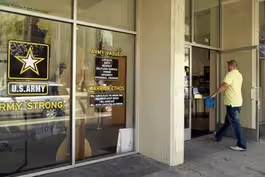
ALI ROGIN: The all volunteer military has reached crisis levels of low recruitment, while at the same time the American public's perception of the Armed Forces is increasingly divided.
A recent Gallup poll found confidence in the U.S. military is at its lowest level in over two decades, only 60 percent of people told Gallup they had confidence in the U.S. military.
At the same time, some military branches are falling short of their yearly recruiting goals by the 1000s.
The army is set to fall 15,000 recruits short this year.
Matthew Gault is a writer for VICE and has covered the military and its relationship with the public for the last decade.
Matthew, thank you so much for joining me first, why are we seeing this record low confidence in the military?
MATTHEW GAULT, Staff Writer, VICE Motherboard: I think there's a lot of different reasons.
I think the probably the biggest one right now this immediate drop is the end of the war in Afghanistan, the American withdrawal from it and how quickly the Taliban was able to retake it, there was a lot of really bad optics, there's a lot of terrible footage, a lot of horrifying stories that happened in the immediate wake of that.
And when America loses a war, confidence in the military goes down.
There's also a lot of culture war issues that are brewing around the military.
And only 1 percent of the American population serves, and they all volunteer force.
And that creates a disconnect, especially over the last 20 years.
ALI ROGIN: And so that's a good segue to my next question, which is what about these low recruitment levels.
What is leading to them?
MATTHEW GAULT: A lot of different things.
One is that the recruitment standards are pretty high.
Pentagon estimates that only around 23 percent of youths aged 17 to 24 can meet the standards for the military.
The reasons why are kind of all over the place, there's fitness standards that people can't meet.
There's weird things like visible tattoos on, you know, the head or the neck or the hands can often kick people out.
Criminal -- past criminal records, no matter how minor, and also a big one now is drug use.
I'm not talking about just marijuana, which is, you know, legal in many, many states, but will prevent you from joining if you pop on a test, but also things that people take for their mental health, big one being ADHD medication.
If you've been on a stimulant in the past 24 months, you have to get a waiver, or they don't want you to join.
ALI ROGIN: And is it the case that more and more people are using these medications who might have otherwise been good recruits for the military?
Is that what's happening here?
MATTHEW GAULT: Yeah, absolutely.
There's a lot of people that smoke marijuana casually don't have a problem with it and are able to like would be fine, active, you know, active service members.
If they change to the recruitment standards, I think they would get a lot more recruits.
You've already seen slackening in some places.
Waivers are being easier to get the Air Force recently lifted the ban on visible tattoos so people can have tattoos on their hands, or their necks and be able to join just fine.
So things are changing, but it's slow.
ALI ROGIN: And in terms of confidence in the institution.
How much does your reporting show military leaders are paying attention to this?
And are looking at ways to address it?
Is it something that they are actively thinking about on a routine basis?
MATTHEW GAULT: So military leadership is incredibly aware of this?
I would say that readiness around recruitment and the lack of confidence in the American military, like feedback into each other and has become like a big culture war issue in the country.
They are constantly talking on Capitol Hill about what they need to do, what they need to change, what they need to address to get people more involved in the military to get the recruits that they need and to prove to the American public, its military is ready and is ready for the fight is ready for the new great power competition that is taking over the planet.
ALI ROGIN: And as you mentioned, the military is trying different strategies to reach out to new cohorts of people.
They're reaching out to the LGBTQ plus community.
They're reaching out to women.
They're trying to access people who are gamers.
And yet some of these efforts have landed them in the hot seat with conservatives who accused them of engaging in the culture wars and then being to quote woke.
So how is the military addressing this paradox?
MATTHEW GAULT: You're already seeing kind of how the military addresses this paradox.
They are betting on the American public is not on legislators.
And in some cases, I would say even attempting to punish legislators in some interesting ways.
The most clear example of this is Tommy Tuberville, who sits on the Senate Armed Services Committee.
And he's from Alabama.
They have Space Force was supposed to build to base there.
Space Force this new -- this new force it's very technically advanced.
Tuberville is preventing over 200 military promotions and has been why is he doing this?
He's doing this because he says that he is worried that the DoD has conveyed a verbal and written commitment to its service members to allow them access to abortion care.
And because of that, he is stalling these promotions.
Well, Space Force recently said, you know what, we're not going to build that base in Alabama.
We're going to go ahead and we're going to stay in Colorado.
There's a bunch of different reasons why this happened.
One of the biggest is that Space Force requires like a highly educated, highly technical class of recruit.
It's also doing a lot of outreach to women.
And access to reproductive health care is a number one issue with that demographic.
In they're not going to move to Alabama, where, you know, their access to reproductive freedom is curtailed.
ALI ROGIN: What sort of impact is this not only having on the day to day work that the military does, you mentioned readiness earlier, but certainly as it looks towards the future, we're moving out of a war against terrorism posture into this great power competition era.
And certainly there's a lot happening in terms of the military's overarching mission.
How is -- how are these twin issues affecting those endeavors?
MATTHEW GAULT: There's simply not enough people joining the military right now.
There's not enough young Americans, especially young Americans that can work computer that no the cyber field back to front, joining the military and preparing that military for the threats that are coming from Russia and China.
These are two countries that have pretty advanced.
They've kind of figured out the cyberspace.
And I would say that America is still playing catch up.
And part of the reason why is that it has these shortfalls, and it can't recruit the kind of people it needs to get in there and, you know, change the game around cyber.
ALI ROGIN: Matthew Gault with VICE News.
Thank you so much for joining us.
MATTHEW GAULT: Thank you so much for having me.
JOHN YANG: Farming can be an uncertain endeavor at the mercy of weather, pests and blight, but another sometimes unexpected factor for farmers around the country, the business decisions at the companies they rely on.
Stan Parker of Montana PBS reports on how closing a processing plant in one small community is up ending the area's farmers and economy.
STAN PARKER: For 90 years and for generations, the Cayko family has grown sugar beets on their family farm here on the far western edge of North Dakota, just outside Fairview, Montana.
But now, that's a thing of the past.
ADAM CAYKO, Fourth-Generation Sugar Beet Farmer: Gave us some pride to say oh, yeah, I'm a sugar beet farmer, you know, as something that people didn't really hear very much.
STAN PARKER: In February, the beet processing facility and nearby Sidney, Montana announced it would close for good.
Spelling the end of an era here on the lower Yellowstone River Valley, where for almost a century, sugar beets have been a fixture of the economy and the local identity.
No factory means no sugar beets.
Trucking them is just too expensive to take them somewhere else.
And efforts by locals to buy the plants were unsuccessful.
After years of fraught, contract negotiations between owners and growers.
The news wasn't a total surprise.
JEFF BIEBER, Montana-Dakota Beet Growers Association President: You know, there's anger at first, and then there's disappointment.
STAN PARKER: Jeff Bieber is the president of the Montana-Dakota Beet Growers Association.
He farms with his son Justin, just down the road from the Cayko family JEFF BIEBER: And they finally announced that they're actually going to close the plant move away from production of sugar beets in the valley.
Here it goes to a level of disappointment and discouragement that having felt in a long time.
STAN PARKER: American Crystal Sugar Company, the nation's biggest sugar refiner, has owned Sidney sugars for roughly the last 20 years.
The company declined our request for an interview, but in a statement said they had to close the plant because the farmers weren't willing to grow enough acres to keep the plant profitable.
The growers say that's not the full story.
JEFF BIEBER: We did everything we could to keep Sidney Montana open.
We took several cuts to our pay over the years, the farmers were willing to take those cuts to keep Sydney open and keep the option of growing beets in Sidney, Montana.
STAN PARKER: Bieber says the cuts just kept coming year after year.
JEFF BIEBER: They were taking money off of the table and to the tune of tens of millions of dollars.
But that money wasn't staying in Sydney, Montana.
And it wasn't being reinvested back into the plant to help them prove to us that they wanted to stay here.
STAN PARKER: The closure impacts not just the farming community, but also the City of Sidney, where the silos beet piles and steam plumes are baked into the community identity.
MAYOR RICK NORBY, Sidney, Montana: There ain't much you can do about it.
So corporate decision and crappy corporate decision, but that's just the way life works.
STAN PARKER: Rick Norby is the mayor of Sindey.
RICK NORBY: My biggest concerns employees, everybody that works there, you're part of their family and I still get treated that way today from working down there just a couple of years.
STAN PARKER: For decades, the beet plant is offered reliable good paying work.
RICK NORBY: It's always been a security a fall back on.
Now, it's not here no more.
STAN PARKER: It was also a cornerstone of the local economy.
Citing a 2012 study from North Dakota State University.
Leslie Messer, who runs a local economic development nonprofit says that through property taxes and wages, Sidney sugars put more than $10 million annually into the local economy.
LESLIE MESSER, Richland Economic Development: That was 120 jobs.
So those were good paying jobs for the community.
STAN PARKER: Despite the loss of the factory, the farmers and this fertile valley will continue to produce.
LESLIE MESSER: The one thing I can say about agriculture over the years is that that is the engine that always runs through the ebbs and tides of the oil and gas the egg has been the economic driver that keeps everything stable.
STAN PARKER: Now these family farms are embarking on a new challenge.
And they'll tackle it the same way they've done for generations together.
MAN: My son has helped a lot that young mind of let's make it work let's figure out how to do it has helped the old dog and me start looking towards the future a little more.
TIM CAYKO, Third-Generation Sugar Beet Farmer: I was pretty set in my ways with beets around but it's going to be a change and I'm willing, STAN PARKER: This year the Caykos will be trying their hand at corn and soybeans, as well as spring wheat which was already in their rotation.
ADAM CAYKO: Changing over to some of these newer crops and different machinery and different farming methods in general is going to be kind of nerve wracking.
That's especially for maybe the older generation.
STAN PARKER: As one chapter closes, another opens for the growers who are looking to pass down what was passed down to them for generations to come.
For PBS News Weekend, I'm Stan Parker and your Fairview, Montana.
JOHN YANG: For several years the Supreme Court has been lowering the barrier between church and state.
In education, the court said last year that religious schools could not be excluded from programs that send taxpayer money to secular private schools.
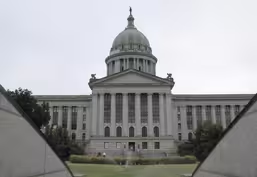
Now Oklahoma officials have approved the creation of what would be the nation's first religious public charter school that has set off a court battle that will likely end up at the Supreme Court.
Adam Kemp is one of our community's correspondents.
He's based in Oklahoma City.
Adam, first of all, what's the proposal that the Oklahoma officials that were approved and who's asking for it?
ADAM KEMP: Right, John, it's an online charter school called St. Isidore of Seville.
Interestingly enough, named after the proposed patron saint of internet users, it will be an online charter school run by the Catholic Archdiocese of Oklahoma.
They plan on using it and they spelled this out directly in their application to spread their evangelical message of the church.
That raises a lot of concerns for folks on, you know, matters of LGBTQ plus issues, sexual gender orientation and sexual morality, whether or not all students will be accepted at this school.
JOHN YANG: Some of those concerns have led to a lawsuit, right?
ADAM KEMP: That's right.
There's been a coalition of groups that have kind of come forward led by the ACLU and the Freedom From Religion Foundation, who are representing like nine different groups from Oklahoma, nine residents, including teachers, some parents, different public education advocates, who are all asking these questions right now of who will be accepted, what kind of accommodations will be made for different students and basically, how much the Catholic Church will, you know, use this school to possibly indoctrinate children, which is, you know, quite the accusation going around right now, but something that these parents are very concerned about right now.
It also comes at a time here in Oklahoma, where Oklahoma is facing a critical shortage of teachers.
The state is one of the lowest in the nation in funding per pupil.
And it has a lot of parents and advocates quite concerned that, you know, they're further expanding this pot of money that is already too small for the number of schools here.
JOHN YANG: I think all the statewide elected officials in Oklahoma Republican, what are they saying about this?
ADAM KEMP: Right, Attorney General Gentner Drummond has already come out and said he believes this is an unconstitutional ruling that doesn't believe it'll has any merit and also believes it could be a slippery slope for a number of different schools to try and create the our way into Oklahoma education.
But Governor Kevin Stitt has come out and said he fully supports this measure.
Earlier this year, in fact, he had already made it possible through a bill for parents to go ahead and take their public funding out of a public school and use it to go to a private school through a tax credit.
He didn't address this lawsuit specifically, but here he is speaking about the need for more charter schools in his opinion.
GOV.
KEVIN STITT (R) Oklahoma: If the Catholics want to want to set up a charter school, specifically in McAlester, Oklahoma, to educate their community and parents choose to go there.
That's a great thing.
And if the Jewish community wants to set up a Jewish charter school, that's an awesome thing.
If the Muslims want to set up a charter school, and their parents want to go there, that's an awesome thing.
Parents want to influence and they want to be involved in their kid's lives.
We're made up of communities here in Oklahoma and taxpayers.
And so to unlock more school options, I'm always going to be supportive of that.
ADAM KEMP: Interesting to note as well that before the vote to approve this school, and here in Oklahoma, the virtual Charter School Board actually had a board member replaced right before the vote by someone who is considered to be an ally of Governor Kevin Stitt.
They were actually asked to be recused themselves from the vote.
They refuse to do so it ended up being the deciding yes vote to approve this school.
JOHN YANG: Adam, does it seem that getting to the Supreme Court was in the minds of the people who proposed this?
ADAM KEMP: Yeah, John, and actually seems like it was a goal of the people who proposed this.
They have talked pretty openly about wanting to change precedent to allow public funds to go to religious institutions like this.
They have kind of spoken about this being the test case to get to the Supreme Court to change that.
JOHN YANG: This is the test case they do they believe that the conservative majority in the Supreme Court would be receptive to this argument?
ADAM KEMP: Yeah, I think they've seen the number of positive rulings that religious institutions and like have received from the Supreme Court and the past couple of years, and I believe they're hoping to take that next step.
JOHN YANG: Are any other religious groups or churches in Oklahoma talking about doing the same thing here.
ADAM KEMP: There's already been some talk that a few different religions have already reached out to inquire about how to submit an application to do this exactly to launch their own charter school.
So far, none of those have come through but the Catholic Church seems to be the one that's the main event right now.
JOHN YANG: Communities correspondent Adam Kemp in Oklahoma City.
Thank you very much.
ADAM KEMP: Thank you.
JOHN YANG: For all of Adams reporting from Oklahoma, on what will be the nation's first publicly funded religious school, visit our website pbs.org/newshour.
And that is PBS News Weekend for this Sunday.
On Monday, Judy Woodruff talks with a conservative former federal judge about accountability for those who tried to overturn the 2020 election.
I'm John Yang.
For all of my colleagues, thanks for joining us.
Have a good week.

Factory closure disrupts local farming community in Montana
Video has Closed Captions
Clip: 8/13/2023 | 4m 55s | Rural Montana factory closure disrupts local economy, farming community (4m 55s)
The fight over public funding for religious charter schools
Video has Closed Captions
Clip: 8/13/2023 | 5m 43s | The legal battle in Oklahoma over public funding for a religious charter school (5m 43s)
Why recruiting, confidence in U.S. military is so low
Video has Closed Captions
Clip: 8/13/2023 | 7m 10s | Why recruiting and confidence in America’s armed forces is so low right now (7m 10s)
Providing Support for PBS.org
Learn Moreabout PBS online sponsorship
- News and Public Affairs

FRONTLINE is investigative journalism that questions, explains and changes our world.

- News and Public Affairs

Amanpour and Company features conversations with leaders and decision makers.












Support for PBS provided by:
Major corporate funding for the PBS News Hour is provided by BDO, BNSF, Consumer Cellular, American Cruise Lines, and Raymond James. Funding for the PBS NewsHour Weekend is provided by...