
East African asylum seeker deported to Equatorial Guinea
Clip: 3/25/2026 | 7m 56sVideo has Closed Captions
East African asylum seeker deported by U.S. to Equatorial Guinea
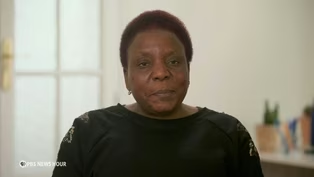
Since retaking office, the Trump administration has deported more than 675,000 people. Even though the administration alleges that it's removing the worst of the worst, some fleeing political violence and some with strong asylum claims are getting swept up as well. William Brangham spoke with one of those individuals and her lawyer.
Problems playing video? | Closed Captioning Feedback
Problems playing video? | Closed Captioning Feedback
Major corporate funding for the PBS News Hour is provided by BDO, BNSF, Consumer Cellular, American Cruise Lines, and Raymond James. Funding for the PBS NewsHour Weekend is provided by...
East African asylum seeker deported to Equatorial Guinea
Clip: 3/25/2026 | 7m 56sVideo has Closed Captions
Since retaking office, the Trump administration has deported more than 675,000 people. Even though the administration alleges that it's removing the worst of the worst, some fleeing political violence and some with strong asylum claims are getting swept up as well. William Brangham spoke with one of those individuals and her lawyer.
Problems playing video? | Closed Captioning Feedback
How to Watch PBS News Hour
PBS News Hour is available to stream on pbs.org and the free PBS App, available on iPhone, Apple TV, Android TV, Android smartphones, Amazon Fire TV, Amazon Fire Tablet, Roku, Samsung Smart TV, and Vizio.
Providing Support for PBS.org
Learn Moreabout PBS online sponsorshipJOHN YANG: Since returning to office, the Trump administration has deported more than 675,000 people.
A federal judge recently allowed the government to continue deporting undocumented immigrants to countries other than their country of origin.
Even though the administration says it's removing the worst of the worst criminal elements, some migrants, including those fleeing political violence and who have made asylum claims, are getting swept up as well.
William Brangham recently spoke with one of those people and her lawyer.
WILLIAM BRANGHAM: We recently interviewed a woman who we will call Julia who was deported through this policy.
After she says she was violently attacked by her government soldiers, Julia fled her home country in East Africa two years ago.
She took a flight to Brazil, traveled two months up through South America, crossed the treacherous Darien Gap, all the way to the U.S.
border where she hoped to claim asylum.
She was detained in the United States for over a year.
And, then last summer, a judge ruled that Julia could not be deported back to her home country, given the risks that she would face.
Four months later, she was put on a plane and sent to Equatorial Guinea, a place she had never been and had never even heard of.
Julia's lawyer, Meredyth Yoon, joins us now.
Meredyth, thank you so much for being here.
We spoke with Julia recently, and she described this horrendous story explaining why she had to flee her country.
And it goes like this.
Her brothers, who were away at the time, had apparently joined an armed -- an opposition group.
And government soldiers came to Julia's home to interrogate them to find out information about their brothers.
And this is very, very hard to listen to.
We also obscured Julia's face to protect her identity.
But this is what Julia told us happened on that day.
"JULIA," Deported to Equatorial Guinea: They came in the night.
I remember there are seven, and three of them, they catch my father.
They start beat him.
Also, two of them, they catch my mom.
And two of them -- one of, he take me on the ground.
And he raped me in my family.
And he kicked my stomach more than three times.
After he finish raping me, he take his cigarette and he burned my breast.
WILLIAM BRANGHAM: Would that kind of circumstance, clearly fleeing political violence in her home country, be the basis for a normal asylum claim?
MEREDYTH YOON, Immigration Lawyer: Yes.
The facts of her case are absolutely heartbreaking and clearly formed the basis for statutory eligibility for asylum in the United States.
However, at the time she entered the United States, she was subject to a temporary rule that was in effect between May 2023 and May 2025 that made it much harder for people to seek asylum if they traveled through a third country before reaching the United States.
WILLIAM BRANGHAM: She crosses, she gets arrested and she's held in this detention center in Eloy, Arizona.
We should say this happened during the Biden administration and transitioned into the Trump administration.
But she's in this detention center for over a year.
Is that common to hold people for such long periods of time?
MEREDYTH YOON: Unfortunately, we're seeing that people are being held in detention for much longer periods of time than was the case in the past.
And this was the case for Julia.
Under the Trump administration, we have been seeing that, when people are granted relief, ICE is continuing to hold them in detention for months and months after they have already won protection in their case.
WILLIAM BRANGHAM: This particular detention center has been criticized for some pretty grim conditions.
This is what Julia described about her conditions there.
"JULIA": Every single minute, every single day, they want remind you are migrants, you are Black, you don't have the rights.
You -- in America, you know?
I don't know.
Before I came to America, I think America is the land of rights, you know?
Everything is became good for people, human rights is very important thing.
But you went to jail?
No.
One year, two months, every single day, they remind me I'm migrant.
WILLIAM BRANGHAM: What else did Julia tell you about her experience in that center?
MEREDYTH YOON: It's horrible to hear the experience that Julia went through in detention.
And, sadly, it is endemic to the immigration detention system in the United States.
Conditions are just absolutely terrible.
ICE is not held accountable for conditions that they have in their detention centers.
They called her names.
They insulted her.
They called her trash,just -- they were racist.
Just absolutely horrific treatment.
WILLIAM BRANGHAM: She finally did get a court hearing, and she was granted this withholding of removal.
Can you again explain what that is and what that meant with regards to her status?
MEREDYTH YOON: Under the Immigration and Nationality Act, the U.S.
may not deport a person to a country where their life or freedom would be threatened.
And when a person has proved that that is likely to be the case, it is mandatory that they may not be sent to that country.
WILLIAM BRANGHAM: So she is then sent four months later to Equatorial Guinea, which she has no connection to whatsoever.
We reached out to DHS for a comment and a spokesperson said, the judge ruled that she could be removed, and to anywhere, as you say, but her home country.
And DHS said -- quote -- "We are applying the law as written.
If a judge finds an illegal alien has no right to be in this country, we are going to remove them, period."
How do you respond to that?
MEREDYTH YOON: Under the Immigration and Nationality Act, which is the act passed by Congress that contains almost all U.S.
immigration law, there are specific procedures that lay out what countries a person may be deported to.
It's not the case that DHS may just deport anyone to any country they please.
They have to go through a specific process and follow specific steps.
That is not what happened in Julia's case.
That is not what happened in nearly all of the cases that we are aware of where someone was deported to a third country.
They -- in Julia's case, she was deceived.
She was lied to.
She was told that she was being actually deported to her country of origin, not to Equatorial Guinea.
She did not find out until the plane was in the air and well into its journey that she was being deported to Equatorial Guinea.
WILLIAM BRANGHAM: The idea, I take it, is that we send people to a third country with some understanding that they will not be mistreated in that country.
Do we have any idea as to what the arrangement America has with Equatorial Guinea?
MEREDYTH YOON: The agreement between the United States and Equatorial Guinea has not been made public.
I have not seen it.
What we do know, based on what we have seen in Equatorial Guinea and elsewhere, is that these arrangements typically are not intended to be sending someone to a new country for that to become their home.
Instead, they are stuck between impossible alternatives, to remain detained indefinitely or to be sent on back to the very country they fled and where they would face danger.
So it is a continuation of the cruel policy of detaining people who are coming to seek protection from legitimate violence in their countries of origin.
WILLIAM BRANGHAM: Meredyth Yoon, thank you so much for talking with us.
MEREDYTH YOON: Thank you so much for having me.
A Brief But Spectacular take on empowering 'soccer grannies'
Video has Closed Captions
Clip: 3/25/2026 | 2m 21s | A Brief But Spectacular take on empowering 'soccer grannies' (2m 21s)

How Australia's social media ban is impacting teens
Video has Closed Captions
Clip: 3/25/2026 | 8m 9s | How Australia's pioneering social media ban is impacting teens (8m 9s)

Iran rejects Trump's ceasefire terms and issues own demands
Video has Closed Captions
Clip: 3/25/2026 | 4m 5s | Iran rejects Trump's ceasefire terms and issues own demands as war continues (4m 5s)

Lebanese emergency workers risk lives to aid civilians
Video has Closed Captions
Clip: 3/25/2026 | 5m 49s | Lebanese emergency workers risk lives to aid civilians during ongoing Israeli attacks (5m 49s)

Meta, YouTube found liable in landmark youth addiction case
Video has Closed Captions
Clip: 3/25/2026 | 7m 38s | Jury finds Meta and YouTube liable in landmark youth addiction case (7m 38s)

Mideast experts on state of Iran war and efforts to end it
Video has Closed Captions
Clip: 3/25/2026 | 7m 23s | Mideast experts analyze state of Iran war and diplomatic efforts to end it (7m 23s)

News Wrap: Democrat wins election in Mar-a-Lago's district
Video has Closed Captions
Clip: 3/25/2026 | 4m 23s | News Wrap: Democrat wins Florida state House seat in district home to Mar-a-Lago (4m 23s)
Where talks to fund DHS stand as shutdown drags on
Video has Closed Captions
Clip: 3/25/2026 | 3m 42s | Where talks to fund DHS stand as shutdown reaches 40 days (3m 42s)
Providing Support for PBS.org
Learn Moreabout PBS online sponsorship
- News and Public Affairs

Today's top journalists discuss Washington's current political events and public affairs.

- News and Public Affairs

FRONTLINE is investigative journalism that questions, explains and changes our world.












Support for PBS provided by:
Major corporate funding for the PBS News Hour is provided by BDO, BNSF, Consumer Cellular, American Cruise Lines, and Raymond James. Funding for the PBS NewsHour Weekend is provided by...