
June 17, 2023 - PBS News Weekend full episode
6/17/2023 | 26m 45sVideo has Closed Captions
June 17, 2023 - PBS News Weekend full episode
June 17, 2023 - PBS News Weekend full episode
Problems playing video? | Closed Captioning Feedback
Problems playing video? | Closed Captioning Feedback
Major corporate funding for the PBS News Hour is provided by BDO, BNSF, Consumer Cellular, American Cruise Lines, and Raymond James. Funding for the PBS NewsHour Weekend is provided by...
June 17, 2023 - PBS News Weekend full episode
6/17/2023 | 26m 45sVideo has Closed Captions
June 17, 2023 - PBS News Weekend full episode
Problems playing video? | Closed Captioning Feedback
How to Watch PBS News Hour
PBS News Hour is available to stream on pbs.org and the free PBS App, available on iPhone, Apple TV, Android TV, Android smartphones, Amazon Fire TV, Amazon Fire Tablet, Roku, Samsung Smart TV, and Vizio.
Providing Support for PBS.org
Learn Moreabout PBS online sponsorshipJOHN YANG: Tonight on "PBS News Weekend," a new report examines the changing face of extremists, hate and antigovernment groups in America.
Then, a look at the shortage of urgently needed mental health services for children who survive gun violence and the importance of deaf children learning sign language early in life.
MAN: It's very difficult to go back and fill in the gaps for their language functioning and for their everyday use of language.
(BREAK) JOHN YANG: Good evening.
I'm John Yang.
President Biden held the first big rally of his reelection campaign today in Philadelphia.
It was before a crowd of hundreds of enthusiastic union members.
The day before, the president picked up the joint early endorsement of some of the biggest and most politically influential unions, including the AFL-CIO and groups representing teachers and city and state government workers.
Organized labor support was key to his 2020 victory.
Today, he struck a decidedly economic populist tone.
JOE BIDEN, U.S. President: If the investment bankers in this country went on strike tomorrow, no one would much notice in this.
No, think about this in a literal sense.
But if this room didn't show up for work tomorrow or Monday, the whole country would come to a grinding halt.
So tell me, tell me who matters more in America?
JOHN YANG: The president made news on other fronts, too.
He told reporters he hopes to meet with Chinese President Xi Jinping in the next several months.
Secretary of state Antony Blinken is in China this weekend for talks aimed at easing tensions between Washington and Beijing.
And Mr. Biden condemned Russia's deployment of tactical nuclear weapons to Belarus, calling it totally irresponsible.
Russian president Vladimir Putin said he would send more nukes to Belarus later this year.
An overnight attack on a school in Uganda has left at least 41 people dead.
Armed rebels linked to the Islamic state entered a dormitory and attacked students with machetes.
Others burned to death after the rebels set the dorm on fire.
The rebels crossed the nearby border into Congo with six people they had abducted.
The rebel group opposes Uganda's president, who is a U.S. ally.
And Pennsylvania governor Josh Shapiro said today a damaged stretch of interstate 95 in Philadelphia will reopen within two weeks.
President Biden toured the collapsed highway by helicopter today.
Crews are using recycled glass pieces to fill in the collapsed area.
They'll pave it to create a temporary roadway.
I-95 is a key artery for car and truck traffic along the East Coast.
Still to come on PBS News Weekend, a look at mental health services for children who survive gun violence and the choices parents of deaf children have to make about sign language.
(BREAK) JOHN YANG: Rarely have Americans been as polarized as they are today.
And as hate groups edge toward the political mainstream, experts say they're employing new tactics and taking on new forms.
Earlier this month, the Southern Poverty Law Center added 12 conservative parent's rights groups to its list of more than 1,200 extremist hate and antigovernment organizations.
Among those added Moms for Liberty, a group that works against school curriculums that includes gender, race and LGBTQ, plus topics.
Earlier, I spoke with Susan Corke, who leads the team at the SPLC that tracks extremist groups.
I asked her why the center ad these organizations to their list.
SUSAN CORKE, Southern Poverty Law Center: We've been tracking the rise of Moms for Liberty and the other.
We're calling them anti student inclusion groups.
They're trying to claim that they are just engaged parents, but behind their statements, their actions really show different goals.
We included them in this year's report because of their anti-government principles.
They traffic and conspiracy theories about an illegitimate government.
They take actions to censor school discussions around race discrimination, LGBTQ identities.
JOHN YANG: One of the founders, co-founders of.
Moms for Liberty, Tiffany Justice, was quoted in the conservative newspaper the Washington Examiner as calling the inclusion of her group on your list absurd and insulting and saying that it paints a target on the backs of American moms and dads.
What's your response?
SUSAN CORKE: I am a mother too.
I am a mother to a mixed race child.
And what Moms for Liberty is trying to do, essentially, is to turn back the hands of time to the pre-civil rights era.
This movement that they are now spearheading is not new.
They are trying to change curriculum so that we don't cover our hard history of slavery and racism.
What they want is a public education that prioritizes white cisgender children and other children of color and different gender identities.
JOHN YANG: They're saying that they're a parental rights group.
What would they have looked like in the past?
SUSAN CORKE: So following the 1954 landmark and unanimous U.S. Supreme Court Brown versus Board of Education decision, which outlawed, of course, segregation in public schools, that was when the real backlash arose, the birthing of this parental rights movement.
The groups that arose comprised mostly middle to upper middle class white southerners that were seeking to preserve their segregationist way of life.
What we're experiencing right now is this new wave of so called parent's rights advocates that really gained energy during the pandemic rallying together around COVID-19 mask and vaccine mandate in schools.
And then they continued on going after critical race theory, going after LGBTQ trans persons.
JOHN YANG: The SPLC in the past has tracked sort of gained notoriety because of Clan Watch.
You track groups like the Ku Klux Klan, neo Nazis, other white supremacist groups, and now you're tracking a group that calls itself Moms for Liberty.
What does that say to you about how extremist groups have changed their public face, have changed their tactics over time?
SUSAN CORKE: What we have seen is a change in the composition of the hard right since - - before Trump was in office.
But particularly when he was in office, these hard right groups really had access to mainstream politics.
They had direct access to the White House.
So they really gained influence.
In the wake of the insurrection they had to change tactics, and so they started moving to take the mainstreaming and the political influence that they were able to gain within the Republican Party, and they took it to the local level, and they have defined school boards and public education as one of their new battlefields.
JOHN YANG: What can be done, in your view?
What should be done in response to groups like this and to combat groups like this?
Are there policy changes you'd like to see?
SUSAN CORKE: One thing that we really recommend is that there be much more investment from government at the national level as well as at the state and local level and partnerships, public and private, to be really investing in preventing hate and violence before they occur, hand and hand with community resilience measures and a greater emphasis and funding for inclusive education and teaching our hard history.
JOHN YANG: Susan Corke of the Southern Poverty Law Center.
Thank you very much.
SUSAN CORKE: Thank you so much, John.
Happy to be here.
JOHN YANG: Children's firearm related injuries are on the rise.
According to the gun safety group Brady, every day in America, 17 children younger than age 18 survive a gunshot wound.
Ali Rogin has the latest on what this is doing to the mental health of children across the country.
ALI ROGIN: Since 2020, guns have been the leading cause of death for children in America.
While many tragically lose their lives, child survivors of gun violence can endure a lifetime of physical and mental health challenges.
A new study from the American Academy of Pediatrics points to the urgent need for connecting children to mental health services following a firearm injury.
The study analyzed Medicaid data of children aged five to 17 who suffered a nonfatal firearm injury.
It found that 63 percent of these children do not receive mental health services within six months after a firearm injury.
The research noted black youth are less likely to have any mental health follow up than white youth.
Jennifer Hoffmann is a pediatric emergency medicine physician at Lurie Children's Hospital of Chicago.
She's also one of the lead authors of the new study.
Jennifer, thank you so much for joining us.
First of all, this seems like such a no-brainer that if children are going through a traumatic event like a firearm experience, that they would have access to mental health services.
Why is this not the case?
Why is this not ubiquitous?
JENNIFER HOFFMANN, Lurie Children's Hospital of Chicago: You know, unfortunately, there are so many barriers for children to access mental health care in the United States.
We know that one in five children in the U.S. has a mental health condition, but only half receive needed mental health services.
And there are many reasons for this, ranging from under recognition to stigma, but also structural barriers, such as workforce shortages of mental health professionals.
ALI ROGIN: For this study in particular, why look at mental health services following a firearm injury?
JENNIFER HOFFMANN: You know as a pediatric emergency medicine physician, it's devastating to me every time I have to care for a child who's experienced a firearm injury.
And if the child is lucky enough to survive, the experience can be very traumatizing for them.
Research shows that firearm injuries can have lasting impacts on child mental health.
So we wanted to understand which children were able to connect with mental health services and which children could do so in a timely manner.
ALI ROGIN: And what did you find in terms of the differences between children who received follow up mental health care and those who didn't following a firearm injury?
JENNIFER HOFFMANN: So we found that children who had mental health needs detected during their injury visit were more likely to receive timely mental health services.
So that means if mental health needs were recognized during the emergency department visit or hospitalization, they were able to connect sooner with mental health care.
That's important because early treatment is more effective, and it allows children to respond to more simple interventions, such as outpatient therapy, rather than waiting for symptoms to progress and become more severe, requiring intensive treatment like psychiatric hospitalization.
ALI ROGIN: What does that early intervention look like in the aftermath of a firearm injury?
If a child is receiving mental health services, what sort of interactions are we talking about?
JENNIFER HOFFMANN: So it can vary.
It can be simple treatments provided in the primary care office, it can be a referral to a therapist for outpatient therapy, or it can be more intensive care as needed based on what the child's experiencing, such as a day program or occasionally even a hospital stay if needed.
We found that some of the most common mental health conditions that occurred after a firearm injury were traumatic related disorders such as PTSD.
We also found increases in substance use among children after their firearm injury and double the rates of serious mental illness, such as schizophrenia and suicidal thoughts and self-harm.
ALI ROGIN: And what are some of the barriers to children receiving this type of care following these incidents?
JENNIFER HOFFMANN: There are too many barriers.
And one reason is that there are significant workforce shortages of mental health professionals in the U.S. but particularly in high poverty areas in those communities where most firearm injuries occur.
And this is also compounded by limited reimbursement rates for mental health services, particularly those offered by Medicaid relative to private health insurance.
And the reason that we focus study on Medicaid enrolled youth is that most youth in the U.S. who sustain firearm injuries are enrolled in Medicaid.
ALI ROGIN: Wow.
And that leads into my next question, I think, which is what did you learn about the racial disparity in these numbers?
The fact that black youth are less likely to experience mental health services in the aftermath than other races are?
JENNIFER HOFFMANN: You know, this is a troubling finding.
But unfortunately, it wasn't surprising to our research team, given a large body of evidence showing there are disparities in access to mental health care among U.S. black youths.
And there are many possible reasons for this, ranging from familial factors, stigma, cultural barriers, but more importantly, structural barriers, such as a lack of mental health providers in the communities where black children live, and a substantial lack of diversity in the mental health workforce.
ALI ROGIN: And so what does that mean in terms of what policymakers can do?
What would you like to see change?
JENNIFER HOFFMANN: So, first of all, I think that policymakers should make more substantial investments to improving access to mental health services for children.
And this includes meeting children where they are investing in school based mental health services.
Also telehealth mental health services that can connect to children in communities that don't have an in person mental health provider.
Also, policymakers need to increase research funding to address and prevent firearm injuries by applying a public health approach.
We know that research on firearm injuries is substantially underfunded relative to the morbidity and mortality burden.
ALI ROGIN: Absolutely.
And lastly, Jennifer, what types of resources should parents and caregivers be aware of when it comes to mental health related to these sorts of events?
JENNIFER HOFFMANN: It's important for parents to have open and honest conversations with their children.
And if you have any concerns about your child's mental health, talk to your pediatrician first.
They can provide an initial assessment and referrals if indicated.
Also, if your child experiences a mental health crisis, don't leave them alone.
Call the National Mental Health Hotline, 988 to be connected to a trained counselor 24/7.
ALI ROGIN: And of course, we could talk much more about the spate of gun violence incidents in this country, but we will leave it there.
And Jennifer Hoffmann with Lurie Children's Hospital of Chicago.
Thank you so much for your time.
JENNIFER HOFFMANN: Thank you for having me.
JOHN YANG: More than 90 percent of deaf children in the United States are born to hearing parents.
For them, the path forward isn't just difficult, it's controversial.
With the advent of cochlear implants, technology has the opportunity to change lives.
Yet many deaf advocates say not teaching sign language is a risky proposition.
Pamela Watts of Rhode Island PBS Weekly takes a look at the stark choices some parents face.
PAMELA WATTS: Jesus Flores was not diagnosed as deaf until he was three years old.
His mother, Marta Gomez, spent years trying to figure out why he wasn't communicating.
Doctors gave her a choice a cochlear implant or sign language.
They said -- MARTHA GOMEZ, PARENT: If you put a cochlear implant, Jesus can hurt.
Jesus want to talk, or you can leave it there and just do a sign language.
Of course I want to go to the side where he can talk, he can hear, because all my family can be like, good communication with him.
PAMELA WATTS: Jesus went through three surgeries for his cochlear implants.
He also went to a specialty school in Rhode Island that exclusively focuses on spoken language.
After seven years at the school, Jesus wasn't showing much progress.
MARTHA GOMEZ: And I'm asking for that second opinion.
And with the second opinion, they did tell us we got that wrong diagnostic.
PAMELA WATTS: It turned out Jesus had an auditory nerve problem that the cochlear implant would never have been able to resolve.
And how did you feel when you heard that?
MARTHA GOMEZ: Oh, my God.
My whole entire world is like everything is - - I cry.
I cry a lot.
I cry a lot.
And then when I decide to thinking about something else and we're talking about School of the Death.
PAMELA WATTS: At Rhode Island School for the Deaf.
DAVID MULLOWNEY, ASL SPECIALIST, RHODE ISLAND SCHOOL OF THE DEAF: What are we doing next?
PAMELA WATTS: Parents like Martha Gomez are learning American Sign Language or ASL together.
DAVID MULLOWNEY: The group hug is what this mouse needed.
PAMELA WATTS: David Mullowney is their teacher being interpreted aloud.
DAVID MULLOWNEY: This is a sign for I love you.
You'll see this a lot in American Sign Language.
PAMELA WATTS: Nancy Maguire Heath is the director here.
NANCY MAGUIRE HEATH, Director, Rhode Island School for the Deaf: We frequently, especially the last few years, have had number of students referred to us who have no language or have little language.
They may have 50 to 100 spoken words when they should have thousands by that age.
PAMELA WATTS: Most arrive never having learned any sign language.
NANCY MAGUIRE HEATH: You and I, because we're hearing, we learn from our environment all the time.
We learned from mom on the telephone, talking to the plumber.
A deaf child may not get any of that.
They're not getting that incidental learning that our brain grows from.
PAMELA WATTS: That brain growth is the focus of extensive research by Dr. Wyatte Hall, assistant professor of Public Health Sciences at the University of Rochester Medical Center.
DR. WYATTE HALL, Assistant Professor of Public Health Sciences at the University of Rochester Medical Center (through translator): We've seen a lot of research that there appears to be a critical period, or a sensitive period, depending on who you talk with.
That period is a time where we are born biologically ready to acquire language.
PAMELA WATTS: Studies estimate the window lasts from birth to ages three to five.
If children can't easily hear people talking or see people signing, they run the risk of developing what's known as language deprivation.
NANCY MAGUIRE HEATH: Their thinking becomes locked in the concrete.
They can keep learning, but they don't do well in the abstract, and they can't keep up.
WYATTE HALL (through translator): By the time the critical period is over, it's very difficult to go back and fill in the gaps for their language functioning and for their everyday use of language.
There is a very powerful, a very strong structure and system, both medical and education in our country that strongly support using spoken language only approaches.
PAMELA WATTS: Hall says less than 10 percent of deaf children in America learn sign language.
Jesus didn't start learning ASL until he was 11 years old at Rhode Island School for the deaf.
Where would you say he's in school now?
MARTHA GOMEZ: Way behind.
Elementary, like, way, way, way, way behind.
PAMELA WATTS: So he has to work harder?
MARTHA GOMEZ: So hard.
PAMELA WATTS: Hall says that language deprivation shouldn't happen to any child.
WYATTE HALL (through translator): We already know how to prevent these problems.
You give deaf children sign language, it's completely preventable.
I've seen problematic framings that options are framed as or that you have to pick ASL or English spoken language.
What I've also seen is it does not have to be that way.
It can be, and you can have ASL and English.
You can give all the options.
PAMELA WATTS: To prevent that language deprivation, more than 20 states across the country have passed laws to monitor deaf children's language development milestones.
Similar bills have been proposed in Rhode Island, but have not passed.
WOMAN: Good morning.
Good morning.
PAMELA WATTS: Another group of hearing parents.
WOMAN: If you've made a snowman with your child, you can explain the buttons.
PAMELA WATTS: Meet to learn sign language from David Mullowney, who is being interpreted aloud.
WOMAN: And there's more snow.
He sees more snow.
He's like, yes, there's more snow.
And he's excited.
PAMELA WATTS: He signs the picture book.
The Snowy Day.
WOMAN: So Peter was sleeping all night.
PAMELA WATTS: And teaches key vocabulary to parents.
WOMAN: Morning.
And then third sliding.
He's walking along, he sees a tree, looks up, and he's poking the tree.
Poking again.
PAMELA WATTS: So that they can sign bedtime stories to their children.
MAN: Pete.
Pete.
Pete got up.
He woke up.
He wake up, he woke up.
PAMELA WATTS: It's a familiar road for Gomez, who has been learning sign language for Jesus.
She says helps her get better.
MARTHA GOMEZ: I think we cooking together and I'm going to ask Jesus, had I signed this or had I paid this, like I tried.
PAMELA WATTS: So he's teaching you?
MARTHA GOMEZ: Yes.
He's my teacher.
And when I do it wrong, he laughs at me.
PAMELA WATTS: What do you say to him to keep him motivated?
MARTHA GOMEZ: I just show how much I love him.
And that's a matter of what happened.
He always got all my support.
PAMELA WATTS: And that's the approach.
Maguire Heath says all parents should take.
NANCY MAGUIRE HEATH: You're the oil that connects things.
You're the link that connects things for your child.
Accept your child as he is, she is.
Let them know that, and to give them every tool in the book, including American Sign Language, and they will let you know what works for them and what doesn't work for them.
And they will appreciate that.
You are open to all of that.
PAMELA WATTS: For PBS News Weekend, I'm Pamela Watts in Providence, Rhode Island.
JOHN YANG: There is more online, including an in depth look at the limited choices unhoused Americans have when they're dying and the organizations trying to fill that need.
All that and more is on our website pbs.org/NewsHour.
And that is PBS News Weekend for this Saturday.
On Sunday, a look at the challenges faced by Native American communities whose tribal lands cut across modern borders.
I'm John Yang.
For all of my colleagues, thank for joining us.
See you tomorrow.
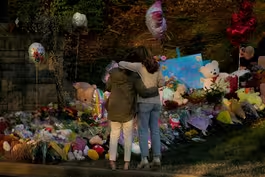
Children injured by guns face barriers to mental health care
Video has Closed Captions
Clip: 6/17/2023 | 6m 56s | Many children who survive gun violence face barriers to mental health care (6m 56s)
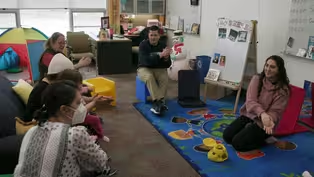
Deaf advocates say learning sign language early is crucial
Video has Closed Captions
Clip: 6/17/2023 | 7m 47s | Why advocates say early sign language learning for deaf children is crucial (7m 47s)
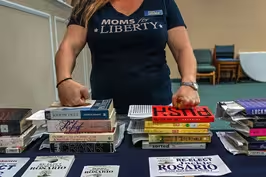
New report looks at changing face of U.S. extremist groups
Video has Closed Captions
Clip: 6/17/2023 | 5m 28s | New report looks at the changing face of extremist groups in America (5m 28s)
Providing Support for PBS.org
Learn Moreabout PBS online sponsorship
- News and Public Affairs

FRONTLINE is investigative journalism that questions, explains and changes our world.

- News and Public Affairs

Amanpour and Company features conversations with leaders and decision makers.












Support for PBS provided by:
Major corporate funding for the PBS News Hour is provided by BDO, BNSF, Consumer Cellular, American Cruise Lines, and Raymond James. Funding for the PBS NewsHour Weekend is provided by...