
June 23, 2023 - PBS NewsHour full episode
6/23/2023 | 57m 46sVideo has Closed Captions
June 23, 2023 - PBS NewsHour full episode
June 23, 2023 - PBS NewsHour full episode
Problems playing video? | Closed Captioning Feedback
Problems playing video? | Closed Captioning Feedback
Major corporate funding for the PBS News Hour is provided by BDO, BNSF, Consumer Cellular, American Cruise Lines, and Raymond James. Funding for the PBS NewsHour Weekend is provided by...
June 23, 2023 - PBS NewsHour full episode
6/23/2023 | 57m 46sVideo has Closed Captions
June 23, 2023 - PBS NewsHour full episode
Problems playing video? | Closed Captioning Feedback
How to Watch PBS News Hour
PBS News Hour is available to stream on pbs.org and the free PBS App, available on iPhone, Apple TV, Android TV, Android smartphones, Amazon Fire TV, Amazon Fire Tablet, Roku, Samsung Smart TV, and Vizio.
Providing Support for PBS.org
Learn Moreabout PBS online sponsorshipGEOFF BENNETT: Good evening.
I'm Geoff Bennett.
AMNA NAWAZ: And I'm Amna Nawaz.
On the "NewsHour" tonight: A year after the High Court overturned Roe v. Wade, Americans on both sides of the abortion debate reflect on the new legal landscape and how it's affecting their lives.
GEOFF BENNETT: And surpassing expectations.
A section of highway in Philadelphia is reopened less than two weeks after it collapsed.
ALEC STAPP, Co-Founder and Co-CEO, Institute for Progress: I think it's a great example of, when there's prioritization and a relaxation of procedure and process, you can actually get things done really quickly in the U.S. AMNA NAWAZ: And it's Friday.
David Brooks and Jonathan Capehart weigh in on the latest candidate to join the Republican presidential race, plus the rest of the weeks political news.
(BREAK) AMNA NAWAZ: Welcome to the "NewsHour."
The U.S. Supreme Court has reinstated President Biden's targeted policy of deporting migrants.
It focuses on those posing egregious threats, instead of the Trump era policy of rounding up anyone in the U.S. illegally.
GEOFF BENNETT: Eight justices ruled that Republican-led states had no legal standing to challenge the new guidelines.
Beyond that, Justice Brett Kavanaugh wrote that the government -- quote -- "lacks the resources to arrest and prosecute every violator of every law."
The court also upheld part of a federal law against encouraging illegal immigration.
AMNA NAWAZ: In the day's other headlines: For the first time, the Justice Department charged four Chinese companies and eight individuals with trafficking precursor chemicals for fentanyl.
The highly addictive opioid has fueled an epidemic of overdoses.
U.S. officials said the chemicals go to the Sinaloa drug cartel in Mexico, which sells the finished fentanyl in the U.S. Attorney General Merrick Garland today defended the investigation of Hunter Biden, the president's son.
IRS whistle-blowers had charged that Garland interfered with a probe by the U.S. attorney for Delaware.
Instead, the attorney general said the prosecutor had full authority, and he insisted politics played no role.
MERRICK GARLAND, U.S. Attorney General: Some have chosen to attack the integrity of the Justice Department and its components and its employees by claiming that we do not treat like cases alike.
This constitutes an attack on an institution that is essential to American democracy and essential to the safety of the American people.
Nothing could be further from the truth.
AMNA NAWAZ: A number of Republicans have said the department went easy on Hunter Biden in a plea deal on gun and tax charges.
Canada and the U.S. have begun investigations into the Titan submersible tragedy.
The vessel imploded during a dive to the Titanic wreckage, killing all five people on board.
U.S. safety officials announced today the Coast Guard will investigate.
And Canada opened a probe because the support ship was Canadian-flagged.
Pakistan now says some 350 Pakistani nationals were on a packed fishing trawler that sank off the coast of Greece last week.
Aerial footage showed the crowded boat before it capsized with up to 750 people on board.
A search found 104 survivors and recovered 78 bodies.
The rest remain missing.
Israeli officials today announced the arrests of three settlers suspected of attacking Palestinian towns in the occupied West Bank.
Hundreds of Israelis have set fire to dozens of homes and cars this week.
The rampages began after a Palestinian shooting attack killed four Israelis.
Rights groups called the arrests a drop in the ocean, given how many settlers were involved.
Monsoon rains in India have forced 14,000 people to take shelter in relief camps.
This week's downpours battered low-lying villages in Assam state, where the Brahmaputra River overflows annually.
The deluge has swamped road crossings, as villagers brave the floodwaters, desperately trying to salvage whatever is left of their homes.
JYOTISH RAJBONGSHI, Flood Victim: (through translator): I have no one to help me.
My wife and I are now alone.
I am sick.
And if I go to my house, I will fall down.
The floodwater has damaged my home and most of my belongings.
AMNA NAWAZ: So far, only one death has been confirmed, but the region is bracing for more torrential rain this weekend.
As of tonight, two tropical storms are active in the Atlantic Ocean in just the first month of hurricane season.
That has not happened since record keeping began in 1851.
The storm named Bret was in the Eastern Caribbean today, but it's expected to dissipate.
And Cindy formed in the central Atlantic.
It's on a path that poses no immediate threat to land.
China broke a different kind of record today for heat.
Temperatures in Beijing topped 104 degrees for a second day for the first time in more than 70 years.
Children cooled down by eating ice cream, and many people used umbrellas to shield themselves from the sun.
But the city went on red alert, highlighting the heat danger.
MAN (through translator): I'm definitely worried, but I'm still young and can handle it.
I hope that older people will go out as little as possible and stay home.
The temperature outside is just too hot.
It's easy to get heat stroke.
AMNA NAWAZ: Forecasters predict the extreme heat could continue for 10 days.
And on Wall Street today, stocks gave more ground, amid simmering concerns about interest rates and economic growth in Europe.
The Dow Jones industrial average lost 219 points to close at 33727.
The Nasdaq fell 138 points, or 1 percent.
The S&P 500 slipped 33 points.
Still to come on the "NewsHour": a wave of anti-trans laws face legal roadblocks; David Brooks and Jonathan Capehart analyze the week in politics; the books that should be on your summer reading list; plus much more.
Tomorrow marks one year since the Supreme Court overturned Roe v. Wade and ended the constitutional right to an abortion.
While some states have expanded access to care, 14 states have banned abortions in nearly all cases.
We spoke to people across the country on each side of the debate about what the past twelve months have been like, and where they go from here.
ELLISHA OLSEN, College Student: My name is Ellisha Olsen.
I am a college student and a pro-life activist.
This year has honestly been an incredible year working in the pro-life movement, both in my state and on a national level.
DR. BHAVIK KUMAR, Family Medicine Doctor: My name is Dr. Bhavik Kumar.
I'm a family medicine doctor in Texas, also an abortion provider, and I'm a board member with Physicians for Reproductive Health.
ELISE, 17 Years Old: My name is Elise.
I am 17 years old.
THERESA, Mother: I'm Theresa.
I'm a mother of two young adult daughters.
And the health care issues that are coming to the forefront in Idaho are have made us decide that were going to be moving out of state.
ELISE: When Roe v. Wade was overturned, I felt very concerned for everyone that can get pregnant in the United States and very angry at the government for, like, taking something away that we should always have.
DENISE HARLE, Alliance Defending Freedom: I'm Denise Harle.
As an attorney at Alliance Defending Freedom leading our Life Team, I work alongside states and pro-life pregnancy centers and pro-life medical professionals and other advocates and churches to help defend laws that protect life.
I believe the biblical world view about God creating every single person in the womb with a life and a future and a hope.
NANCY DAVIS, Louisiana: My name is Nancy Davis.
I am from Baton Rouge, Louisiana.
I have been here my entire life.
My initial reaction when Roe overturned was, I was very upset.
You know, it's very, very upsetting that a human right, a fundamental human right, was ultimately taken away from us.
ELLISHA OLSEN: We got the news and then we immediately rushed to the Supreme Court.
And I just remember it being such an exciting time.
There was a lot of hugging and there were tears just because this was something that we'd been working for, for so long.
DR. BHAVIK KUMAR: Right away, in the middle of the day, we had to stop care and say that we can no longer care for anybody.
We're not sure what that would mean.
We had to read the decision, talk to our attorneys.
But, essentially, that day was when any meaningful access to abortion care in Texas stopped completely.
It was very, very overwhelming and I think just heavy to sit with.
DENISE HARLE: On the day of the Dobbs oral argument, I was out there on the steps of the Supreme Court at a rally and speaking.
And at the time, I was six months pregnant with my daughter, who ended up being born in March.
I named her Eve, which means life, in hopes that Roe would be overturned.
And she was the one that I was holding and nursing when the leak came out.
And it was just wonderful to be holding her also on the day that Dobbs was decided.
And, to me, that was just such a symbol.
NANCY DAVIS: Well, at 10 weeks pregnant, we received some very, very, very devastating news about our much-wanted pregnancy.
Our fetus was actually diagnosed with acrania.
Acrania refers to the absence of the skull and some parts of the brain.
The doctor advised us that we should terminate.
Initially, whenever we were denied for the abortion in Louisiana, the only thing I could think of was, I was carrying my baby to bury my baby.
We had to travel to New York City to get the care that we needed.
And this was the most difficult part of it, leaving my home, leaving my children behind and having to address this, as well as the trauma I was already dealing with.
DR. BHAVIK KUMAR: There's very little that I can do for somebody when I'm telling them to go to another state that they have never been to and to access this care.
And it just feels so bewildering, especially when you know you can just help them and you have got the skills already to be able to provide them with that care.
And you have done that for so long, and all of a sudden to state that you have to just go to another state and I can't do anything, it's extremely overwhelming.
And I don't think there's any words that really carry the weight of what it really feels like to have to do that over and over again.
DENISE HARLE: We have been very busy.
We are currently working with probably a dozen to 15 different states on active litigation.
We're counsel for some of them, co-counsel with some of them.
We're the amicus coordinators and consultants for several states in defending their pro-life laws.
You know, it probably will take some time for the people of America to sort of get used to this and relearn the fact that abortion was never a fundamental right.
NANCY DAVIS: The laws that are in place, the laws that currently stand, they are controlling our lives.
They are controlling other people's lives.
And because of this control, it's putting our lives in danger, it's putting our lives at risk, and it's putting our lives at jeopardy.
DR. BHAVIK KUMAR: Health care providers like me should have these conversations with their patients, sharing facts, sharing information, talking about risks and benefits, and then we decide together what's best for that person.
That person alone is the only person who knows what's best for them, their body, their life.
And that's how it is in the rest of medicine.
That's how it should be when it comes to abortion care.
ELLISHA OLSEN: I think when thinking about the abortion laws, especially the ones that have exceptions for rape and incest, one thing that that really just reminds me of is, if we make an exception for that, my mom could have been like, I don't see value in this life.
My birth mom was raped and conceived me, and then I was brought into my adoptive family at a very young age.
The America that we want to see, where no woman is left behind and every child has a chance, isn't going to happen if people like myself and my friends don't step up.
THERESA: My greatest fear about these abortion restrictions in Idaho as a mother of two young adult women, as a mother figure to a lot of their friends, is that I'm not going to be able to help them get health care when they need it.
To have people make blanket statements about how abortion is wrong and it's murder, without having any understanding of any of the nuance of what that position looks like in the real world, is very frustrating.
AMNA NAWAZ: President Biden marked the one-year anniversary of the fall of Roe today by signing an executive order aimed at protecting and expanding access to contraceptives.
Rallying supporters and activists today, the president said reproductive health care is under attack.
JOE BIDEN, President of the United States: The right to use birth control, did you ever think we'd be arguing about that?
They're not stopping here.
Make no mistake, this election is about freedom on the ballot once again.
AMNA NAWAZ: Our White House correspondent, Laura Barron-Lopez, has been following all of this and joins me here.
Laura, good to see you.
LAURA BARRON-LOPEZ: Good to be here.
AMNA NAWAZ: So tell us more about the executive order President Biden signed today.
What exactly does it do?
LAURA BARRON-LOPEZ: So some of our viewers will remember that when the Dobbs decision came down, Justice Clarence Thomas wrote a concurring opinion.
And in it, he said that the Supreme Court should reconsider the 1965 Griswold v. Connecticut decision that established the right to privacy to use contraceptives.
So that's how the White House has framed this announcement, which is to protect access to that.
President Biden is directing agencies to consider new guidances and rules that would do a number of things.
First, they would ensure private insurance covers all forms of contraception.
They would expand access to affordable, over-the-counter and emergency options of contraception, reduce barriers to access for Medicare and Medicaid recipients.
And it would also increase availability generally at federally supported health care clinics.
So President Biden has, since his Senate days, along with the help of his sister, really framed access to contraception and access to abortion as a fundamental right to privacy.
AMNA NAWAZ: As you know, it's in the year since Roe was overturned, President Biden, his administration, they have taken a number of steps, right?
Where does today's executive action -- or executive order, rather, fit into all of those other steps?
LAURA BARRON-LOPEZ: Today's executive action is the third one that President Biden has issued since the Dobbs decision last year, and all three have been on reproductive health care access.
The first came July 8, 2022.
That was about two weeks after the Dobbs decision.
It expanded access to abortion pills and encouraged free legal representation for doctors and patients.
The second one was on August 3 of last year, and that allowed assistance for women traveling out of state for health care and supported providers navigating these new restrictions.
In addition to that, Amna, the Justice Department is fighting in the courts to protect access to abortion care.
Most notably, you have covered this extensively, the ongoing case around mifepristone, which is abortion medication.
The White House this week expressed a lot of confidence in their ability to win that case.
AMNA NAWAZ: So, Laura, back in 2022, in the midterm elections, we saw how abortion access, abortion rights were a real motivating, mobilizing force for Democratic voters in particular.
When you talk to sources on the Biden campaign today, do they think this is going to be the same story in '24?
LAURA BARRON-LOPEZ: The short answer is yes.
So, in the lead-up to this one-year anniversary, the White House held multiple events, talked to reporters throughout the week.
Neera Tanden, the domestic policy adviser for the White House, spoke to reporters, and I was there.
And she said the White House does not see this issue dissipating at all.
Some of that confidence comes from events like today, the Faith and Freedom Coalition event, where a number of GOP candidates repeatedly said over and over again that they were happy with the Dobbs decision and that they would support some form of a national ban to abortion.
I also spoke to the campaign today, and they told me that they're going to be highlighting voices like some of the ones we just heard, like Nancy, who said that she had to leave Louisiana and go to New York to get health care.
The campaign also told me to expect Vice President Kamala Harris to be really the leading voice.
They expect her to be out there and be the most prolific campaigner on this issue.
Compare -- they said President Biden will be talking about it, but that she is going to be the leader on it.
AMNA NAWAZ: Laura Barron-Lopez, thank you for your reporting.
Good to see you.
LAURA BARRON-LOPEZ: Thank you.
GEOFF BENNETT: Traffic is moving again on a stretch of I-95 that collapsed less than two weeks ago in Philadelphia and reopen today.
It's been rebuilt on a quick timeline that few thought was possible, and may be a reminder of how much and how quickly infrastructure projects can be accomplished.
GOV.
JOSH SHAPIRO (D-PA): We showed the nation what Philadelphia and Pennsylvania are all about.
GEOFF BENNETT: From the beginning, the reconstruction of six lanes of I-95 has beaten deadlines.
After a truck carrying gasoline flipped and caught fire on a highway exit two weeks ago, causing part of the bridge to collapse, officials estimated it would take months to repair it.
Philadelphians braced for a summer of traffic slowdowns, and officials warned of supply chain disruptions from trucks diverted from a stretch of interstate that supported 160,000 vehicles a day on average.
But, within days, the old bridge had been demolished, a contractor hired.
Union crews worked in shifts, 24 hours a day, seven days a week.
And a livestream of the around-the-clock effort to rebuild the roadway had become a local sensation.
GOV.
JOSH SHAPIRO: I must confess, I'm completely addicted to the livestream.
I have it up on my phone, my iPad when I'm in the truck.
I look at it first thing in the morning, at night.
GEOFF BENNETT: Instead of building a permanent bridge, the gap was backfilled with material made from recycled glass, manufactured and supplied by a company in nearby Delaware county.
MICHAEL CHAJES, University of Delaware: The design is very, very simple, actually.
It's a series of retaining walls, and filling it with soil like you would with a sandbox.
GEOFF BENNETT: Michael Chajes is professor of civil and environmental engineering at the University of Delaware, who is not involved in the rebuilding project.
MICHAEL CHAJES: In this case, they're using actually a very lightweight glass aggregate that's about one-sixth the weight of a normal fill.
You know, in the bridge community, whether you're building a permanent bridge or a temporary structure, it's designed to the same standards.
So the public should not be concerned that this is not being built to the same level of safety that any roadway would be.
GEOFF BENNETT: A six-lane roadway has been put on top of the backfill, so crews can start work on a permanent bridge while traffic flows.
When that part is done, the temporary roadway will be removed and the bridge completed.
MICHAEL CHAJES: I think it's a brilliant solution.
It's going to get six lanes up immediately.
Obviously, it's going to cost -- it's costing something to do this.
But if you look at the cost of delayed traffic for every day for 160,000 vehicles, that's a tremendous cost when you put dollars to it.
GEOFF BENNETT: Funds for the roughly $30 million dollar project have so far come from the state and the federal governments.
Last weekend, President Joe Biden got an aerial tour of the site and pledged $3 million dollars in immediate emergency funding.
JOE BIDEN, President of the United States: I'm directing my team, not figuratively, but literally to move heaven and earth to get it done as soon as humanly possible.
GEOFF BENNETT: At the same event, Governor Shapiro dramatically moved up the timeline.
GOV.
JOSH SHAPIRO: We will have I-95 reopened within the next two weeks.
GEOFF BENNETT: Days later, another shift.
GOV.
JOSH SHAPIRO: The traffic will be flowing here on I-95 this weekend.
GEOFF BENNETT: And then today, again, ahead of schedule, traffic is flowing.
ALEC STAPP, Co-Founder and Co-CEO, Institute for Progress: It's a great example of when there's prioritization and a relaxation of procedure and process, you can actually get things done really quickly in the U.S. GEOFF BENNETT: Alec Stapp is the co-founder of Institute For Progress, a nonpartisan research, organization.
ALEC STAPP: It is not the largest infrastructure project ever, but it's also not tiny.
It's a six-lane highway that they're reopening in less than two weeks.
And it shows that the governor had a real choice in the matter and was able to actually move things quickly by coordinating with local and federal officials and by, I think, most importantly, prioritizing the outcome, which is getting the road open as quickly as possible, over the procedure in terms of how it gets done.
GEOFF BENNETT: Stapp says there's lessons to be drawn for other infrastructure projects, including renewable energy, even if what was done in Philadelphia is a unique and temporary solution.
ALEC STAPP: For larger projects, I'm not saying, yes, that a power line can be done in two weeks or a subway project can be done in two weeks.
But, again, to go back to the power lines, it takes us on average more than 10 years to build those.
I'm saying we could have massive benefits by just cutting that in half.
GEOFF BENNETT: In Philadelphia, Governor Shapiro celebrated the opening today and took a call from President Biden.
GOV.
JOSH SHAPIRO: Mr. President, thank you so much.
Be back soon.
GEOFF BENNETT: But he acknowledged that it wasn't a given workers would hit the deadline.
When rain threatened to delay the project yesterday, a jet-engine powered dryer from a nearby NASCAR raceway was enlisted to be on hand just in case.
GOV.
JOSH SHAPIRO: Mr. Mayor, they said it couldn't be done, you know, and, today, all of us here together proved them wrong.
GEOFF BENNETT: While traffic is now moving on the temporary lanes, state officials have not put a timeline on the permanent fix.
AMNA NAWAZ: The Russian mercenary leader Yevgeny Prigozhin is said to be under investigation by Russian intelligence tonight, after claiming that Russia's war with Ukraine was started under false pretenses by top military officials.
Prigozhin has thousands of personnel aiding Russia's onslaught in Ukraine, and he now says Russian troops have fired on his forces.
There also reports riot police and the National Guard are tightening security at government buildings in Moscow tonight.
Meantime, as Lindsey Hilsum of Independent Television News tells us, Ukraine's capital, Kyiv, has sprung back to life under the watchful eyes of air defense crews that guard the city.
LINDSEY HILSUM: Every night over Kyiv and other cities, air defenses protect Ukrainian civilians.
Every morning, in an undisclosed location just outside the capital, the radar, guns and controls of a German Gepard system are prepared for action.
Each gun fires 550 rounds per minute.
In the last six months, this crew has shot down four Iranian-made Shahed drones and two cruise missiles, preventing death and destruction in the city.
ROMAN, Crew Commander (through translator): The main advantage of this self-propelled anti-aircraft gun is that it's simple to use, because of the computer system and ease of control.
Another important thing is that relatively cheap shells can be used to shoot down the very expensive significant targets that our enemy has.
LINDSEY HILSUM: The Ukrainian military celebrated the arrival of two Patriot batteries from the U.S. and Germany in April.
These missiles, by contrast, cost $4 million to fire, but they can shoot down ballistic and hypersonic missiles at long range.
Last March, we saw the impact of a rocket strike on an apartment block in Kyiv.
The mayor of the capital, Vitali Klitschko, was there, and Olha Timoschuk from a neighboring block.
OLHA TIMOSCHUK, Kyiv Resident: It is 50/50.
Either you get hit or not.
LINDSEY HILSUM: Now the block has been rebuilt, better than before, complete with phoenix mural.
But Olha no longer thinks she might have to leave the city.
OLHA TIMOSCHUK: I sleep better at night, to be honest.
Sometimes, I don't even hear the sirens.
So, I go to sleep and I know that I will wake up in the morning, actually.
I believe in that more than I did last year, to be honest.
And now it's -- it's, like, easier, yes.
Feels better.
LINDSEY HILSUM: And what do you feel about the guys who are manning the air defenses?
OLHA TIMOSCHUK: Oh, they're heroes.
(LAUGHTER) LINDSEY HILSUM: But last month saw an onslaught.
And while 154 missiles were shot down, 18 got through, killing five people.
The mayor of Kyiv is, therefore, more circumspect.
VITALI KLITSCHKO, Mayor of Kyiv, Ukraine: Yes, of course.
Blue sky, great weather, summer, it's peaceful atmosphere, and but it's illusion.
LINDSEY HILSUM: It's an illusion?
VITALI KLITSCHKO: It's illusion.
It's, any moment, we can listen air alarm, bombing alarm.
It mean that every moment the -- every building can be destroyed from Russian missiles.
LINDSEY HILSUM: Kyiv is full of outdoor cafes and bars.
After the Russians were pushed back from the outskirts last spring, many people reverted to their old life, deciding that the odds of being hit by a missile or drone were acceptably small.
Sometimes, it's hard to remember this is a city at war.
The contrast with the destruction and relentless fighting in the east is stark.
The air defense crews prepare for another night.
The safety of the capital's civilians is in their hands.
AMNA NAWAZ: A raft of anti-LGBTQ legislation in mostly Republican-led states now faces mounting legal challenges.
Laura Barron-Lopez is back with a look at those cases and their broader implications.
LAURA BARRON-LOPEZ: Twenty states have put into place bans or severe restrictions on transition-related medical care for minors, but measures in at least five of those states have now been permanently or temporarily blocked from taking effect.
To discuss the legal challenges around these laws and where they go next, we're joined by Danielle Weatherby, a law professor at the University of Arkansas who focuses on LGBTQ legal issues.
Professor Weatherby thank you so much for joining.
Arkansas was the first state to ban gender-affirming medical care for minors.
But, this week, a federal judge ruled that ban unconstitutional, making it the first ever ruling to overturn such a prohibition.
Can you explain the judge's determination in this case?
DANIELLE WEATHERBY, Professor of Law, University of Arkansas: Absolutely.
Thank you for having me.
His determination was that Act 626 was unconstitutional for three reasons.
First, he said that the act violated the Equal Protection Clause, to the extent that it discriminated on the basis of sex.
Second, he said that it usurped the parental right to make well-informed medical determinations on behalf of their minor children.
And this is a right that is implicated by the substantive due process clause.
And then, finally, he said that this act violated physicians, treating physicians' First Amendment rights, insofar as it prohibited them from consulting with their patients about the gender-affirming care.
LAURA BARRON-LOPEZ: The Arkansas attorney general has already said that he is going to appeal the ruling and rejected the scientific consensus that transgender youth benefit from such care.
What do you make of that appeal?
And is it a matter of inevitability that this is ultimately going to reach the Supreme Court?
DANIELLE WEATHERBY: Well, that will take some time.
Certainly, the Arkansas attorney general has said that he intends to appeal to the Eighth Circuit Court of Appeals.
And I believe that that is just inevitable.
In terms of the medical science, however, the vast majority of experts, including the American Medical Association, the American Pediatrics Association, and all of the experts that have weighed in on this subject, unanimously agree that this type of gender-affirming care is in a minor's best interest when the minor has been diagnosed with gender dysphoria.
And I think that's important to note that Judge Moody's decision was based on a weighing of the credibility of all that medical science.
LAURA BARRON-LOPEZ: In Florida, a judge struck down the state's prohibition on Medicaid coverage for gender-affirming care.
And in Indiana recently, another judge temporarily blocked most of their ban for minors, only allowing the prohibition surgeries to take effect.
What has been the legal strategy behind these challenges?
DANIELLE WEATHERBY: Well, it's the strategy that you're seeing from the ACLU of Arkansas, the allegations that these bans on medical determinations which implicate personal autonomy and human dignity violate the First Amendment of treating physicians and the due process rights of parents and the equal protection right of these minor patients.
This kind of three-pronged approach seems to be effective.
And that's exactly what we're seeing in the decision out of the Florida court, which was based on equal protection and the one out of Arkansas that came out from Judge Moody.
LAURA BARRON-LOPEZ: When you look at all of the rulings across these five states, some have been by Trump-appointed judges to block these -- portions of these bans from taking effect.
Do you see a pattern in their decisions?
DANIELLE WEATHERBY: Not necessarily.
I think the judiciary is nonpartisan.
And even though, yes, some of the decisions have come from Trump appointees and some have come from appointees by Democratic presidents, the judiciary's role is to apply the law and to apply precedent under the principles of stare decisis.
Some of these rights are well-established, including the right of parents to direct and control the upbringing of their children.
And that's what these challenges to these bans implicate.
LAURA BARRON-LOPEZ: And, finally, I just wanted to ask you, do you think that these legal challenges and the ultimate rulings that we have seen so far are going to be impacting the politics of this issue?
You have seen some of this play out in Arkansas yourself.
DANIELLE WEATHERBY: Well, these are deeply charged issues, and people feel very strongly about them one way or the other.
I would note that Governor Asa Hutchinson, who has put his name in the hat for presidential candidate, actually initially vetoed this bill when it came out of the Arkansas legislature, and it was only passed after the legislature overrode his veto.
So I think that candidates on both sides of the aisle recognize that these issues affecting personal health care decisions are personal and involve some government overreach when it comes to these transgender health care bans.
LAURA BARRON-LOPEZ: Professor Weatherby of the University of Arkansas, thank you so much for your time.
DANIELLE WEATHERBY: Thank you.
GEOFF BENNETT: President Biden's son strikes a deal to avoid prison time, GOP presidential candidates embrace abortion restrictions one year after the overturning of Roe v. Wade, and a report outlines fresh examples of questionable ethics from the country's most powerful judges.
For analysis of this week's news, we turn to Brooks and Capehart.
That's New York Times columnist David Brooks, and Jonathan Capehart, associate editor for The Washington Post.
It's good to see you both.
JONATHAN CAPEHART: Good to see you too.
GEOFF BENNETT: So, we have a lot to talk about, and let's get to it, starting with the 2024 Republican presidential hopefuls in Washington for the Faith and Freedom Coalition, one of the largest gatherings of Christian conservative political activists, coinciding with the one-year anniversary of the Supreme Court eliminating the constitutional right to an abortion.
All of the GOP candidates were really emphasizing their anti-abortion credentials, chief among them Mike Pence.
MIKE PENCE (R), Presidential Candidate: The cause of life is the calling of our time, and we must not rest and must not relent until we restore the sanctity of life to the center of American law in every state in this country.
(APPLAUSE) GEOFF BENNETT: Jonathan, Mike Pence says he rejects the conventional wisdom that Republicans paid a price in the midterms for the Supreme Court overturning Roe.
You heard him say there should be restrictions in every state.
How might that play politically?
JONATHAN CAPEHART: It played well in that room.
It'll play well among Republican primary voters, for sure.
But it is political death in a general election.
You can look at the midterm elections to see that that is the case.
Even before the midterm elections, the vote in Kansas, ruby-red Kansas, people came out in support of abortion rights.
Wisconsin state Supreme Court justice seat decided on the issue of abortion.
And a new poll out from NBC News on the one-year anniversary of the overturning of Roe shows that 61 percent of the American people disapprove of Roe being overturned.
So, I believe that the former vice president firmly believes in his gut what he's saying, but the American people have shown time and time again in the last year that they don't like what the Supreme Court's done.
GEOFF BENNETT: How do you see it?
Because, in Ohio, Governor Mike DeWine signed a six-week abortion ban, got reelected handily.
In Georgia, Brian Kemp, same thing, signed a six-week abortion ban, easily defeated Stacey Abrams.
DAVID BROOKS: Yes, first of all, the most amazing thing in the past year since Dobbs was how has it affected the number of abortions done in this country?
And they went down a little.
And now, in June -- in March of 23, there are more abortions being performed than in June of '22.
So it has this weird and very surprising effect on people's actual behavior, which kind of surprises me.
I do think it's possible for people like DeWine and Kemp to get reelected, because I think, for a lot of independent voters, it's not the deciding issue.
And I suspect that will probably be true in the presidential elections.
Nonetheless, the polls are -- the evidence is incontrovertible.
The country has shifted sharply to the left on abortion.
If you ask people, should first trimester, second trimester, third trimester, in all those three different trimesters, more people think it should be legal.
And so the country has decided they feel -- the majority feel constricted by the new laws that are being put on the states, and that has caused them to move to the left.
GEOFF BENNETT: Well, abortion is a major topic at this Faith and Freedom Coalition.
So too are the culture wars, with Republicans promising to fight what they call woke beliefs.
Here's Ron DeSantis.
GOV.
RON DESANTIS (R-FL), Presidential Candidate: My pledge is this.
We will fight the woke in the schools.
We will fight the woke in the corporations.
We will fight the woke in the halls of government.
We will never, ever surrender to the woke mob.
(APPLAUSE) GOV.
RON DESANTIS: We are going to leave woke ideology in the dustbin of history, where it belongs.
(CHEERING AND APPLAUSE) GEOFF BENNETT: So when Governor DeSantis says we're going to fight woke in the schools, woke in the corporations, woke in the so on and so forth, what is he really saying?
JONATHAN CAPEHART: I don't know.
No, Geoff, I'm being serious.
I do not know.
I would love for the governor to define woke.
What does it mean to him?
Because, to me and millions of other Americans, when Republicans start spouting off about woke this and that, it's usually something that an aggrieved person on the right usually doesn't like about what's happening in the country, oh, I don't know, about African Americans wanting the fullness of American history being taught in schools, or LGBTQ+ Americans wanting to be able to just have their kids go to school and be able to talk about what's going -- what did they do that weekend without getting their teacher or themselves in trouble.
Those are just two examples.
And so if Governor DeSantis wants to have that, you know, we will storm -- meet them on the beaches and meet them on this or whatever he's saying, fine, do that.
Play -- do that to the Republican faithful.
But then explain to the nation what exactly do you mean and how you're going to implement that as president.
GEOFF BENNETT: To Jonathan's point, I was speaking with a Republican strategist who said, the political utility of woke is that it is whatever you want it to be and it is whatever the listener hears.
Is it effective politically?
DAVID BROOKS: Well, yes and no.
First, I should say, DeSantis is obviously quoting Churchill or citing Churchill there, we will fight them on the beaches, on landing strips.
JONATHAN CAPEHART: Yes.
(LAUGHTER) DAVID BROOKS: It's offensive.
Churchill was talking about the Nazis.
And to compare fellow Americans, to even evoke an anti-Nazi speech as an anti-fellow American speech is just an offensive rhetorical device.
I do think if you -- I hate all the way that the word woke has stood in for all this.
If you do want to say the educational schools where teachers go to get trained are overwhelmingly progressive, unrepresentative of the country, and they're spreading curriculums that are probably unrepresentative of the country that a lot of conservative and moderate families find uncomfortable, then I would agree with that.
And that would be a way to say that they are spreading a version of American history which is elementally and exclusively between oppressor and oppressed groups.
Now, I think part of American history is between oppressor and oppressed groups, but there are a lot of different stories of American history that I would want to see represented.
Now, that speech I just gave, if I gave it on the presidential stump, everyone would fall asleep.
So -- but I find the use of the word woke offensive.
But if they want to say there's something wrong with the way education has evolved in this country, then I think that's actually a reasonable argument.
GEOFF BENNETT: Well, let's talk about the latest development in the Hunter Biden legal drama, because Attorney General Merrick Garland today really forcefully rejected allegations from congressional Republicans and an IRS whistle-blower that political considerations affected the federal investigation into Hunter Biden.
Jonathan, what's your assessment of the plea deal and the way that Republicans are targeting Hunter Biden as a proxy for Joe Biden?
JONATHAN CAPEHART: When we talked about this earlier, I was asked the question, is this justice?
How do you define it?
What does that mean in this case of Hunter Biden?
To me, look, a special counsel was appointed.
That person is someone who was appointed by President Trump and was given unbelievable power in terms of investigating, in terms of doing all sorts of stuff.
And this is what he came up with, two minor tax charges and then something involving -- involving a gun charge.
And, meanwhile, you have got House Republicans, Chairman Comer -- Chairman Comer, who keeps talking about whistle-blowers, but he hasn't talked to them in three years.
There seems to be a lot of people pumping up smoke about Hunter Biden and not coming up with anything.
In a lot of ways, I think it's really sort of unseemly that, fine, you want to go after the president and use his son as proxy?
OK, that's the nature of ugly politics these days.
But we're talking about the son of a president who was an addict, who went through some really hard times and did some really stupid things.
And I'm having a hard time raising that to the level of a twice-impeached, now twice criminally indicted former president who we really should be talking about and really asking Republicans, why don't you talk about him and what's going on with him?
Because there are national security implications, rule of law implications that are at stake here, not with Hunter Biden, not all the stuff that we have seen over the last few years.
Come on.
GEOFF BENNETT: David, the way Republicans tell it, President Biden has been complicit in this years-long scheme of Hunter Biden to profit off the family name.
They have yet to provide evidence to support at that.
Yet Hunter Biden has forged business dealings that raise questions about whether he is trying to cash in on access to his father.
And Republicans have used that.
They have opened that up for political attack.
Talk to me about the effectiveness of that strategy.
DAVID BROOKS: Yes, I mean, I think that it's worth investigating.
This week, the lead IRS investigator released this WhatsApp where you have Hunter Biden going to a Chinese official and saying, you better send me the money.
I'm sitting with my father right here.
If you don't send the money, there's going to be a world of hurt laid down on you.
Now, was Joe Biden actually sitting next to Hunter Biden when he sent that on WhatsApp?
I kind of doubt it, but we don't know.
It seems to me worth investigating.
It does seem there has been some -- the tax thing, I think -- probably I think is a little more serious than Jonathan.
The gun thing, I think, is what it is.
I think it was perfectly legitimate for the prosecutor not to include jail time.
That's absolutely normal in these kinds of cases.
But the influence peddling, I doubt Joe Biden is involved, highly doubt Joe Biden is involved.
But Hunter Biden was playing on the family name.
And that WhatsApp message, it deserves to be looked into.
GEOFF BENNETT: We have got a couple of minutes left.
And I want to end with the reporting from ProPublica this past week that Supreme Court Justice Samuel Alito did not disclose a luxury trip he took with a hedge fund billionaire, Paul Singer.
Is this the tipping point where we might finally see the Supreme Court enact some serious ethics reform?
JONATHAN CAPEHART: I would hope so.
I would hope that Chief John Roberts takes this really seriously, because if we get one more ProPublica story about either Justices Thomas or Alito or another justice on the court, not only will Congress start moving, but public sentiment against the court will move even faster against it, I think.
GEOFF BENNETT: How do you see it?
DAVID BROOKS: Yes, I thought the Singer thing was more serious than what Thomas was, because, with Thomas, there was no quid pro quo.
There was no -- Harlan Crow was not involved in any -- but Paul Singer clearly was.
He had his major case.
The court ruled in his favor.
Alito was a major figure in that ruling.
It yielded Singer lots and lots of money.
And so that makes you feel very uncomfortable.
He should have at least disclosed his relationship with Singer before ruling on that case.
So, Roberts has in the past sort of gestured to some openness to reform.
I think it's a -- he's now got an invitation to really, yes, let's change the rules here.
GEOFF BENNETT: David Brooks and Jonathan Capehart, thank you both.
JONATHAN CAPEHART: Thanks, Geoff.
DAVID BROOKS: Thank you.
AMNA NAWAZ: It's summertime, and the reading is easy.
At least, we hope you will get the time to enjoy some books during vacation and travel.
Here to help Jeffrey Brown.
He speaks to two big-time readers, who offer some guidance.
It's part of our arts and culture series, Canvas.
JEFFREY BROWN: We look at some of the many books out or soon out for your summer reading pleasure with Maureen Corrigan, book critic for NPR's "Fresh Air," and Gilbert Cruz, books editor at The New York Times.
It's nice to see both of you.
Gilbert, I'm going to start with you.
A couple of summer books, however you want to define those.
Why don't you start us off?
GILBERT CRUZ, Books Editor, The New York Times: So there are two books I want to start off with.
The first is called "The Five-Star Weekend."
It's by an author named Elin Hilderbrand, and she's a summer staple.
This is a woman, an author who has written almost 30 books, most of which are set on Nantucket Island.
She's a perennial bestseller.
This one involves a recently widowed food blogger who brings a bunch of friends together on Nantucket to sort of help her heal.
I have read many of these books.
I have read one a summer for the past many summers, and they all share similar themes and similar dynamics, and they're quite entertaining.
And I'm looking forward to reading this one very much on my vacation soon.
Another book I'm looking forward to this summer is "Crook Manifesto" by Colson Whitehead.
Many of your viewers probably know Colson Whitehead's name.
He's a two-time Pulitzer winner.
He's won for very serious books about the Black experience in America, "Underground Railroad" and "The Nickel Boys."
But he's worked across many genres, and he has written a heist novel.
And this is a sequel to that heist novel "Harlem Shuffle," which came out a couple of years ago.
That novel was set in 1960s Harlem, and this one is set in 1970s Harlem.
And if you know anything about New York in the 1970s, it was a grimy place, a dangerous place, but it was also a very exciting place.
So I'm looking forward to seeing how Colson Whitehead sort of tackles that time period.
JEFFREY BROWN: OK. Maureen Corrigan.
MAUREEN CORRIGAN, NPR Book Critic: One novel that I think really is perfect for summer is Luis Alberto Urrea's novel "Good Night, Irene."
Usually, he's writing about issues of the U.S.-Mexican border.
But here he's drawing on a story that derives from his mother's experiences during World War II.
She was a volunteer with the Red Cross.
She was a so-called Donut Dolly.
She and another woman rode around in a truck delivering coffee and donuts to servicemen.
I had no idea -- my dad was in World War II, and I had no idea that these women did more than just meet soldiers at the railroad station.
His mother followed Patton's Army behind the lines in Battle of the Bulge.
I mean, so we're kind of getting a Herman Wouk-type big history, but also with a lot of twists and turns, and very affecting.
So, "Good Night, Irene" is one of my recommendations.
And then Lorrie Moore's "I Am Homeless If This Is Not My Home."
Lorrie Moore, there's nobody like her, the way she plays with language, her kind of warm, but absurdist view of life.
She's telling a double story here.
One is a story set in the 19th century, and it has something to do with Abraham Lincoln.
So anybody who's read George Saunders' "Lincoln in the Bardo," this kind of has that feel to it.
And then the other story she's telling, it's very up to the minute about a young man who's lost his lover.
And it plays into that fantasy of, if only I had a few more hours with this person I have loved.
And they go on a road trip together, he and his dead lover.
(LAUGHTER) JEFFREY BROWN: Sounds very uplifting for summer.
MAUREEN CORRIGAN: It's great.
(LAUGHTER) JEFFREY BROWN: OK. Gilbert, I don't know if -- does your reading change during the summer or do you turn to other genres, other things that you want to - - give us a couple of other picks.
GILBERT CRUZ: I love the horror genre.
And there's a young author, a Mexican-Canadian author named Silvia Moreno-Garcia, who has a new book out this year called "Silver Nitrate."
She's had some wonderful titles the past couple of years, "The Daughter of Doctor Moreau."
A very big one in 2020 was "Mexican Gothic."
And this one is set in the 1990s Mexico City film scene.
It stars a sound editor, her best friend, who is a soap opera actor, and this cult horror director that they come across who believes he's been cursed by a piece of film that a Nazi occultist sort of handled.
It's spooky and it's scary, but it's also set in Mexico City.
So you have both the cool and the hot.
It's something that I'm looking forward to checking out this summer.
JEFFREY BROWN: You know, Maureen, you have both mentioned some big-name authors.
Colson Whitehead, we heard Lorrie Moore.
MAUREEN CORRIGAN: Yes.
JEFFREY BROWN: I noticed -- I don't know if this is different -- but there seem to be a number of novels coming out by some well-known names.
MAUREEN CORRIGAN: There are.
JEFFREY BROWN: Ann Patchett, Richard Ford, Isabel Allende.
MAUREEN CORRIGAN: Yes.
Yes.
JEFFREY BROWN: Any that you want to tell us about or... MAUREEN CORRIGAN: You know, I'm looking forward - - who could not to -- Ann Patchett's "Tom Lake," in which she kind of plays with Chekhov's three sisters.
These are three sisters who isolate at a family cherry orchard during the pandemic.
So there's that.
Richard Ford.
he's bringing his Frank Bascombe novels to a close with a fifth novel called "Be Mine."
What an achievement.
I love Richard Ford.
I love his writing.
And to think that he's sort of saying farewell to this character whose life has followed his own through the seasons of his own life is really touching.
So, I'm also looking forward to James McBride, "The Heaven & Earth Grocery Store."
He too is so wonderful at combining social commentary.
This novel is set in the 1970s in Pottstown, Pennsylvania, a Jewish and African American community.
But a body is found under the floor of a building site.
So that's something I'm really looking forward to.
It does seem as though more big-name authors like Colson Whitehead too are now publishing in the summer.
And summary used to be more lighter fare, but I'm happy to see that.
JEFFREY BROWN: Let me ask you with both of you one final thing.
A lot of us, a lot of people use the summer to reread an old favorite or perhaps a classic.
I don't know if either of you do that.
Gilbert, is there anything that you want to go back to?
GILBERT CRUZ: I wish I could say that there was.
In this job, I feel incredibly guilty if I'm going back and rereading books.
JEFFREY BROWN: Oh, you're not allowed to anymore, huh?
GILBERT CRUZ: No.
No, it's in the contract.
But there are classics that I have not read.
It embarrasses me to say so.
So, is this the summer that I finally get to "Bleak House" by Charles Dickens?
Is this the summer when I finally get to "The House of Mirth"?
I don't know.
You know, hope springs eternal.
I'm hoping that I -- this might be the one.
JEFFREY BROWN: All right, Maureen, you have one or two?
MAUREEN CORRIGAN: Yes.
This is a big year for Willa Cather, who we're celebrating the 150th anniversary of her birth.
This year, "A Lost Lady" celebrates 100 years of its publication.
That was made into a film in the '30s with Barbara Stanwyck.
And Cather hated the film so much, she wrote a clause into her will: No more films of any of my novels.
JEFFREY BROWN: Oh, I have heard that from other novelists who don't like what happened to their... MAUREEN CORRIGAN: Yes.
JEFFREY BROWN: Yes.
MAUREEN CORRIGAN: But I have been rereading Cather, "One of Ours," her novel about World War I, and "A Lost Lady."
And, as a native New Yorker, I came late to Cather.
But these novels of the Great Plains are really spectacular.
JEFFREY BROWN: All right, that's great, some old books and some new books.
Maureen Corrigan, Gilbert Cruz, thank you both very much.
MAUREEN CORRIGAN: Thank you.
Thank you.
GILBERT CRUZ: Thank you.
AMNA NAWAZ: And you can find the full list of book recommendations online at PBS.org/NewsHour.
GEOFF BENNETT: And be sure to tune in to "Washington Week" later tonight right here on PBS hosted tonight by our friend and colleague William Brangham, as his panel of reporters discusses the week in politics.
That's at 8:00 p.m. Eastern here on PBS.
AMNA NAWAZ: Later still on PBS, tune in to "Amanpour & Company" to see Christiane's interview with former President Barack Obama.
GEOFF BENNETT: And there's also "PBS News Weekend" tomorrow for a look at how rising rents, inflation and unaffordable housing are affecting some Americans.
And that is the "NewsHour" for tonight.
I'm Geoff Bennett.
AMNA NAWAZ: And I'm Amna Nawaz.
On behalf of the entire "NewsHour" team, thank you for joining us.
Have a great weekend.
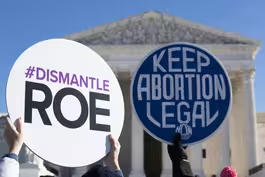
The abortion legal landscape a year after Roe v. Wade
Video has Closed Captions
Clip: 6/23/2023 | 10m 54s | The abortion legal landscape a year after overturn of Roe v. Wade (10m 54s)

Anti-trans laws face legal roadblocks in several states
Video has Closed Captions
Clip: 6/23/2023 | 5m 50s | Anti-trans laws face legal roadblocks in several states (5m 50s)

Brooks and Capehart on how abortion will motivate voters
Video has Closed Captions
Clip: 6/23/2023 | 11m 21s | Brooks and Capehart on how abortion restrictions could motivate voters in 2024 (11m 21s)

Critics discuss this summer’s most anticipated books
Video has Closed Captions
Clip: 6/23/2023 | 8m 13s | Critics share their picks for this summer's most anticipated reads (8m 13s)

I-95 in Philadelphia reopens after overpass collapse
Video has Closed Captions
Clip: 6/23/2023 | 5m 11s | Stretch of I-95 in Philadelphia reopens 12 days after overpass collapse (5m 11s)

Kyiv springs back to life as air defense crews guard city
Video has Closed Captions
Clip: 6/23/2023 | 4m 17s | Kyiv springs back to life as Ukraine air defense crews guard the city (4m 17s)
Providing Support for PBS.org
Learn Moreabout PBS online sponsorship
- News and Public Affairs

FRONTLINE is investigative journalism that questions, explains and changes our world.

- News and Public Affairs

Amanpour and Company features conversations with leaders and decision makers.












Support for PBS provided by:
Major corporate funding for the PBS News Hour is provided by BDO, BNSF, Consumer Cellular, American Cruise Lines, and Raymond James. Funding for the PBS NewsHour Weekend is provided by...