
June 26, 2023 - PBS NewsHour full episode
6/26/2023 | 57m 46sVideo has Closed Captions
June 26, 2023 - PBS NewsHour full episode
June 26, 2023 - PBS NewsHour full episode
Problems playing video? | Closed Captioning Feedback
Problems playing video? | Closed Captioning Feedback
Major corporate funding for the PBS News Hour is provided by BDO, BNSF, Consumer Cellular, American Cruise Lines, and Raymond James. Funding for the PBS NewsHour Weekend is provided by...
June 26, 2023 - PBS NewsHour full episode
6/26/2023 | 57m 46sVideo has Closed Captions
June 26, 2023 - PBS NewsHour full episode
Problems playing video? | Closed Captioning Feedback
How to Watch PBS News Hour
PBS News Hour is available to stream on pbs.org and the free PBS App, available on iPhone, Apple TV, Android TV, Android smartphones, Amazon Fire TV, Amazon Fire Tablet, Roku, Samsung Smart TV, and Vizio.
Providing Support for PBS.org
Learn Moreabout PBS online sponsorshipAMNA NAWAZ: Good evening.
I'm Amna Nawaz.
GEOFF BENNETT: And I'm Geoff Bennett.
On the "NewsHour" tonight: Vladimir Putin tries to project a sense of order after a short-lived mutiny exposes instability in Russia.
AMNA NAWAZ: A dangerous heat wave plagues Texas, as the worsening effects of climate change become clearer.
GEOFF BENNETT: And we look at the first year of an African American studies program in high schools that's been a top target of the culture wars.
TONY GREEN, Teacher, Bishop O'Dowd High School: I don't think the course is political at all, any more or any less than American history is political.
(BREAK) AMNA NAWAZ: Welcome to the "NewsHour."
Russian President Vladimir Putin is playing up national unity two days after an abortive uprising by mercenaries.
He hailed them as patriots in a televised statement.
GEOFF BENNETT: But the statement did little to quiet the questions swirling about the Kremlin.
They range from the Russian regime's stability to what happens next.
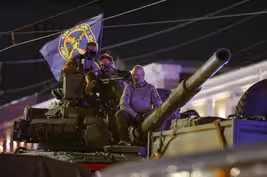
Russian President Vladimir Putin tonight addressed his nation for the first time since a short-lived rebellion marked the most significant threat to his 23-year rule.
While thanking the mercenary forces for standing down, he had tough words for their leaders.
VLADIMIR PUTIN, Russian President (through translator): However, the organizers of the rebellion betrayed those who were lured into the crime.
They lied to them, pushed them to shoot their own people.
It was precisely this outcome, fratricide, that Russia's enemies wanted, both the neo-Nazis in Kyiv and their Western masters.
GEOFF BENNETT: Earlier today, President Joe Biden denied any U.S. role in the Wagner Group's short-lived rebellion against Russia.
JOE BIDEN, President of the United States: We made clear we were not involved.
We had nothing to do with it.
This was part of a struggle within the Russian system.
GEOFF BENNETT: Meantime, Yevgeny Prigozhin, the Wagner Group chief whose forces seized a Russian city and marched toward Moscow, today said he acted to protect his fighters, not to overthrow Vladimir Putin.
YEVGENY PRIGOZHIN, Wagner Group Chief (through translator): In 24 hours, Wagner covered the same distance that the Russian forces could have covered on February 24, 2022, to Kyiv.
If they had been as prepared as Wagner, the war could have been over in a day.
GEOFF BENNETT: It was a feud between military leaders that festered into a mutiny, and the images were striking.
(CHEERING AND APPLAUSE) GEOFF BENNETT: Locals cheering the rebels as heroes, columns of armed men meeting little opposition as they journeyed within 125 miles of Moscow, and panicked authorities tearing up roads leading into the city.
Last seen on Saturday, Prigozhin was mobbed by jubilant crowds after striking a deal to avoid prosecution.
Russia's Defense Ministry today released what appeared to be a show of unity, a video of its top minister, Sergei Shoigu, still with a job, at least for now.
He was seen visiting troops in Ukraine, though it's unclear when the video was taken.
YEVGENY PRIGOZHIN: Shoigu, Gerasimov!
GEOFF BENNETT: For months, Prigozhin had railed against corruption and inaction among Moscow's armed forces, whom he fought alongside in Ukraine.
YEVGENY PRIGOZHIN (through translator): We have a 70 percent shortage of ammunition.
GEOFF BENNETT: A warlord known as Putin's chef for once running a catering company that fed the Kremlin, Prigozhin's private empire grew to span dozens of countries.
Much of his force in Ukraine is made up of former convicts.
They spent eight months fighting to win control of Bakhmut in the war's bloodiest battle.
His firm also provides private security services to leaders across Africa, where the U.N. accused it of conducting multiple massacres.
Today, Russian Foreign Minister Sergey Lavrov assured Wagner-linked African nations that they still had Moscow's support.
SERGEY LAVROV, Russian Foreign Minister (through translator): Apart from relationships with Wagner, the Central African Republic and Mali have official governmental contacts with Russia.
Following their appeal, several hundred Russian servicemen will continue to work in the Central African Republic as instructors.
GEOFF BENNETT: While, on Moscow's streets, an appearance of calm and order, as its mayor today canceled a terror alert.
Some Russian residents say they're finally at ease.
NIKITA, Moscow Resident (through translator): I feel relief because there was no armed conflict.
Apart from that, we didn't feel much panic.
We survived far worse since 1985.
We get used to everything.
GEOFF BENNETT: Others appeared to be unfazed.
MAXIM, Moscow Resident (through translator): I'm absolutely calm about the situation, because everything was quite predictable.
So, when we are aware and constantly monitoring the news, everything could be predicted.
GEOFF BENNETT: But it was far from quiet on Russia's front in Ukraine, as Kyiv's forces claimed to capture another village in what's proving to be a slow and grinding counteroffensive.
For additional perspective on the short-lived Russian rebellion and what comes next, we are joined by Alina Polyakova, president and CEO of the Center for European Policy Analysis.
Thank you for being with us.
As we just reported, Wagner chief Yevgeny Prigozhin said he called off the march on Moscow because he wanted to avoid Russian bloodshed and what he had in mind was more of a protest demonstration than an attempted coup.
Still, what does this suggest about Vladimir Putin's hold on power?
How stable is his regime?
ALINA POLYAKOVA, Director, Center for European Policy Analysis: Well, what we witnessed over the last several days has been nothing short of extraordinary.
And I think the most important thing we learn from this very strange sequence of events is that Putin is far weaker than we thought and his regime is much more fragile than we thought.
And I think this challenge by an armed military group marching towards Moscow, it's truly, truly extraordinary, as I said.
It would be something akin to Blackwater, the U.S. private security company, suddenly taking up arms in the middle of the Iraq War, for example, and marching on Washington.
And the response from the Kremlin initially was very, very muted.
And I think that surprised quite a few people.
GEOFF BENNETT: In his speech this evening, Vladimir Putin addressed the Wagner fighters, and he said that they could join the regular military, go home or relocate to Belarus.
So it wasn't clear what this means for Prigozhin himself.
Based on what you know of Yevgeny Prigozhin, will he truly just cede the floor, or will he regroup and wait for confrontation at a future date?
I mean, he still has a significant amount of standing and influence.
ALINA POLYAKOVA: Well, to be honest, we don't know a lot as to what's been happening behind the scenes.
This deal that Prigozhin supposedly struck mediated by Belarus' dictator, Lukashenko, where he's going to be in exile in Belarus,it just doesn't make a huge amount of sense.
Prior to Putin's address today, Prigozhin put out his own voice message on his social media, basically sounding defined and unapologetic and saying that everything they did was the right thing to do because it exposed the ineptitude of Russia's military operation in Ukraine.
And then what we saw Putin say later today, was, I think, a overcorrect, because he looked very weak.
And in this very short speech, Putin basically tried to present himself as a strongman, saying that this -- they are traitors, this was a mutiny, and they will be dealt with.
But I think the damage has already been done.
And we don't know where Prigozhin is.
We don't know if he's actually in Belarus.
We don't know if Wagner is still loyal to him.
But, so far, I have not seen any evidence that Wagner is actually being dismantled or that its soldiers are in fact joining the former Russian military command.
GEOFF BENNETT: Officials across NATO member countries, one imagines, are scrambling right now to make sense of what's happening inside Russia ahead of the NATO summit next month.
How do Putin's newly apparent vulnerabilities affect the containment strategy for Russia as it relates to the West and NATO countries?
ALINA POLYAKOVA: I think we really need to be thinking about some serious contingency planning for a regime change in Russia.
Prior to these events over the weekend, the assumption was that Putin was going to be there through the war and he was going to be there at the end of the war, and that there was really no real challenge to his power and to his authority.
And I think we have seen something very, very different over these last few days.
And I think that really speeds up the potential timeline for how the alliance needs to be thinking about a future Russia without Putin.
And that may come through a coup attempt.
This was not a coup attempt, as we now have learned.
But it certainly opens the door for a possibility like this in the near-term, versus the very, very long-term.
And, to my mind, the right approach from the allies is to really use the summit that's just happening in a little over two weeks now to double down on support for Ukraine, because there's a real strategic opportunity here to show, through a sign of force, that the U.S., the -- Europe, we're not going anywhere, and we're going to outlast the Putin regime, because the Putin regime doesn't look like it's going to potentially last as long as we thought.
GEOFF BENNETT: Alina Polyakova, thank you so much for your insights.
ALINA POLYAKOVA: Thank you.
GEOFF BENNETT: And for more insight on what the revolt means for Russia's war in Ukraine, we turn to Samuel Bendett, a Russian military analyst for the Center for Naval Analyses.
Thank you for being with us.
Samuel, what lies ahead for the Wagner Group?
Because Yevgeny Prigozhin has said that his fighters will never accept the options that Vladimir Putin put to them today, which is fight for Russia, go home or go to Belarus.
SAMUEL BENDETT, Center for Naval Analyses: Well, I think that's a good question.
This is something that a lot of us are trying to figure out.
And these questions are probably going to reverberate for the next several weeks, if not months.
Clearly, Wagner is not dismantled.
Clearly, it's still a functioning organization.
Clearly, there are officers in the Wagner Group that are still with Prigozhin.
And, clearly, Wagner is still a useful force internationally, especially in Africa, when it comes to many of Russia's geopolitical interests.
So it isn't as simple as simply dismantling Wagner.
There's a lot of money invested.
There's a lot of effort invested.
There's a lot of discussions in the Russian government today whether or not private military companies like Wagner should even be allowed following what happened this weekend.
But Prigozhin probably has his own allies in the Kremlin.
And so the fight over its fate, it will continue.
GEOFF BENNETT: Well, on that point, how much does Putin need the Wagner Group to fight his war?
SAMUEL BENDETT: It depends at this point.
Clearly, Wagner was a good attacking force around Bakhmut, good in the sense that they could keep Ukrainian forces occupied in that particular city.
But, right now, Russia is fighting a defensive war.
It doesn't need Wagner forces to storm Ukrainian positions the way they have done in Bakhmut.
And so this is a question that it's up to the Ministry of Defense, it's up to the Kremlin, and it's up to Prigozhin's allies and foes, as they are now discussing how the country is going to move forward after this 72 hours.
GEOFF BENNETT: Is Ukraine well-positioned to take advantage of this moment?
Might this be a decisive turn in their counteroffensive?
SAMUEL BENDETT: Anything is possible, but a lot of Russians were concerned that Ukraine will take advantage of what is happening in Russia this weekend.
However, no significant Ukrainian breakthrough has materialized in the last 72 hours against the Russian positions.
Even though Ukrainians have advanced somewhat against the Russian positions, there was no massive breakthrough that probably a lot of people were hoping for.
So it's not exactly clear what will happen to the advance going forward.
But, right now, Russians seem to be holding firm, even if they're losing some of the territory to the attacking Ukrainian formations.
GEOFF BENNETT: From your vantage point, what might this revolt mean for morale among Russian troops, many of whom are conscripts and were conscripted into service unwillingly, reluctantly?
SAMUEL BENDETT: The morale can't be good, especially when the president officially pardons the Wagnerites, who have shut down Russian military aircraft and killed the pilots.
Probably there's a lot of bad feelings right now and there's a lot of anger and resentment at Wagner across the military, and especially within the MOD.
There was bad blood between Wagner and military before this uprising, or mutiny, whatever it is going to be called, but the bad feelings are probably going to persist.
And so it's not exactly clear how much the military will welcome Wagner, even as the president welcomes Wagner soldiers into its ranks, although Prigozhin, in his audio message this morning, indicated that very few Wagnerites are going to join the military.
So, again, a lot of questions and really not a lot of answers right now.
GEOFF BENNETT: And, lastly, Samuel in the 20 seconds or so we have left, what does the undermining of Vladimir Putin's authority mean for him as the leader of Russia's military?
What's that do to his standing?
SAMUEL BENDETT: Well, certainly, the events of the weekend -- of the past week undermine his standing.
They were bad optics for him in general.
Certainly, he seemed weak.
And, certainly, there are issues within the government and the government's response to this crises that have to be considered.
But we shouldn't necessarily rush to judgment and we shouldn't write Putin off quite yet.
He can survive certain crises.
And he's probably going to try and survive this one as well.
And, again, all roads lead to Putin at this point.
And he is still the chief decision-maker and the one who is the arbiter of a lot of disputes and decisions in the government.
So, we will have to see.
GEOFF BENNETT: Samuel Bendett with the Center for Naval Analyses, thanks so much for being with us.
SAMUEL BENDETT: Thank you.
AMNA NAWAZ: In the day's other headlines: The plea was guilty, the sentence was life in prison for the murders of five people at a Colorado Springs nightclub last fall.
The defendant entered guilty pleas at a livestreamed hearing, and survivors and victims relatives had their say.
In a Colorado courtroom today, Stephanie Clark confronted the person who shot and killed her 35-year-old sister, Ashley Paugh, and recalled telling her niece that her mom was gone.
STEPHANIE CLARK, Sister of Ashley Paugh: The lives you have shattered and the sadness, anger and grief my family and I have to endure is overwhelming.
Our lives are forever changed, and this is a whole other level of pain by the way she was taken from us.
We never got to say our last goodbyes or "I love you"s before she was gone.
AMNA NAWAZ: Paugh was one of five people killed in the November 2022 mass shooting at Club Q, an LGBTQ nightclub in Colorado Springs.
The victims were Daniel Aston and Derrick Rump, both club employees, and Kelly Loving, Raymond Green Vance, and Ashley Paugh, all patrons.
The shooter, Anderson Lee Aldrich, who identifies as nonbinary, used in AR-15-style rifle in the attack.
Now 23 years old, they pled guilty and received one life sentence for each person killed, adding up to hundreds of years in prison.
Kassandra Fierro was celebrating a friend's birthday on the night of the attack with her boyfriend of six years, Raymond Green Vance.
KASSANDRA FIERRO, Girlfriend of Raymond Green Vance: We, as victims, have to deal with the physical, emotional and psychological consequences of what this man has inflicted on us for the rest of our lives, for no reason other than the immense amount of hate this man has and chose to release on innocent people just trying to have a good night.
I ask you, Your Honor, to please give this assailant the maximum possible sentence.
AMNA NAWAZ: For months, families argued the shooter should acknowledge their targeting of the LGBTQ community.
But today's plea included no details for their motive, even as they pleaded no contest to bias-motivated crimes.
The shooter could still be charged with federal hate crimes, as the impact from last year's mass shooting continues to ripple through this community.
Colorado no longer has a death penalty, but a conviction on federal charges could still mean a death sentence for the shooter.
In Florida, lawyers made closing arguments in a trial link to the 2018 Parkland school shootings that killed 14 students and three staffers.
A former sheriff's deputy, Scot Peterson, is charged with child neglect for not confronting the gunman.
Today, prosecutors condemned Peterson's inaction.
The defense argued he had followed protocol.
KRISTEN GOMES, Florida Assistant State Attorney: The defendant was taught, as all police officers in Broward County, likely in this entire country since Columbine, that you move towards the sounds of gunshots and there is no other job that you should be doing in that moment.
Get in, cause a distraction, and save lives.
MARK EIGLARSH, Criminal Defense Attorney: Every officer that responded to that scene, whether it be the 36-year veterans or those with less experience, all did exactly what they're trained.
They take tactical positions of cover, because only in cheesy movies does the cop just walk around without a bulletproof vest and somehow walks like he's 10-foot-tall and bulletproof.
AMNA NAWAZ: This is the first trial for any law enforcement officer in the U.S. related to a school shooting.
A new round of severe storms has claimed three more lives in parts of the Midwest.
Video on Sunday captured a tornado outside Indianapolis as it ripped through at least 75 homes.
A twister in Southern Indiana killed one man.
Meanwhile, high winds blew a tree onto a home in Central Arkansas.
Two people died there.
In the Middle East, Israel's far right government approved plans today for another 5,000 homes in Jewish settlements across the occupied West Bank.
The move defies U.S. appeals to halt expansion.
It also follows a recent wave of violence between Israeli settlers and Palestinians.
It's not clear when construction will begin.
The annual Hajj, the pilgrimage to Mecca, officially began today in Saudi Arabia, back at full capacity after years of pandemic restrictions.
Some two million Muslims finished the ritual circuit around the Kaaba in Mecca, then headed to camp in a vast tent city in the desert.
Many said they overcame obstacles to their journey, including inflation.
ABU ANAS ABU RAHAL, Palestinian Pilgrim (through translator): for the sake of the Holy Mosque and seeing the Kaaba, saluting the prophet and standing on the pure Arafat Mountain, everything is worth it.
But the economic conditions are really tough, and the prices are embarrassing.
AMNA NAWAZ: The Hajj is one of the largest religious gatherings in the world.
All Muslims are required to make the pilgrimage at least once, if they're able to do so.
Back in this country, the Supreme Court cleared the way for resuming the legal challenge to Louisiana's congressional map.
The Republican-drawn map has just one-majority Black district, and challengers say that violates the civil rights of Black residents, who make up one-third of the state's population.
This month, the High Court struck down Alabama's congressional map on similar grounds.
And on Wall Street today, the week got off to a slow start, as tech stocks lead the way lower.
The Dow Jones industrial average lost 12 points to close at 33714.
The Nasdaq fell 156 points, or 1 percent.
The S&P 500 slipped 19.
And a passing of note: John Goodenough, who helped create the widely used lithium ion battery, has died in Austin, Texas.
Goodenough's work, along with others, revolutionized battery technology in the 1990s.
Nearly 30 years later, he shared the Nobel Prize for chemistry for his accomplishments.
John Goodenough was 100 years old.
Still to come on the "NewsHour": President Biden lays out his plan to expand access to broadband Internet; many major retailers pull back their LGBTQ merchandise after conservative backlash; and two film critics take a look at the most anticipated summer movies.
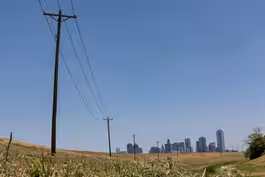
GEOFF BENNETT: Texas is entering its third week of a record-breaking heat wave.
The heat index could top 120 degrees.
And the sweltering weather is not limited to Texas.
At least 45 million Americans across the Southern U.S. were under heat advisories over the weekend into today.
For a closer look, we're joined by Jeff Berardelli, chief meteorologist and climate specialist for WFLA-TV in Tampa, Florida.
Jeff, thanks so much for being with us.
So, this brutal heat wave, as we said, is entering week three.
What's driving it?
JEFF BERARDELLI, Chief Meteorologist, WFLA-TV: Well, we have a very weird jet stream across the Northern Hemisphere, and especially right across North America.
Things have been stuck for weeks and weeks.
And this heat dome has been stuck across especially Mexico.
And, also, Texas has been on its northern end.
And because of that, we're seeing what is an extreme heat wave, one of the worst heat waves ever in Mexico, and a very bad one also in the southern part of Texas, especially.
And that's going to be spreading to the north.
GEOFF BENNETT: So there's heat.
We have also seen tornadoes and other sorts of extreme weather across the South.
Is all of that connected?
JEFF BERARDELLI: Yes, when we have these heat domes, we call them rings of fire, because, on the north side of these rings of fire, we have the energy, the contrast between really hot and just warm and, at the same time, stronger winds in the upper atmosphere that tend to generate these big thunderstorms.
And then they follow that ring of fire, and they can produce tornadoes and also very, very strong squall lines that have extremely strong gusts of wind as well.
GEOFF BENNETT: Jeff, help us understand the ways in which this heat wave is connected to climate change.
JEFF BERARDELLI: Well, every heat wave basically is connected nowadays to climate change.
Remember that the climate has warmed around two degrees Fahrenheit since around 1900.
Now, that is when you consider both the land temperatures and the surface of the water.
But land itself has increased by about double the average of the Earth's increase.
In Texas specifically, we have seen an increase of around three to five degrees during the summertime.
So, the baseline of these heat waves starts a lot higher.
It's a lot easier to achieve heat waves nowadays.
Also, heat domes aggregate heat really, really well.
So we tend to emphasize the extremes even more than the averages.
So, the averages go up by a couple to a few degrees.
The extremes go up by several degrees.
In addition to the intensity of these heat waves, we're also seeing them last longer and occur more frequently.
The connection between climate change and heat waves is a direct A-to-B connection.
There's a lot of evidence for it.
In fact, Climate Central is doing rapid attribution these type events and says that this particular event in Texas is at least five times more likely to be because of climate change.
And what's happened in Mexico may be very well the worst heat wave we have seen in modern history, because it's been going on for so long, not just it's intensity.
GEOFF BENNETT: So, Jeff, this persistent heat becomes increasingly dangerous, even potentially deadly, as we head into the July 4 holiday week.
How should people in the affected areas prepare?
JEFF BERARDELLI: They're going to have to spend less time outside, frequent breaks, drink lots of water.
I mean, this heat wave has been confined mainly to Texas, and especially Mexico, but it's going to be expanding north into the Southern Plains states, into the Mississippi Valley, all across the Deep South, and even to Florida.
We're going to see temperatures that are going to affect a lot of people.
In fact, 100-degree temperatures will probably impact about 25 million people over the coming week, and 90-degree temperatures or greater will impact about 100 million people.
Then you add to it all the humidity from the Gulf of Mexico, because a lot of this heat will be along the Gulf Coast, and you're talking about heat index, feels-like temperatures 115 to 120 in spots.
And that, of course, can be very dangerous.
GEOFF BENNETT: So, when might this let up?
When can people start to expect some relief?
JEFF BERARDELLI: It's going to be a little while.
The worst of this heat wave is not done yet.
In fact, we're expecting the worst of it to be the middle to the end of this week.
It's going to let up a little bit as we head into the weekend.
But, even over the weekend, we're still going to see some record highs.
I think the worst is going to be probably Wednesday, Thursday into Friday.
So it's going to take a while for this to go away.
But the bottom line is, in a warmed climate because of climate change, we're going to see more of these heat waves in the future, they're going to be more intense, and they're going to last for a longer period of time.
GEOFF BENNETT: Jeff Berardelli is chief meteorologist and climate specialist for WFLA-TV in Tampa, Florida.
Thanks so much for being with us.
JEFF BERARDELLI: You're welcome.
AMNA NAWAZ: President Biden is kicking off efforts to expand high-speed Internet access to the 8.5 million homes and businesses without it.
Expanding affordable broadband access was a key component of his 2021 infrastructure bill.
At the White House today, the president pledged a $42 billion investment to get Americans up to speed by 2030.
JOE BIDEN, President of the United States: It's the biggest investment in high-speed Internet ever, because for today's economy to work for everyone, Internet access is just as important as electricity was or water or other basic services.
High-speed Internet isn't a luxury anymore.
It's become an absolute necessity.
AMNA NAWAZ: And Laura Barron-Lopez has more on what all of this means.
Laura, good to see you.
LAURA BARRON-LOPEZ: Good to be here.
AMNA NAWAZ: So, this is ambitious, to say the least, right?
The president equated it to electrifying the entire country in the 1930s.
Who will this expanded broadband reach?
LAURA BARRON-LOPEZ: So today marks the official allocation of this money that comes from the bipartisan infrastructure law.
And the funds are going to go essentially all across the country.
So they're going to go to every state, District of Columbia, all the territories, but 19 states, in particular, are going to receive more than $1 billion to increase their broadband.
And within those 19 states, I just want to highlight a few.
Missouri is going to get more than $1.7 billion, California more than $1.8 billion.
And Texas is going to receive the most at about $3.3 -- more than 3.3 billion.
This is all based on local needs.
AMNA NAWAZ: So, the president says the goal is that every house has access by 2030.
Will they actually reach that goal?
LAURA BARRON-LOPEZ: So, give or take, essentially, Amna.
Essentially, the White House provided reporters with a rough timeline.
Now, a lot of things can get in the way of a timeline.
But starting now, in June of 2023, this month, allocations are announced.
States begin drafting their plans for projects.
Then, December of 2023, the first state plans are due.
And 20 percent of the funds are going to start being distributed.Then, around spring of 2024, work is going to begin on some of the projects if they have received approval.
Then, spring of 2025, final plans are due for states that haven't had their plans approved yet and the remaining funds will be sent out.
And as you can see, some of these projects are not going to get going and certainly not finished before the 2024 election.
AMNA NAWAZ: Well, when you talk about the millions of Americans who still don't have this kind of broadband access, who are we talking about?
What are these communities like?
And how does the administration make sure that people who need this service get it?
LAURA BARRON-LOPEZ: So, I spoke to Nicol Turner Lee at the Brookings Institution, and she told me that the federal estimate of about 7 percent of Americans receiving -- not receiving broadband access is probably an undercount.
NICOL TURNER LEE, Brookings Institution: The pandemic demonstrated that it's a lot of people.
And it's not so much people that we suspected, the poor, people who live in tribal communities, people who are older, people who are foreign-born, people in rural America, but it also extended to people that we didn't even realize, people on the exurban side, people in suburban America who couldn't get online with their kids to actually learn, or teachers who couldn't teach because they lived in areas where they didn't have broadband or couldn't afford it.
LAURA BARRON-LOPEZ: And so Nicol Turner Lee added that, when it comes to making sure that this reaches those people who don't have access at all, the ones that are the most in need of broadband access, that it really is going to come down to the administration and accountability, and then scrutinizing and interrogating those state plans.
AMNA NAWAZ: So we know that this was a critical part of that 2021 infrastructure plan, President Biden's vision behind that.
What about his reelection campaign?
Where does this fit into that?
LAURA BARRON-LOPEZ: It's definitely important to the reelect, Amna, because, even though the White House and those on the president's campaign believe that the GOP attacks on LGBTQ rights and on abortion are going to be big Democratic motivators, they also know that there is an enthusiasm gap for the president, and that the way to address that, particularly on his handling of the economy, is to be out there talking about this, showing that some things are getting done.
So, making more progress towards actual shovels in the ground on these projects and blanketing the country with Cabinet officials, as well as himself, is going to be key to that.
AMNA NAWAZ: All right, Laura Barron-Lopez, our White House correspondent.
Thanks, Laura.
LAURA BARRON-LOPEZ: Thank you.
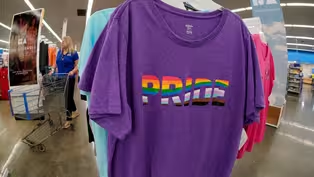
GEOFF BENNETT: June is Pride Month, a time when many companies show their support for in celebration of the LGBTQ+ community by launching Pride Month campaigns, displaying pride merchandise, and including LGBTQ+ people in ads and marketing.
But, this year, after weeks of political attacks, right-wing backlash has forced some companies to rethink Pride.
William Brangham has more.
WILLIAM BRANGHAM: Geoff, some protesters have started calling out dozens of companies over their Pride campaigns.
In just the last few months, companies like Bud Light, Target, PetSmart, Nike, The North Face and Adidas have all faced right-wing protests over LGBTQ+ products and ads and partnerships.
Activists have taken their criticism to social media and spread false information over Pride products targeting kids, like these at Target.
WOMAN: So, we are like 10 steps in before there is an entire Pride display for your children to see.
WOMAN: We have "Glad you came out" and "I'm so happy that you're queer" in the kids section.
Are you kidding me?
MAN: Hey, ma'am, do you support this?
MAN: What did I just say?
MAN: You support Pride propaganda?
WOMAN: Please... (CROSSTALK) MAN: Whoa.
I'm buying this.
Whoa.
Let go.
WOMAN: We need you to -- you just said you're not buying it.
MAN: I'm going to buy it and burn it.
WILLIAM BRANGHAM: Boycotts, employee harassment and threats of violence have prompted companies, including Target, to pull back some Pride initiatives.
For more on this backlash, we're joined by Bob Witeck.
He is president of Witeck Communications, which is a firm specializing in LGBTQ+ marketing.
Bob, thank you so much for being here.
I know you have been in this business of consulting companies for 30 years.
Would you say that there is a demonstrable uptick in these types of protests happening towards companies right now?
BOB WITECK, President, Witeck Communications: I'd say two things.
One, we are in a moment.
But the backlash that we're witnessing is hardly spontaneous or authentic or organic.
It's primarily instigated backlash.
The feigned indignation, for example, against one beer was a calculated tactic.
And it was used by anti-woke provocateurs, frankly, who had political agendas.
I think Budweiser tripped a wire that offered some an invitation to exploit.
WILLIAM BRANGHAM: And is it your sense that this is -- again, I know you're arguing that this is a ginned-up and nonorganic movement.
But you were telling us before that this has been going on in some fashion for many, many years.
BOB WITECK: About 30 years ago, when I began doing the work I do, I worked with American Airlines, and, 30 years ago, they faced an onslaught of right-wing backlash that, at the time, I believe was intended to change the direction of the culture.
What they witnessed was, if a corporation got behind the gay community, others would follow.
They wanted to shame and frighten American Airlines out of the market, and they failed.
WILLIAM BRANGHAM: I know you're not a social scientist, but if you believe that this is not an organic movement, what do you attribute all these attacks to?
BOB WITECK: Well, I think the political moment tells us that we're in a -- the United States is driven by division, and the so-called anti-woke activists are trying to find every wedge possible.
And they're wielding them in the hands of candidates to use it to attack drag shows, to attack books in schools, to attack trans kids.
And they're taking on a variety of exploitable topics that do divide the American households.
WILLIAM BRANGHAM: You mentioned this protest against Budweiser.
And that was because Budweiser had done this partnership with a trans woman.
And that protest that came up seemed to dent Budweiser's sales.
Did you hear from other companies who said, boy, looking at Budweiser's experience, we don't want to have that same thing happened to us?
BOB WITECK: It did give other companies pause.
But they need to examine the case that Bud Light took.
The brand sales already were slipping.
And they made a miscalculation, I think, to try to expand consumer loyalty.
And their timing -- and, worse, it was their response that seemed most amateurish.
No brand or corporation would want to be in Bud Light's shoes when they offended almost everyone.
That was the problem, I think, that corporate reputation.
It's not so much about sales, which are always going to be somewhat volatile.
It's about standing and reputation.
WILLIAM BRANGHAM: In that particular case, that was a protest against Bud Light's connection to a trans individual.
And trans people do seem to be the target of a particular level of ire.
Have you -- have you seen that similarly?
BOB WITECK: Yes.
Unfortunately, yes.
What it speaks to is the dehumanizing of a whole group of people.
The LGBTQ community is not alien to this.
We have -- we have felt it over many, many years.
But trans people, particularly, are being put into a position to be so dehumanized that it's frightening, and many families and trans people, justifiably, are afraid.
WILLIAM BRANGHAM: So when you're counseling companies, and they come to you, and they say we would like to appeal to this part of America, how -- but we don't want to suffer one of these boycotts.
How do you counsel them how to navigate that?
BOB WITECK: There are three things they often think about in the beginning.
First, what is it you stand for?
What are your values?
What are your principles?
And if you know what those are, and you stick to them, you can weather almost any setback or any challenge.
But, also, you have to invest your campaigns in those values.
When you show images and expressions of LGBTQ people, do it honestly, do it authentically, and do it for a purpose.
And, finally, when you are challenged, stand up, because I think, at the end of the day, you will discover that the marketplace will imbue you with more trust and more integrity for the future.
The storms come and go, but your standing is going to be what you're going to be tested by.
WILLIAM BRANGHAM: I understand that there has also been some criticism of corporate America from within the LGBTQ+ community, parts of it, that they have been cowardly or not standing up enough or not doing enough.
How serious is that criticism?
BOB WITECK: I think that is a sense of unity.
What the community leaders want to do is embolden and stiffen the spines of corporate America, who are traditional allies and partners in the gay community.
They have been with us and on our side, I think, for decades.
What they want to do is make sure they understand that fair-weather friends are no friends.
WILLIAM BRANGHAM: All right, Bob Witeck of Witeck Communications, thank you so much for being here.
BOB WITECK: Thank you.
AMNA NAWAZ: The school year is coming to a close and, with it, the first year of Advanced Placement African American studies, an interdisciplinary class by the College Board that's attracted praise by professors and also fierce opposition from some Republican politicians.
Laura is back now with a look inside one school, where she spoke with educators, students and experts.
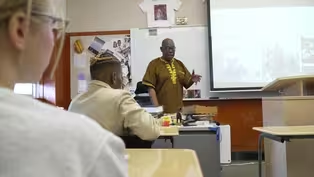
LAURA BARRON-LOPEZ: At Bishop O'Dowd High School in Oakland, California, students file into Tony Green's classroom papered with imagery of civil rights and the Black power movement.
TONY GREEN, Teacher, Bishop O'Dowd High School: All right, so, you guys, take out your notebooks.
LAURA BARRON-LOPEZ: This is Advanced Placement African American studies, a new pilot course.
TONY GREEN: The reason for this migration, so the furthest map to your right, OK, that's a map of all the lynchings that had taken place, OK, in the South.
LAURA BARRON-LOPEZ: It's a curriculum that drew national media attention, when, 3,000 miles away in Florida, Republican Governor Ron DeSantis called it indoctrination and banned it from Florida schools.
GOV.
RON DESANTIS (R-FL), Presidential Candidate: That is somebody pushing an agenda on our kids.
LAURA BARRON-LOPEZ: But, in Oakland, juniors and seniors enrolled in the class don't see it that way.
LEILA ISMAIL, Student: I feel like it's very important as a person to know where your people came from and what they went through.
And that isn't something that I found has been centered very much in other history courses I have taken.
DAVID GREENE, Student: The content of basic African American history content, they cover Martin Luther King, they cover Malcolm X, they cover the transatlantic slave trade, and then they end it right there, and they basically say, OK, if you cover these three pillars, we're basically done.
LAURA BARRON-LOPEZ: Instead, this four-part curriculum spans centuries, from ancient African kingdoms to the transatlantic slave trade, Reconstruction and the Harlem Renaissance, and modern civil rights movements.
TONY GREEN: I believe the -- probably, the primary thing that the students have taken away from the course is the level of leadership, intelligence and competence that people of African descent actually experienced during the history that we study.
LAURA BARRON-LOPEZ: Do you think that this course is political?
TONY GREEN: I don't think the course is political at all, any more or any less than American history is political.
LAURA BARRON-LOPEZ: For Green, it's the capstone of more than 30 years teaching African American studies at this private Catholic school.
TONY GREEN: So, this book here, "The Mis-Education of the Negro," is the book that everybody starts with, because he talks at the turn of the century about how the study of African people and their descent is never covered, so we're totally miseducated about who we are.
LAURA BARRON-LOPEZ: Texts like these are under threat in a national Republican campaign attacking books and teachings about race and LGBTQ identity.
GOV.
RON DESANTIS: Education, not indoctrination.
(CHEERING AND APPLAUSE) LAURA BARRON-LOPEZ: It took root in Florida, where DeSantis, now a presidential contender, signed legislation to dictate how Black history is taught in the state.
GOV.
RON DESANTIS: If you want to do things like gender ideology, go to Berkeley.
Now, who would say that an important part of Black history is queer theory?
LAURA BARRON-LOPEZ: Backing the effort is Moms for Liberty, a national organization challenging hundreds of books across the country.
JENNIFER PIPPIN, Moms for Liberty: We challenged to date 252 library books.
LAURA BARRON-LOPEZ: Jennifer Pippin is a founding chair of the group in Florida's Indian River County.
She supported changing the AP curriculum.
JENNIFER PIPPIN: And when they polled that AP American history course, they saw that there was a lot of Critical Race Theory and also queer studies in there that had nothing to do with the African American teachings that were offered in the course.
LAURA BARRON-LOPEZ: She claimed the course lacked objectivity.
JENNIFER PIPPIN: Look at both sides and let's have critical thinking with this.
So what they were discussing was with the Black Lives Matter movement, where is the opposition?
Where is the opposition?
Is there a white lives matter movement?
LAURA BARRON-LOPEZ: Since Florida's announcement, four other Republican-led states launched similar investigations into the class, which Green said does not teach Critical Race Theory or queer theory.
It does teach about queer activists, like James Baldwin, who Willie Rogers calls a personal hero.
Rogers chose Baldwin as a subject for his final research project.
As a singer, songwriter and music producer, he grew up admiring Baldwin's creative struggle.
His mom, Adrienne, said she's seen a change in her son, including an interest in attending a historically Black college in the fall.
ADRIENNE ROGERS, Parent: I have just seen a lot of growth.
He was actually learning, and he was enjoying learning.
LAURA BARRON-LOPEZ: They said attacks on the AP class are misguided.
ADRIENNE ROGERS: They're thinking that, if you learn about Black history, that it might be teaching some people to be anti other races.
And it's not.
WILLIE ROGERS, Student: To me, it just shows a lack of understanding for our culture and for the importance of having different perspectives in our history, the same way you have different perspectives in American history.
LAURA BARRON-LOPEZ: Growing up in Oakland is to be surrounded by that history.
And students got the chance to see it up close.
They tasted gumbo, a dish born in West Africa, passed down by enslaved people and brought West.
They took a field trip to study housing discrimination and redlining in the city, visiting the birthplace of the Black Panther Party and historic Black-owned businesses like this diner.
It's been eye-opening for junior Bella Makeig, who is worried about the censorship movement championed by DeSantis.
BELLA MAKEIG, Student: I'm learning much.
And, honestly, it feels like it's been covered up.
And I think a lot of it has on purpose.
And I think that he wants to continue that and keep people ignorant.
And I think this class is not helping him push his agenda, and that's why he's trying to silence this class.
LAURA BARRON-LOPEZ: You think he's trying to cover up this particular history, Black history?
BELLA MAKEIG: Yes, I do.
LAURA BARRON-LOPEZ: The original curriculum given to Green and the other pilot teachers at the start of the school year has since been revised, but Florida has not reversed its decision.
Green stands behind the original framework.
TONY GREEN: It's revolutionary, engaging and vitally important, especially in this day and age.
Social divisions have been a part of the entire colonial experience.
Social divisions have been a part of slavery, right, Reconstruction, Jim Crow, right, the Black Codes, civil rights movement.
So why would we possibly think that things would be any different right now, unless we work on erasing those social divisions?
And the only way to do that is through education.
LAURA BARRON-LOPEZ: What does it feel like as a Black man to be able to teach this course?
TONY GREEN: A lot of pride that we have come this far.
We struggle.
We still got a lot longer to go, but a lot of pride.
LAURA BARRON-LOPEZ: More students will have the chance to enroll in AP African American studies this fall, as it expands from 60 schools this year to more than 800.
For the "PBS NewsHour," I'm Laura Barron-Lopez in Oakland, California.
GEOFF BENNETT: It's another summer of movies, with big blockbusters returning to theater and some comedy and horror indie films too.
But will that combination be enough to finally draw people back to theaters?
Jeffrey Brown zooms in with two film critics for our arts and culture series, Canvas.
JEFFREY BROWN: As always, there are way too many movies out or out soon for us to cover, but we will offer a few suggestions with the help of Ann Hornaday, chief film critic of The Washington Post, and Aisha Harris, host of NPR's "Pop Culture Happy Hour" and author of the new book "Wannabe: Reckonings with the Pop Culture That Shapes Me."
Nice to see both of you.
Aisha, congratulations on your book.
Let me start with you.
A couple of the big blockbusters.
This is the season, right?
So what's coming that you're looking forward to?
AISHA HARRIS, NPR: I think the blockbuster that I'm most excited about is "Barbie," which is directed by Greta Gerwig, and it is I.P.
It's a franchise.
I know a lot of us critics, including myself, are little over the franchisification of everything, but I am excited about this because Greta Gerwig is one of the most interesting directors we have working right now.
And the cast is amazing.
You have Margot Robbie, Ryan Gosling, Issa Are, many, many other stars.
And Greta Gerwig and her co-writer, Noah Baumbach, seem like they are taking Barbie in a different direction and a little bit more of a subversive direction.
So I'm excited for "Barbie" especially.
I'm also very curious about the new "Mission: Impossible."
Of course, Tom Cruise is a reliable box office star.
And I'm really excited for that, because it's one of those franchises that I think keeps getting better every new installment.
And Tom Cruise is still really fun to watch.
JEFFREY BROWN: Ann, you're nodding your head with Tom Cruise, right?
ANN HORNADAY, Film Critic, The Washington Post: Avidly.
Avidly.
(LAUGHTER) ANN HORNADAY: I am completely with Aisha on "Mission: Impossible."
This franchise has proven to be so durable.
And as she pointed out, it does get better and better.
And I think we can attribute a lot of that to Tom Cruise.
JEFFREY BROWN: OK, have you got a couple of other biggie blockbusters for the summer?
ANN HORNADAY: Well, same day as "Barbie," we're going to get "Oppenheimer," which is the biopic from Christopher Nolan about Robert Oppenheimer, the father of the nuclear bomb.
This is based on a masterful biography by Kai Bird and Martin Sherwin, "American Prometheus," which was just this really comprehensive look at Oppenheimer's life and all the contradictions of his character and, of course, obviously having to do with his later remorse over developing the Bob, just a fascinating man of contradictions and paradoxes.
And I'm optimistic that Nolan will really embrace those.
Cillian Murphy will play Oppenheimer, which I think looks like a stellar piece of casting.
So I'm really optimistic for this one.
JEFFREY BROWN: How about a smaller film?
You want to start us on our next round, Ann, an independent, something that gets less attention?
ANN HORNADAY: Absolutely.
I mean, this has been such a great year for first-time filmmakers.
And one of them is this woman named Celine Song.
And she has a new movie coming out called "Past Lives" starring Greta Lee about a young woman whose family emigrates from South Korea when she's 12, and she has to leave her best friend and kind of schoolgirl crush behind.
She ends up moving to New York to become a writer.
And she and her old flame played by Teo Yoo reconnect online.
And this is just this acutely observed, delicate, sensitive, just I think a beautifully wrought drama.
It's a love story we don't really see very often on screen.
And Celine Song has just brought it to life with such subtlety and style and flair.
I'm a huge fan.
JEFFREY BROWN: Aisha, do you have a couple of smaller or more independent films, something you're really looking forward to?
AISHA HARRIS: Yes.
The first one I would say is "The Angry Black Girl and Her Monster."
It's by newcomer Bomani J.
Story.
And the premise really intrigues me.
It is about this young girl who loses her brother to gun violence.
And she's sort of this science nerd whiz kid.
And she decides to mourn her brother and express her grief by creating this sort of Frankenstein-ish monster.
And Story has talked about sort of being inspired by the Frankenstein Mary Shelley story.
And so I'm really curious to see how him taking this very -- this story that's been told many, many times, and creating this very new piece of work will play out.
So I'm really looking forward to that.
I'm also excited about something I did see at Sundance, "Theater Camp," which is sort of a Christopher Guesty-style comedy about a summer theater camp.
ACTRESS: You guys are so talented.
So unbelievable.
This will break you.
This will fully destroy you.
ACTOR: Congratulations on being the most talented kids at camp.
AISHA HARRIS: And they have to sort of figure out what they're going to do.
The camp is in danger of shutting down because their director and their leader is ill. And it's really, really funny.
You have got Ben Platt, Molly Gordon.
And if you're a theater nerd, like I am, I think you will appreciate how funny and spot-on this, like, parody of that world is.
JEFFREY BROWN: Ann, you mentioned Tom Cruise, and you went on about Tom Cruise.
Are there other actors, directors -- we talked about Christopher Nolan -- are there other people with films out this summer that you're really looking forward to?
ANN HORNADAY: Well, there's a big and a small.
I -- speaking of franchises, I'm also a fan of "The Equalizer," which is the Denzel Washington franchise, and this is a movie that's going to be coming later this summer, which I think is nice, because, by that time, I think we're often looking for something to see.
And the big, big blockbusters have already played.
This will arrive a little bit later.
And, again, I just think it's become a really reliable series.
He's always amazing to watch.
He's one of our last great movie stars.
And I'm always interested to see what he will do.
And then there's a smaller movie coming out called "Problemista" from Julio Torres.
And some people might not be familiar with his name, but he was the creator of a cult HBO show called "Los Espookys," which was this kind of surreal, really almost sui generis television show.
And this is his feature debut.
He's playing a toy designer from El Salvador who comes to New York, and he's trying to get something going before his work visa expires.
ACTRESS: This sucks so much for you.
ANN HORNADAY: And Tilda Swinton plays his mercurial and idiosyncratic boss.
And just the idea of Tilda Swinton, plus Julio Torres, is delicious to me.
JEFFREY BROWN: I just want to ask you both in the time we have left.
I mean, we are in the middle of a writers strike.
It's not impacting the film's we're talking about, clearly.
But how -- as people who love the movies, how worried are you both, Aisha, at this point?
AISHA HARRIS: I think, aside from being just generally concerned about these writers being able to make a living for what they do, I think I'm also just a little concerned about what projects by minority filmmakers and those who often have a harder time getting stories pushed through, how those projects will be affected in the long run, while they're kind of in limbo.
Are we going to see a slip back from the growth and representation we have been seeing because they are kind of locked in this battle right now?
So that's my huge concern at this moment.
JEFFREY BROWN: And, Ann, one other question is, do we see people coming back to the theaters after pandemic?
ANN HORNADAY: Yes and no.
The box office is rising.
We're not at pre-pandemic levels yet.
And the strike plays into this, because I think that we have these big hits like a "Top Gun: Maverick" or an "Avatar," but then there's a lull.
And I think what we have yet to get to is that steady cadence, that steady kind of ecosystem, where people feel all sorts of reasons to go to the movies, and not just for superheroes or for cartoons or for horror, but for a whole wide range of movies.
We haven't hit that steady state.
And a glitch in the pipeline that a protracted strike means can actually affect that cadence down the line.
JEFFREY BROWN: All right, Ann Hornaday, Aisha Harris, thank you both very much.
ANN HORNADAY: Thank you.
AISHA HARRIS: Thank you.
GEOFF BENNETT: I have to say I'm looking forward to the final Indiana Jones film out this Friday.
AMNA NAWAZ: Yes.
GEOFF BENNETT: How about you?
AMNA NAWAZ: So many great movies there.
I have to say, the one I have seen is "Theater Camp."
I was not a theater nerd, but I loved it anyway.
I was a different kind of nerd.
(LAUGHTER) GEOFF BENNETT: And you can find the full list of movie recommendations online at PBS.org/NewsHour.
AMNA NAWAZ: And that is the "NewsHour" for tonight.
I'm Amna Nawaz.
GEOFF BENNETT: And I'm Geoff Bennett.
Thanks for spending part of your evening with us.

Biden lays out plan to expand high-speed internet access
Video has Closed Captions
Clip: 6/26/2023 | 4m 29s | Biden lays out plan to expand high-speed internet access to every home by 2030 (4m 29s)

Critics share the must-see films of the summer movie season
Video has Closed Captions
Clip: 6/26/2023 | 8m 44s | Critics share the must-see films of the summer movie season (8m 44s)
Dangerous heat wave plagues southern U.S.
Video has Closed Captions
Clip: 6/26/2023 | 4m 43s | Dangerous heat wave plagues southern U.S. with 45 million people under heat advisories (4m 43s)
Examining the AP African American studies course
Video has Closed Captions
Clip: 6/26/2023 | 7m 37s | Inside the African American studies class praised by some and fiercely opposed by others (7m 37s)
How attempted Russian rebellion could affect war in Ukraine
Video has Closed Captions
Clip: 6/26/2023 | 4m 44s | How the attempted rebellion in Russia could affect Putin's war in Ukraine (4m 44s)
Retailers pull back Pride plans after conservative backlash
Video has Closed Captions
Clip: 6/26/2023 | 7m 29s | Some retailers pull back Pride plans after conservative backlash (7m 29s)

What's next for Putin's regime after revolt in Russia?
Video has Closed Captions
Clip: 6/26/2023 | 8m 36s | What's next for Putin's regime after Wagner revolt in Russia? (8m 36s)
Providing Support for PBS.org
Learn Moreabout PBS online sponsorship
- News and Public Affairs

FRONTLINE is investigative journalism that questions, explains and changes our world.

- News and Public Affairs

Amanpour and Company features conversations with leaders and decision makers.












Support for PBS provided by:
Major corporate funding for the PBS News Hour is provided by BDO, BNSF, Consumer Cellular, American Cruise Lines, and Raymond James. Funding for the PBS NewsHour Weekend is provided by...