
June 27, 2023 - PBS NewsHour full episode
6/27/2023 | 57m 46sVideo has Closed Captions
June 27, 2023 - PBS NewsHour full episode
June 27, 2023 - PBS NewsHour full episode
Problems playing video? | Closed Captioning Feedback
Problems playing video? | Closed Captioning Feedback
Major corporate funding for the PBS News Hour is provided by BDO, BNSF, Consumer Cellular, American Cruise Lines, and Raymond James. Funding for the PBS NewsHour Weekend is provided by...
June 27, 2023 - PBS NewsHour full episode
6/27/2023 | 57m 46sVideo has Closed Captions
June 27, 2023 - PBS NewsHour full episode
Problems playing video? | Closed Captioning Feedback
How to Watch PBS News Hour
PBS News Hour is available to stream on pbs.org and the free PBS App, available on iPhone, Apple TV, Android TV, Android smartphones, Amazon Fire TV, Amazon Fire Tablet, Roku, Samsung Smart TV, and Vizio.
Providing Support for PBS.org
Learn Moreabout PBS online sponsorshipGEOFF BENNETT: Good evening.
I'm Geoff Bennett.
Amna Nawaz is on assignment.
On the "NewsHour" tonight: The U.S. Supreme Court rejects a controversial legal theory that could have thrown the 2024 election into disarray.
A newly released audio recording further complicates former President Trump's legal troubles.
And Russia drops charges against the mercenary group which rebelled against the Kremlin, as Vladimir Putin attempts to project order.
ANDREI SOLDATOV, Russian Investigative Journalist: It's a sign that Vladimir Putin is still in a deep shock, because, usually, he hates to disclose these kind of details.
(BREAK) GEOFF BENNETT: Good evening, and welcome to the "NewsHour."
The U.S. Supreme Court today rejected a controversial legal theory that state legislatures have almost unlimited power to decide the rules for federal elections and draw partisan congressional maps without interference from state courts.
The so-called independent state legislature theory regained attention after the 2020 presidential election, when then-President Donald Trump's allies raised it as part of an effort to reverse the election outcome.
Chief Justice John Roberts wrote the opinion for the 6-3 majority in this case known as Moore v. Harper, which stems from a dispute in North Carolina.
Roberts was joined by Justices Sonia Sotomayor, Elena Kagan, Brett Kavanaugh, Amy Coney Barrett, and Ketanji Brown Jackson.
Neal Katyal is the former acting U.S. solicitor general.
He argued the case before the court and joins us now with more on the impact of this ruling.
Neal, thank you for being with us.
NEAL KATYAL, Former Acting U.S.
Solicitor General: Thanks for having me.
GEOFF BENNETT: So, this case had to do with gerrymandering.
But how does this ruling, as you see it, go beyond that, and potentially protect the integrity of future elections?
NEAL KATYAL: The facts of this case, you're right, are limited to gerrymandering, but the holding of the case is a widespread, thorough repudiation of this independent state legislature doctrine, Geoff.
And that was the doctrine being pushed by the Republican Party to say, for all voting choices, not just redistricting or maps, but polling places, absentee ballots, everything, the Republican Party said, all of that is up to the state legislature, and the state legislature alone, that they could be even acting unconstitutionally against their own state constitutions, and there would be no check on that, the state courts had no business reviewing that.
That's what we argued against.
That's what the Supreme Court in a very strong 6-3 decision said we were right about, ordinary checks and balances, the American system.
GEOFF BENNETT: After the 2020 presidential election, the Trump campaign and its allies filed and lost more than 60 lawsuits at the state level aimed at overturning the election outcome.
Had this legal theory been legal and actionable back then, what would have been the impact?
NEAL KATYAL: The 60 cases and the 2020 election that were decided against Trump really do illustrate the dangers of this independent state legislature theory.
It would have meant most those cases couldn't have been decided by courts at all, that it will be up to raw political power and what state legislatures do and want to do, with no check or balance, so much so Geoff, that is Trump people even tried to do, say to state legislatures, you can throw out the popular vote altogether and install your own folks before the electorate -- before the Electoral College and send your own votes to -- instead of the popular vote.
So this was a really radical theory.
It was a theory that was defended at the Supreme Court by none other than John Eastman, who was the architect of a lot of President Trump's January 6 policies.
And I'm very pleased to see the Supreme Court rejecting it 6-3.
To me, this decision is a signal that six justices, a solid six justices, are going to stand against monkeying and games and shenanigans in the 2024 election.
GEOFF BENNETT: Well, tell me more about that.
What message does it send that John Roberts, the chief justice, authored the opinion, and that two of the justices that Donald Trump nominated, Brett Kavanaugh and Amy Coney Barrett, joined with the majority in rejecting this legal theory that Trump and his allies pushed and promoted?
NEAL KATYAL: It's a thorough repudiation of the independent state legislature theory, an opinion authored by the chief justice, who's certainly no liberal, joined by Justice Kavanaugh, not a liberal, joined by Justice Amy Coney Barrett, again, not a liberal.
It's a demonstration that law and our history and our tradition of checks and balances still has resonance.
And I do think this will go down as one of the chief justice's finest opinions, if not his finest.
GEOFF BENNETT: The court, in effectively preserving the status quo today, Neal, in your view, is that sufficient?
Are those good enough guardrails in preventing another well-coordinated effort to overturn a future presidential election?
NEAL KATYAL: No, not at all.
So, certainly, the court today took an important step by preserving the 200-year tradition of checks and balances and judicial review over state legislation over elections.
But remember, Geoff, it was 10 years ago this week that the Supreme Court struck down the key provisions of the Voting Rights Act of the Constitution, and the Voting Rights Act, the 1965 Voting Rights Act, saying it was unconstitutional.
That's really opened the door to a lot of gamesmanship at the state and local level.
GEOFF BENNETT: Neal Katyal.
Neal, thanks for your time, as always.
We appreciate it.
NEAL KATYAL: Thank you so much for having me.
GEOFF BENNETT: In the day's other headlines: A Senate report cited sweeping intelligence failures by the FBI and the Department of Homeland Security before the January 6 attack on the U.S. Capitol.
Democrats on the Homeland Security Committee released the findings.
They said the agencies ignored tips and social media posts calling for violence before January 6 and, even after the attack began, intelligence officials still played down the threat.
In the end, the report concludes the FBI and DHS simply could not conceive the Capitol would be overrun.
A heat dome scorched Texas again today, amid warnings that blistering temperatures will invade the Midwest and the Deep South through July 4.
Roughly 62 million Americans from Arizona to the Florida Panhandle were under heat warnings today.
Dallas had a forecast high of 110 degrees.
Meantime, smoke and haze from wildfires in Canada covered Chicago and much of Michigan and triggered air quality alerts.
SUZANNE LEITNER, Visiting Chicago: It's burning on the eyes and burning in the nose.
And I don't think this mask is even strong enough.
I have an N95, but I think I need a better one.
GEOFF BENNETT: Officials say the haze could drift farther south and linger for several days.
The Roman Catholic bishop of Knoxville, Tennessee, Richard Stika, has resigned over allegations he mishandled sexual abuse claims.
The Vatican had complaints from priests, who said the Bishop abused his power and protected a seminarian accused of rape.
In an interview today, Stika denied covering up abuse.
In Germany, police and prosecutors in Cologne searched Catholic Church properties today in a perjury probe of Cardinal Rainer Woelki, the region's archbishop.
Investigators went through church offices in Woelki's home.
They're focused on allegations that he lied in court regarding sexual abuse complaints.
ULF WILLUHN, Cologne Prosecutor (through translator): In terms of content, the main issue in each case is whether Cardinal Woelki had any knowledge at all, and, if so, at what specific point in time, of allegations of abuse leveled against two clerics.
GEOFF BENNETT: The cardinal has denied the allegations.
Police in the Czech Republic say they have arrested 14 people and broken up an international ring of migrant smuggling.
Police video today showed squads of officers raiding apartments and restraining suspects with handcuffs.
The ring allegedly smuggled at least 1,000 migrants from Turkey to Western Europe since 2021.
A U.S. government watchdog today doubled the estimate of pandemic relief money stolen from two main programs.
The inspector general for the Small Business Administration now says the total could top $200 billion.
It was meant to aid businesses and workers.
Other estimates have run even higher.
Newly analyzed sales records show a surge of e-cigarette devices onto the U.S. market in the last three years.
The Associated Press reports the number almost tripled to more than 9,000.
They were mostly unauthorized disposable vapes from China.
That's despite the FDA's crackdown on flavors that appeal to minors.
On Wall Street today, encouraging economic reports helped stocks rebound a bit.
The Dow Jones industrial average gained 212 points to close at 33926.
The Nasdaq rose nearly 220 points, more than 1.5 percent.
The S&P 500 was up just over 1 percent.
And archaeologists at the ancient Roman ruins of Pompeii may have uncovered a slice of culinary history.
Italy's Culture Ministry says they have found a fresco depicting a precursor to pizza.
The image appears on the wall of a house dating back 2,000 years.
It looks like pizza, but it's not, since tomatoes and mozzarella weren't yet available.
Instead, it's said to be a kind of focaccia.
GABRIEL ZUCHTRIEGEL, Director, Pompeii Archaeological Park (through translator): We are in the atrium of a house that was already partially excavated over 100 years ago.
We think this is a kind of sacrificial flatbread, an offering with perhaps a seasoning on it, some spices, some kind of condiment, but also pomegranates and dates, an image that obviously to the modern observer immediately brings to mind a pizza, since we are near Naples.
GEOFF BENNETT: The Italian culture minister said Pompeii never ceases to amaze.
Indeed.
Still to come on the "NewsHour": an aging population poses many challenges for the country's future; the weaponization of deepfake technology to target women; a new book calls for a renewed commitment to American citizenship; and a citywide art project hopes to reveal the forgotten history of St. Louis.
A newly leaked audio recording appears to show former President Donald Trump discussing sensitive documents with people who didn't have security clearances during a 2021 meeting in Bedminster, New Jersey.
In this audio first obtained by CNN, the former president seems to acknowledge he knowingly held onto a document about a potential attack on Iran.
DONALD TRUMP, Former President of the United States: This totally wins my case, you know.
STAFFER: Mm-hmm.
DONALD TRUMP: Except it is, like, highly confidential.
STAFFER: Yes.
(LAUGHTER) DONALD TRUMP: Secret.
This is secret information.
STAFFER: Yes.
(LAUGHTER) DONALD TRUMP: I think we can probably -- right?
STAFFER: I don't know.
Well, we'll have to see.
Yes, we'll have to try to... DONALD TRUMP: Declassify it.
STAFFER: ... figure out a -- yes.
DONALD TRUMP: See, as president I could have declassified it.
STAFFER: Yes.
DONALD TRUMP: Now I can't.
But this is classified.
STAFFER: Yes.
(LAUGHTER) STAFFER: Now we have a problem.
DONALD TRUMP: Isn't that interesting?
GEOFF BENNETT: The two-minute audio recording could hold key evidence in Trump's indictment over his handling of classified information after he left the White House.
David Kelley is the former U.S. attorney for the Southern District of New York.
He is also an experienced trial lawyer and investigator.
And he joins us now.
Thank you for being with us.
DAVID KELLEY, Former U.S. Attorney, Southern District of New York: Happy to be here.
Thanks.
GEOFF BENNETT: On this recording, which the "NewsHour" hasn't independently verified.
Donald Trump is also heard saying -- quote - - "It's so cool" and that the information was classified and -- quote -- "highly confidential."
How might the special counsel leverage this recording as evidence in the indictment against the former president?
DAVID KELLEY: I think the special counsel would look at this recording as if he's opening a chest and suddenly the glow of gold shines in his face when he sees evidence like this.
It's a -- really quite a recording.
I think it does principally two things.
One, it helps prove one of the overt acts alleged in the indictment, namely, that he showed documents to folks who didn't have clearances.
And, two, it also really speaks to his state of mind.
Number -- it says that he knew that he couldn't declassify it.
He knew that he shouldn't be showing it.
So these are all things that kind of fly in the face of a lot of the public statements that he's making, including the one that he made today, that he did nothing wrong.
GEOFF BENNETT: Well, the episode is referenced in the special counsel indictment.
Donald Trump has, of course, pleaded not guilty to the charges against him.
How might a jury react to hearing this audio, as opposed to just reading the transcript in black and white?
DAVID KELLEY: Well, it's interesting.
You always like to have something more real-life than just a transcript, and having it here and hearing his own voice, because it's really unlikely that he will testify on his own behalf.
And I think the government will try to use his recordings to hear his own voice.
And, also, not only does it bring more life to the courtroom, but it's also a little less cumbersome than having just a transcript there and having people read along with it.
Having the real-life voice there is exponentially better, in terms of the form of evidence.
GEOFF BENNETT: As you mentioned, Donald Trump reacted to this leaked recording today.
Here's what he told FOX News while speaking in New Hampshire.
DONALD TRUMP: We did absolutely nothing wrong.
This is just another hoax.
It's called, I would say, election interference more than anything else.
But everything was fine.
We did nothing wrong.
And everybody knows it.
GEOFF BENNETT: How do his public statements, in which he oftentimes admits to the thing that he's accused of -- he often says: I took those documents.
I had every right to take those documents.
How does that complicate his legal case?
DAVID KELLEY: Well, look, there's two ways of looking at it, right?
One is just say that he's making a lot of statements that his defense lawyer typically would not like him to make, because it kind of flies in the face of the defense that they would like to construct, because the other thing, the other pieces of evidence, like this new recording, indicate that he did know what he was doing was wrong.
The other thing, from a -- another way to look at it, maybe from his twisted prism, is to think of it in terms of that he's kind of crazy, like a fox or dumb like a fox, insofar as he really thought that what he was doing was not wrong.
The problem with that is that, under all the circumstances, under all the evidence that I think they're going to present at trial, that that belief, if it was in fact, his belief, is simply not a reasonable belief.
GEOFF BENNETT: We also learned that investigators from special counsel Jack Smith's office are set to interview the Georgia secretary of state, Brad Raffensperger, about the special counsel probe into efforts to overturn the election.
Of course, Donald Trump back in January of 2021 called Raffensperger and pressed him to find the votes that he needed to turn that state in his favor.
Help us understand the value that a Brad Raffensperger has in the special counsel case.
DAVID KELLEY: A couple of -- a couple of different ways.
First off, he's not somebody who can be painted by the defense as kind of having an axe to grind, a political axe to grind, in particular, but more important that, whenever you have somebody who is on a recording to be there live in the courtroom, to help explain the context of the conversation, to get the background of how you came to have that conversation, and what you may have done in relation to that conversation is all important evidence that helps to bolster the strength of a pretty damning piece of evidence.
Or so it would appear from what we have seen so far.
GEOFF BENNETT: David Kelley, thanks for your time and for your insights.
We appreciate it.
DAVID KELLEY: Thank you.
GEOFF BENNETT: Russia's security services said today they'd close the criminal case against those responsible for a stunning, but short-lived revolt over the weekend.
The leader of the mutiny, Yevgeny Prigozhin, arrived in Belarus.
And, in Eastern Ukraine, Kyiv's offensive continues, but a devastating Russian missile strike hit a shopping center and a restaurant, killing at least three people.
Lisa Desjardins has the details.
LISA DESJARDINS: At the Kremlin today, a grand ceremony, as Russian President Vladimir Putin sought to recast the weekend's failed revolt as a moment of pride.
Among the hundreds that attended, a strained-looking Defense Minister Sergei Shoigu.
His removal had been a key demand of the mutineers.
Putin praised Russian government troops as heroic.
VLADIMIR PUTIN, Russian President (through translator): You defended the constitutional order, lives, security and freedom of our citizens, and saved our motherland from turmoil.
In fact, you stopped a civil war.
You acted clearly and harmoniously in a difficult situation.
LISA DESJARDINS: But just days earlier, those same government forces allowed the mercenary Wagner Group to seize the southern city of Rostov and drive within 125 miles of Moscow, with little resistance.
The Wagner Group shot down six Russian helicopters and an airplane and reportedly killed at least a dozen soldiers during the revolt.
But, today, Putin's government dropped the charges against the rebels, that in stark contrast to the heavy punishments last year for Russians who protested the Kremlin's Ukraine war.
A charge for armed mutiny in Russia could normally mean up to 20 years behind bars.
We spoke to journalist Andrei Soldatov about the amnesty for the Wagner Group.
ANDREI SOLDATOV, Russian Investigative Journalist: We see that the criminal charges were dropped, which means that he actually could get back to St. Petersburg.
And what is more, even his companies, they could still operate financial activities of his companies uninterrupted.
LISA DESJARDINS: Something else unusual, today, Putin announced that his government paid the Wagner Group over $1 billion, a first admission of the official relationship, and to Soldatov: ANDREI SOLDATOV: It's a sign that Vladimir Putin his still in a deep shock, because, usually, he hates to disclose these kinds of details.
LISA DESJARDINS: This as Belarusian President Alexander Lukashenko confirmed today that the man behind the rebellion, Wagner chief Yevgeny Prigozhin, had arrived there.
Prigozhin was last seen Saturday in Southern Russia saying goodbye to cheering crowds, after Lukashenko brokered a deal for Wagner to stand down.
Now the group may be repositioning, with Lukashenko saying Belarus is open to hiring its forces as, he says, instructors.
ALEXANDER LUKASHENKO, President of Belarus (through translator): There's much talk currently of Wagner, and we take a pragmatic approach.
If their commanders come to us and help us, this is experience.
Their assault squads are at the forefront.
LISA DESJARDINS: That prospect of Wagner forces in Belarus raised alarm in neighboring countries like Latvia and Lithuania.
Today, both called for NATO reinforcements on their borders.
Meanwhile, in Ukraine, more Russian missiles tore into everyday life, this time hitting a shopping area in Kramatorsk in Eastern Ukraine.
As Russia launches weapons, the U.S. is sending more help, today pledging an additional $500 million in military aid.
For the "PBS NewsHour," I'm Lisa Desjardins.
GEOFF BENNETT: New numbers from the Census Bureau show the U.S. population is older than it's ever been, with the nation's median age now over 38.
William Brangham explains how an older America could pose significant challenges for the economy, work force and social programs in the years to come.
WILLIAM BRANGHAM: Geoff, between 2021 and 2022, nearly every state in the U.S. saw its population's median age go up.
In about a third of states, more than half of the population is older than 40.
Maine had the highest median age of 44.8 years.
And Utah is our youngest state with a median age of 31.9 years.
As the share of older Americans continues to rise, the need for benefits and assistance from Medicare and Social Security will grow.
And, at the same time, an aging work force could cause worker shortages in the years to come.
Joining us to discuss the implications of this shift is Philip Bump.
He is a national columnist for The Washington Post and author of "The Aftermath: The Last Days of the Baby Boom and the Future of Power in America."
Also joining us is Wendy Edelberg.
She's the director of The Hamilton Project at Brookings.
She's a former chief economist for the Congressional Budget Office.
Thank you both so much for being here.
Wendy, to you first.
Geoff mentioned that the median age in the country is 38.
Back in 1980, it was 30.
What is the main reason why this trend line is ticking upwards?
WENDY EDELBERG, Brookings Institution: Well, we have two main effects.
One is that we have improvements in mortality rates.
We are living to older and older ages.
And that is only good news.
But we also, like many countries across the globe, have declining fertility rates.
So we're getting hit on both sides.
WILLIAM BRANGHAM: And, Wendy, do you know why we're having fewer kids in general?
WENDY EDELBERG: This seems to be a trend that goes along with countries as they get richer.
And it isn't, in and of itself, a worrying development.
I mean, it is absolutely true that we are on track for slower labor force growth, about half the pace of growth than in previous decades, recent decades.
But we are also a country that is greatly valued by immigrants.
There are immigrants from all over the world who desperately want to come to the United States.
So we have a very simple way of boosting our population growth, if that becomes a priority for us.
WILLIAM BRANGHAM: Philip, you mentioned both in your book and in your column in The Washington Post that this is not just all Americans getting older.
It's principally white Americans getting older.
Can you explain both that demographic reality and the implications of that?
PHILIP BUMP, The Washington Post: Yes, I mean, I mean, one of the reasons, obviously, also that the United States is getting older is that we had this massive surge in birth from 1946 to 1964 that we call the Baby Boom, right?
This is this massive influx of new Americans all in the same age range.
Now, the size of the Baby Boom has changed over time, both because immigration laws were loosened after the Baby Boom itself and, of course, because people die over time.
But this is also a continuation of the pattern that we saw originating with the Baby Boom, back in the 1940s.
So, you have this big cluster of people all in the same age group that are reaching age milestones together.
And when you think about the year in which there were the most births was 1957, you add 65 to that, the retirement age, and you get 2022.
So we're right at this apex of the Baby Boomers retiring as well.
The Baby Boom was also a very heavily white generation.
Immigration was restricted by law about a century ago, and not lifted until after the Baby Boom was over.
And that led to a very, very white population.
And so what we see when we actually look at the population today is that older Americans are disproportionately white, relative to younger Americans.
The youngest Americans are about half nonwhite.
There are about -- about half of them are Black or Hispanic or Asian.
Older Americans, that's simply not the case.
And so then that, of course, overlaps with a lot of the political and cultural trends that we're seeing in the country.
WILLIAM BRANGHAM: Wendy, there are, as you were touching before, a lot of potential implications here.
One of them, most obviously, it seems that programs like Medicare and Social Security require a larger pool at the bottom to feed the relatively smaller pool at the top.
What does that mean for us policy-wise, if we are seeing this aging population?
WENDY EDELBERG: Payroll taxes, as a share of the whole economy, have been roughly flat for decades and are on track to remain flat over the next decades.
But, at the same time, are spending on Social Security, ignoring the fact that I'm sure we will get into in a second that the trust funds will get exhausted and in -- about in the next decade, Social Security benefits are projected to increase by 50 percent, relative to its share in previous decades, and Medicare, health care spending on the elderly, is projected to double.
So the challenge here is that, largely because of our aging population, but also because of increases in health care costs, we have very significant increases in benefits on the horizon.
But we haven't planned for those with increases in taxes.
WILLIAM BRANGHAM: So, Philip, what -- hearing what Wendy is describing, that demographic reality and the costs going upwards, what are the policy levers policymakers have to try to address that?
PHILIP BUMP: Well, it depends on a number of factors, right?
It depends on the willingness of policymakers to, for example, raise taxes, to increase spending, to potentially reduce the amount of benefits that people are receiving, which, of course, is going to cause a lot of political backlash, should they choose to do so.
It depends on how many people are paying into the system, as was mentioned, if we bring in a bunch of immigrants.
We have seen this strain on the number of people who are being hired.
When I first started researching my book back in 2021, one of the people within my book said, look, we're going to be gasping for jobs, for people to fill these jobs here in short order.
And that came true.
Again, we have seen this pattern over the course of -- from the very beginning.
When the Baby Boom first emerged, we had to build a bunch of schools.
We had to figure out how we were going to do that.
Luckily, we were able to accommodate it.
But one of the changes we're seeing now is the Baby Boom, for really the first time in its existence, is having to compete for power and resources with another comparably sized generation, the millennials.
And so now we see that there's actually additional political tension for the Baby Boom generation at this moment when they have reached a stage that was very much foreseeable, but is causing a lot of strain on the country and the economy.
WILLIAM BRANGHAM: And, Wendy, the tensions that Philip is describing are not easily remedied.
I mean, addressing Medicare and Social Security are third rails of American politics.
Immigration is right behind that.
What do you see as the most likely things that policymakers will do to try to address this?
WENDY EDELBERG: Because of the way that we have organized the Social Security program and the Medicare program, as trust funds, these will become very politically salient over the next several years.
So, because we are spending out more in Social Security benefits and in Medicare benefits, particularly hospital insurance benefits, because we're spending out more than we're taking in, in taxes, the trust fund for Social Security is projected to essentially run out of money by 2031, and the Medicare hospital insurance trust fund soon thereafter.
So what that will mean is that, under current law, if there are no changes, then the Social Security benefits, for example, will be constrained by how many taxes or how big the tax revenues are that are coming in.
And we only take in about 75 percent in taxes for the benefits that go out.
So, without any change in law, you're talking about an across-the-board cut in Social Security benefits of 25 percent.
Talk about third rails.
That will never happen.
And so that will be a strong impetus for policymakers to act.
WILLIAM BRANGHAM: Philip, one of the things that you both have touched on is this -- the idea of bringing in more immigrants to add to that work force, to create more payroll taxes, to help fulfill these gaps.
Again, you cover national politics as closely as anybody.
How likely do you think this issue will help be a lever to true immigration reform in this country?
PHILIP BUMP: To some extent, it depends on what you mean by true immigration reform.
I think it is certainly the case that both parties have a vested interest in changing the system in a way that they might not have previously.
For example, the Republican Party is very heavily old, right?
There are a lot of older Americans who are members of the Republican Party, more so than the Democratic Party.
And that then muffles the longstanding tendency by the Republican Party to say, hey, we need to cut these what they call entitlements, right?
There is no longer the same push within the Republican Party to cut Social Security now that a third of the Republican Party is over the age of 65, right?
So these things are changing.
These things are shifting, and I think it will be the case as well that the Republican Party may be increasingly open to the idea of reforming immigration in a way that makes it sustainable to be able to pay out Social Security benefits, right?
Now the competing instincts that the party has our in tension and need to be resolved.
And so this is a moment of flux.
It is a moment of flux that is caused largely by the Baby Boomers having reached this age.
But it's a moment of flux in which I think the party's positions may themselves change.
WILLIAM BRANGHAM: Such an important, interesting discussion.
Philip Bump, Wendy Edelberg, thank you both so much for being here.
PHILIP BUMP: Thank you.
WENDY EDELBERG: Thank you.
GEOFF BENNETT: Fears of the rapid rise of artificial intelligence often overlook the devastating and more immediate impact of this technology on women.
That's the focus of Laura Barron-Lopez's conversation tonight.
LAURA BARRON-LOPEZ: For years, women have faced sexual harassment online.
And with the rise of artificial intelligence, it's only getting worse.
Deepfakes, which use A.I.
to create manipulated, but hyper-realistic images and videos of real people in fake situations, are routinely used against women.
A 2019 study revealed that a staggering 96 percent of all deepfake videos were nonconsensual pornography.
Our guest, Nina Jankowicz, is a disinformation researcher and the author of two books on the subject.
She ran the Biden administration's Disinformation Governance Board before it was dissolved after intense Republican pressure.
She's also the target of deepfake pornographic videos, an experience she wrote about this week in "The Atlantic."
Nina, thanks so much for being here.
You are now the target of the very thing that you have researched, disinformation.
And for more than a year, you have been experiencing online harassment.
What has that experience been like to find yourself in multiple pornographic deepfake videos?
NINA JANKOWICZ, Author, "How to Be a Woman Online: Surviving Abuse and Harassment, and How to Fight Back": Well, Laura, I think, some people might be surprised to find out that it didn't shock me.
I have written about this and written about online abuse writ large for many years.
And, frankly, I was surprised it took me this long to find these videos.
I got a Google Alert a couple of weeks ago when I woke up in the morning.
These basically just track news mentions of me.
And there was a deepfake porn Web site that had tagged me and my image.
And there were a couple of videos on there.
And, frankly, it's not even in the top 10 worst things that have happened to me over the past year-plus.
And that kind of gives you a picture of what it's been like to be the face of a nationwide harassment campaign.
LAURA BARRON-LOPEZ: And what has the impact been on your career from this online harassment?
NINA JANKOWICZ: Well, it's exhausting.
And that's exactly the point.
The point is to make you not want to speak out, to make you not want to stand up for the truth, to just retreat into anonymity online.
And I think that's something that I have really pushed back against.
I know that there are women that look up to me.
There are women who I don't want to have to go through this in the future.
And so I am making a point of drawing attention to this despicable behavior, whether it's deepfake porn, or violent threats, or just the incessant harassment like -- that women like me are on the receiving end of.
I have had to get a restraining order against a stalker that I have.
I have been named in extraneous lawsuits.
It's all taken a lot of time and, frankly, taken away from the work that I'd like to be doing, working on disinformation related to national security.
But I'm not going to give up and I'm not going to stay silent.
LAURA BARRON-LOPEZ: And women like Hillary Clinton and Greta Thunberg have been subjects of these deepfake pornographic videos.
When you recently researched one well-known Web site where people post these videos, you found that they were is only one video of former President Donald Trump, but pages of videos sexually explicitly depicting his wife, Melania, and daughter Ivanka.
Are women the usual targets of these deepfake pornographic videos?
NINA JANKOWICZ: Yes, I think that's a really important point to make.
These models are trained on women's bodies.
So even if you feed a male image into the kind of face-swap tools that exist, it's not going to work as well, because they have been created by men for the purpose of either demeaning women or pleasuring themselves.
And it just doesn't work as well on men's bodies.
And that's why we see that 96 percent figure of nonconsensual pornographic videos of women, I think, is an important point to make.
LAURA BARRON-LOPEZ: And A.I.
has made these videos more convincing.
But even poorly edited videos known as cheapfakes can prove equally damaging.
What's the motive here?
NINA JANKOWICZ: I think the motive is just to, again, demean and discredit women who are in the public eye.
As I said, the videos of me were actually posted on a Web site for deepfake porn.
It's not like they're mixed in there with the real porn, right?
But, even so, the idea is to humiliate me, to show me in an instance in which -- would be extremely private, right.
And this is entirely the point, the cheapfakes as well meant to cast doubt on somebody's integrity, meant to say that they are not fit for public office or public life.
LAURA BARRON-LOPEZ: And you have spent a lot of time on these forums where you can actually see -- watch the people interact that are posting these deepfake videos.
What did you see on those forums?
NINA JANKOWICZ: The men are very concerned about their own privacy.
They don't want to be found out for making these videos, but they're not concerned about the privacy of the women that they're making videos of.
They say, if you're a public figure, if your image is out there, then they have the right to make this art, as they call it.
And I don't believe it's art to put somebody in an image that they have not consented to, again, in their most private moments.
LAURA BARRON-LOPEZ: What recourse do women have who find themselves in these pornographic deepfake videos?
And have there been any instances of the people posting these being held accountable?
NINA JANKOWICZ: So there's a patchwork of state level laws in the United States that do hold the distributors of deepfake pornography to account, if you can find out who they are.
But that is very difficult to do.
So, when a woman like me finds herself in a deepfake video, what you have got to do is see if you can find out who it is.
If they happen to be in your state and in your jurisdiction, then you might be able to bring them to account in civil court.
But if they're out of your state, or even out of the country, then you really don't have any recourse.
And that's why I'm hoping that legislators, rather than wax poetic about the threats of A.I.
that we might see in the future, look at the threat that's facing us today and ruining many women's lives.
LAURA BARRON-LOPEZ: And you were on the Disinformation Governance Board for the Biden administration.
That was under the Homeland Security Department.
But it only survived about, what, three weeks.
And then, ultimately, it was totally killed due to Republicans -- Republican outcry over what they said was attacks on freedom of expression and freedom of speech.
Did the administration make a mistake by dissolving that board?
NINA JANKOWICZ: I absolutely think the administration made a mistake by dissolving the board.
And, Laura, I will push back a little bit.
It wasn't Republican outcry.
It was lies and disinformation about the board and about me and my positions on how to fight disinformation.
People said that I was going to be censoring American speech.
I would never do any such thing.
I have stood up my entire career for people under real freedom of expression threats in places like Russia, Belarus, Ukraine.
I would have never taken a job that had anything to do with censorship.
And, frankly, it's been proven by public documents now that the board never had anything to do, nor any capacity to do anything with censorship.
LAURA BARRON-LOPEZ: In this "Atlantic" article, you're at a point where you're addressing policymakers using words "I begged them" that before stopping potential -- that before they act to stop greater existential threats potentially posed by A.I., that they first stop the men who are using it to discredit and humiliate women.
What do you think it's going to take for lawmakers to actually regulate this?
NINA JANKOWICZ: I wish I knew.
I would ask the lawmakers who are stalling on this and saying, oh, this is just a women's issue, or it's one that we're going to -- we're going to deal with when we think about the broader A.I.
threat, to think of your wife, your daughter, your sister, your mom in this situation.
And, again, that's a little bit trite, right?
We shouldn't have to ask for our basic human rights and privacy to be respected just by men thinking of the women in their lives in this position.
But if that's what it takes, then I hope that they do it, because, certainly, I think, if they saw any of those women in their lives in that private situation for anybody on the Internet to see, they might think of it differently.
This is a democratic issue that affects women's political participation.
And it's something I think, in the future, we're definitely going to see nations like Russia and China and Iran using against female officials in the United States, because it works.
LAURA BARRON-LOPEZ: Nina Jankowicz, thank you so much for joining and for sharing your personal experience.
NINA JANKOWICZ: Thanks for having me.
GEOFF BENNETT: We often hear deep concerns about the state of American democracy, but a new book provides some optimistic advice and answers.
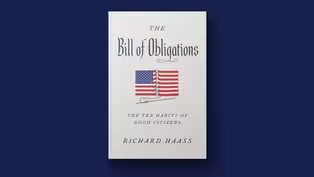
"The Bill of Obligations: The Ten Habits of Good Citizens" argues that democracy works best when citizens recognize not just their rights, but also their duties.
Amna spoke with its author, Richard Haass, a veteran diplomat and outgoing president on the -- of the Council on Foreign Relations.
AMNA NAWAZ: Richard Haass, welcome back to the "NewsHour."
Thanks for joining us.
RICHARD HAASS, Author, "The Bill of Obligations: The Ten Habits of Good Citizens": Great to be with you.
AMNA NAWAZ: So, you write in this book, the greatest threat to America right now comes from within, as you say, from political divisions that for only the second time in U.S. history have raised doubts about the future of American democracy and even the United States itself.
You cite January 6, as proof of that.
And, as you know, a lot of people said, you know what, yes, January 6 was terrible, but the system held, democracy survived.
So why are you still worried?
RICHARD HAASS: Well, just because democracy survived that day, it doesn't mean we have the luxury of being sanguine.
This is a country where I -- it's all too easy to imagine frequent widespread politically inspired violence.
Our political institutions still are not really working as intended.
We can't pass much of the legislation we need in this country.
We can't meet many of our domestic challenges.
We are as polarized as we have ever been as a society.
And I'm not predicting the worst.
I'm simply saying no one can be confident that the best will happen, that we're somehow out of the woods.
So we ought to be worried and we ought to do something about it.
AMNA NAWAZ: Do you think the idea of American exceptionalism in some way prevents most Americans from seeing our democracy as vulnerable in any way?
RICHARD HAASS: That's interesting.
It might be that or simply momentum.
Here we are.
We're three years away from marking the 250th anniversary of the Declaration of Independence.
My guess is, most Americans take it for granted.
They have always lived in a democracy.
They also, I think, in many cases, don't study it.
We don't teach civics in our schools.
Or, if it's offered, it's not required.
You can graduate from virtually any college in America not having read the Constitution or the Declaration of Independence or The Federalist Papers, or knowing what citizenship requires, what the country requires of its citizens.
So, my sense is Americans aren't really alert as much as they should and could be to the danger that we're in.
AMNA NAWAZ: You write about the idea of citizenship and say it should be expanded.
You say we have been overly focused on rights.
And you lay out obligations you believe we should adopt and adhere to instead.
Why are these important?
RICHARD HAASS: Because a rights-based democracy, as important as rights are, won't simply be enough.
Think about it.
A woman's right to an abortion vs. the rights of the unborn, well, how do we navigate that?
Someone's right to bear arms, pursuant to the Second Amendment, someone else's right to public safety, how do we navigate that?
So, rights alone are not enough.
We need to think about obligations, the obligations each of us has to one another, that you and I have to one another.
We need to begin to reimagine citizenship as a coin.
One side is rights, but the other side must be our obligations.
AMNA NAWAZ: Let's get into a few examples here.
One of the obligations you lay out is to remain civil.
I don't need to tell you about the state of our political discourse these days.
How do you even begin to adopt and to enforce that kind of obligation?
RICHARD HAASS: I'm not sure you can enforce it.
You have got to basically persuade people, if I'm uncivil to you today, it's unlikely that you and I are going to have a working relationship on something else tomorrow.
So it's simply in our own self-interest.
But this is something for parents, for teachers.
What about religious authorities, the people who stand up and preach on Fridays, Saturdays and Sundays?
Just to call for civility is not calling for a policy position.
It's simply saying, this is what we owe one another.
We want to be treated well, and we have to therefore treat one another well.
AMNA NAWAZ: Another one of your obligations you lay out is to be informed.
And in the current landscape we have right now of those bad actors out there actively spreading misinformation and disinformation, we have leaders who are so far either unable or unwilling to rein in those actors or to stop the spread of bad information.
So, how do we ensure that we have an informed citizenry that's armed with good information?
RICHARD HAASS: Well, it's essential.
It was Jefferson who basically said that we need to be informed.
I think it's up to our schools.
So, making public education in this country better, I would say, needs to be the single highest public policy priority.
One thing I like going on, Amna, is, in New Jersey, there's now a requirement to teach information literacy in the schools.
The whole idea is not to teach young people what to think, but it's to teach them how to be an informed consumer, how to be a critical consumer of information in the age of the Internet.
How do you know a fact when you see one?
What's the difference between a fact and a misstatement?
And that's the sort of thing we could do much better at teaching in our schools.
AMNA NAWAZ: You talk as well about the lack of a shared national experience in America.
And it strikes me, based on a lot of our reporting, that much of the policymaking, decision-making has shifted to states, and where you live in America means you have a very different experience in terms of your rights and how you live.
Does the amount of power that our states currently have take away from our ability to have a shared national experience?
RICHARD HAASS: Look, you raise a really good point.
And I worry about that.
This is a country founded on an idea of Americanness, of equality of opportunity, certain principles.
When we were founded, though, we were a country of three million people.
Now we're more than 100 times that.
We're a country of 340 million people.
Much harder to operate.
And, in some cases, it may be better to do things at the state or the city or the county level.
But there's certain things that we can't.
There's got to be certain protections for all Americans when we act in the world.
Florida can't have a foreign policy that's somehow different from Ohio's, that's different from Oregon's.
We have got to have a single American foreign policy.
So, there are certain things that cannot be done at the state or local level.
AMNA NAWAZ: Which brings me to the last obligation in your book.
You say, put country first.
And I will tell you, the people I talked to outside the Capitol on January 6 believed they were doing just that.
And many thought that their violence was justified.
Are you worried that we will see more and an increase in political violence ahead?
RICHARD HAASS: I am worried.
I spent years as the U.S. envoy to Northern Ireland.
The three decades of political violence there known as the Troubles, we could have a version of it here, particularly given how prevalent our guns -- guns are here.
But let me quote Ronald Reagan here.
In his -- I think it was his farewell address.
The former president said, it's not enough to be a patriot.
We need informed patriotism.
We need Americans to understand why certain actions are consistent with patriotism, why other actions are not.
So motives alone are not enough.
We need Americans to be informed about what makes this democracy so special, what it takes to protect it, why it's worth protecting.
AMNA NAWAZ: Richard, as we speak, you are stepping down as president of the Council on Foreign Relations after 20 years at the helm.
You have seen democracies rise and fall.
Are you optimistic that American democracy will survive?
RICHARD HAASS: I'm optimistic, or I wouldn't be writing this book.
On the other hand, I'm not sanguine, Amna.
I think we need to worry.
Look, right now, we live in a world where one democracy, Ukraine, is being threatened from without by invasion.
The much bigger problem historically for democracies is corrosion and eroding from within.
That is challenge -- that's the challenge facing the United States.
As big as China and Russia and North Korea and Iran are as challenges to United States, as threats, we are the biggest threat to ourselves.
The good news is, we have the potential to fix it.
AMNA NAWAZ: The book is "The Bill of Obligations: The Ten Habits of Good Citizens."
The author is Richard Haass.
Richard, thank you.
Good to speak with you.
RICHARD HAASS: Thank you, Amna.
GEOFF BENNETT: A public art exhibition explores art as a way of uncovering hidden history and addressing contemporary urban life.
Jeffrey Brown traveled to St. Louis for our arts and culture series, Canvas.
DAMON DAVIS, Artist: Right now, we are probably standing in somebody's living room or kitchen or something like that.
So, yes.
So, yes, we are, I guess, in the neighborhood, but you have to use your imagination, because the buildings are gone.
JEFFREY BROWN: Yes.
Yes.
Not far from downtown St. Louis, it's famed arch in the distance, the old buildings are gone.
This was the site of an historic and vibrant Black neighborhood called Mill Creek Valley, razed in the name of urban renewal in the late 1950s.
Now it's memorialized in a large public installation titled Pillars of the Valley, each pillar holding an hourglass shape signifying the passage and loss of time and people.
DAMON DAVIS: One, representation of time, but also the pillars, like pillars of the community.
JEFFREY BROWN: With inscribed quotations from some of those who once lived here, their names and occupations nearby.
It's the work of 38-year-old St. Louis artist Damon Davis.
DAMON DAVIS: Because I'm a kid that grew up in East St. Louis.
So I have been in this area my entire life, St. Louis, East St. Louis, and I had never heard about this, and I thought I had a very good grasp on Black history, specifically where I was from.
JEFFREY BROWN: So you're thinking, why don't I know about this?
DAMON DAVIS: Yes.
And I wanted to make sure no other kid ever - - that ever happened again.
JEFFREY BROWN: Weeks earlier, this was the site of the opening of an ambitious citywide public art exhibition, of which the Pillars are part, titled Counterpublic; 30 artists were commissioned to create works along a six-mile axis from the city's south to its north, much of it running along Jefferson avenue, a main thoroughfare.
There are small pieces, such as sculptures by Matthew Angelo Harrison at the George B. Vashon Museum of African American History, and very large works including Torkwase Dyson's Bird and Lava in St. Louis Place Park, with sound inspired by Scott Joplin, the ragtime composer who lived and worked in the city for several years.
Video by an artist who goes by the name X projected onto the bluff of a Mississippi River industrial zone.
Wind chimes by Raven Chacon paraded through city streets and then hung in Benton Park.
A mural titled Justice by Simiya Sudduth based on a tarot card, and much more.
Counterpublic artistic director James McAnally: JAMES MCANALLY, Artistic Director, Counterpublic: We talk about this as a civic exhibition, in particular, because we're really trying to think about, where does art connect with social change?
Where does it connect with the city itself?
This was a moment where, across our country, monuments were being taken down, recontextualized.
And this question of how are we telling history and public was really on people's minds, and so we took that up as our mission.
JEFFREY BROWN: As a starting point, McAnally writes in the catalog," "St. Louis is, for better and worse, at the crux of American history," the gateway to the West, based on ideas of manifest destiny and realities of Indian annihilation and removal, a long history of racial discrimination and violence, up to the 2014 killing of Michael Brown by a police officer and the Ferguson protests and riots that followed.
JOHN YANG: In St. Louis, 10 children... JEFFREY BROWN: Divisions and tensions continue, and just a few days after our visit, a downtown shooting that left 10 injured and one dead.
JAMES MCANALLY: Art can't exist in a silo in a city like St. Louis.
That's very clear, especially public art, where immediately you're talking about public safety.
Immediately, you're talking about land ownership or gentrification.
Kind of the changes of the city itself become part of the art and we wanted to be very intentional and say, like, we think that we could do this better.
JEFFREY BROWN: One examples still in progress when we visited, renowned architect David Adjaye, designer of the National Museum of African American History and Culture in Washington, is erecting a sculpture of earth walls that will enhance the grounds of the Griot Museum in the north of the city.
Another theme, uncovering past history, captured in a work next to Sugarloaf Mound, consider the oldest human-made structure in St. Louis, the last remnant of a once thriving indigenous culture.
Above, billboards created by Counterpublic artists.
Below, an installation titled WayBack by artist Anita Fields.
ANITA FIELDS, Artist: And they also are used during our ceremonial... JEFFREY BROWN: With a soundtrack by her musician son Nokosee.
Fields is a member of Osage Nation, whose people once lived in this area before being removed to Oklahoma, where Fields grew up and lives.
ANITA FIELDS: You know, it's a very complex history that we have in this area, of removal, of erasure, the ideas behind manifest destiny and Western movement and how that affected us, as Osage people, our culture, all aspects of a being Osage.
JEFFREY BROWN: Her response, 40 colorful platforms adorned with ribbons and iconography, structures she remembers from her own youth used for family and ceremonial gatherings, symbols of a continuous culture.
ANITA FIELDS: I thought, well, why not initiate a series of platforms where we can put them in a situation where people in this area can come and also sit here and enjoy, but also think about the history of this place?
JEFFREY BROWN: Does it, in that sense, reclaim that history or bring forward that history for you?
ANITA FIELDS: Yes, that is my hope.
We are actually making our way back.
There's a double meaning there.
So by having this installation with these platforms, we are making our way back to this - - to our -- part of our ancestral homeland.
JEFFREY BROWN: A way back, but also, the organizers of Counterpublic hope, a way forward.
Some of the artworks are ephemeral, including an opening day jeep parade of sights and sounds through city neighborhoods.
But others will remain, and Damon Davis' Pillars of the Valley will continue to grow, as new sculptures stretch along a mile-long greenway.
For Davis, Counterpublic is also a statement for the local art scene.
DAMON DAVIS: People consider us a flyover spot, but we don't get the type of respect that many other coastal cities get when it comes to art and creation.
So I really liked the idea of people being able to stay at home and the world coming to us, and the idea of public art and what it can do to change the civic makeup of the city in a positive way, just like outstanding.
I haven't heard anything like that.
And I like that it's happening home -- at home, here.
JEFFREY BROWN: Now it is happening here.
For the "PBS NewsHour," I'm Jeffrey Brown in St. Louis.
GEOFF BENNETT: And that is the "NewsHour" for tonight.
Don't forget, there is more online.
Amna got a sneak peek ahead of the U.S. Women's World Cup and caught up with the members of the team.
A behind-the-scenes look is on our Instagram account right now.
I'm Geoff Bennett.
Thanks for spending part of your evening with us.

Art project hopes to reveal forgotten history of St. Louis
Video has Closed Captions
Clip: 6/27/2023 | 6m 54s | Citywide art project hopes to reveal forgotten history of St. Louis (6m 54s)
Book calls for renewed commitment to American citizenship
Video has Closed Captions
Clip: 6/27/2023 | 8m 1s | New book 'The Bill of Obligations' calls for renewed commitment to American citizenship (8m 1s)

How an aging population poses challenges for U.S.
Video has Closed Captions
Clip: 6/27/2023 | 9m 34s | How an aging population poses challenges for U.S. economy, workforce and social programs (9m 34s)

Leaked audio complicates Trump's legal troubles
Video has Closed Captions
Clip: 6/27/2023 | 5m 36s | Audio of Trump discussing classified material further complicates his legal troubles (5m 36s)

Russia drops charges against Wagner mercenary group
Video has Closed Captions
Clip: 6/27/2023 | 3m 53s | Russia drops charges against mercenary group as Putin attempts to project order (3m 53s)
Supreme court rejects independent state legislature theory
Video has Closed Captions
Clip: 6/27/2023 | 5m 13s | Supreme Court rejects legal theory that could have thrown 2024 election into disarray (5m 13s)

Women face new sexual harassment with deepfake pornography
Video has Closed Captions
Clip: 6/27/2023 | 8m 30s | Women face new sexual harassment with deepfake pornography (8m 30s)
Providing Support for PBS.org
Learn Moreabout PBS online sponsorship
- News and Public Affairs

FRONTLINE is investigative journalism that questions, explains and changes our world.

- News and Public Affairs

Amanpour and Company features conversations with leaders and decision makers.












Support for PBS provided by:
Major corporate funding for the PBS News Hour is provided by BDO, BNSF, Consumer Cellular, American Cruise Lines, and Raymond James. Funding for the PBS NewsHour Weekend is provided by...