
March 25, 2026 - PBS News Hour full episode
3/25/2026 | 57m 46sVideo has Closed Captions
March 25, 2026 - PBS News Hour full episode
Wednesday on the News Hour, Iran rejects President Trump's ceasefire proposal as Israeli strikes continue in Tehran and U.S. Army paratroopers head to the region. Meta and YouTube face a legal reckoning over charges that their platforms are a danger to children and teens. Plus, an immigrant woman detained in the United States before being deported to Equatorial Guinea speaks about her treatment.
Problems playing video? | Closed Captioning Feedback
Problems playing video? | Closed Captioning Feedback
Major corporate funding for the PBS News Hour is provided by BDO, BNSF, Consumer Cellular, American Cruise Lines, and Raymond James. Funding for the PBS NewsHour Weekend is provided by...
March 25, 2026 - PBS News Hour full episode
3/25/2026 | 57m 46sVideo has Closed Captions
Wednesday on the News Hour, Iran rejects President Trump's ceasefire proposal as Israeli strikes continue in Tehran and U.S. Army paratroopers head to the region. Meta and YouTube face a legal reckoning over charges that their platforms are a danger to children and teens. Plus, an immigrant woman detained in the United States before being deported to Equatorial Guinea speaks about her treatment.
Problems playing video? | Closed Captioning Feedback
How to Watch PBS News Hour
PBS News Hour is available to stream on pbs.org and the free PBS App, available on iPhone, Apple TV, Android TV, Android smartphones, Amazon Fire TV, Amazon Fire Tablet, Roku, Samsung Smart TV, and Vizio.
Providing Support for PBS.org
Learn Moreabout PBS online sponsorshipJOHN YANG: Good evening.
I'm John Yang.
Geoff Bennett and Amna Nawaz are away.
On the "News Hour" tonight: Iran rejects President Trump's cease-fire proposal, as Israeli strikes continue in Tehran and U.S.
Army paratroopers head to the region.
Then: Meta and YouTube face a legal reckoning over charges their platforms are a danger to children and teens.
And an immigrant woman detained in the United States before being deported to Equatorial Guinea speaks out about her treatment.
"JULIA," Deported to Equatorial Guinea: They want remind you are immigrant, you are Black, you don't have the rights.
Before I came to America, I think America is the land of rights.
(BREAK) JOHN YANG: Welcome to the "News Hour."
There are two major stories we're tracking tonight.
One is a landmark decision handed down against social media companies.
But the ongoing war with Iran is where we begin again tonight.
Now in its fourth week, there were more diplomatic efforts today to end the war, though, airstrikes and counterstrikes continue unabated throughout the region.
White House correspondent Liz Landers begins our coverage.
LIZ LANDERS: Across the Middle East, the flames of war are still burning furiously and with no end in sight after Iran apparently rejected an American cease-fire proposal, Iran's military today showing no willingness to negotiate.
LT.
COL.
EBRAHIM ZOLFAGHARI, Iranian Military Spokesperson (through translator): Our first and last word has been the same from day one, and it will stay that way.
Someone like us will never come to terms with someone like you, not now, not ever.
LIZ LANDERS: The proposal had been confirmed earlier today by Pakistani officials involved in mediation efforts.
They said it had 15 points that reportedly included sanctions relief for Iran, but only if Iran rolled back and allowed monitoring of its nuclear program, limited its missile capacity, and ended its blockade of the Strait of Hormuz.
The narrow passageway has been backlogged for weeks amid Iran's relentless strikes on energy targets.
Iran countered with its own demands, like allowing it to continue its choke hold of the strait, as well as reparations for the war.
Those are likely nonstarters for the U.S.
at the negotiating table.
In Washington today, White House Press Secretary Karoline Leavitt cautioned reporters on the accuracy of the reports of that original U.S.
proposal, but would not go into detail.
KAROLINE LEAVITT, White House Press Secretary: The White House never confirmed that full plan.
There are elements of truth to it, but some of the stories I read were not entirely factual.
So I am not going to negotiate on behalf of the president here at the podium.
What I will tell you is, these talks are ongoing.
We're not going to get into the nitty-gritty details that have been exchanged between the United States and Iran at this time.
LIZ LANDERS: And Leavitt warned Iran not to - - quote -- "miscalculate again," pointing to the United States killing of much of Iran's top leadership.
KAROLINE LEAVITT: But if Iran fails to accept the reality of the current moment, if they fail to understand that they have been defeated militarily and will continue to be, President Trump will ensure they are hit harder than they have ever been hit before.
President Trump does not bluff, and he is prepared to unleash hell.
LIZ LANDERS: The U.S.
military says it continues to hit targets inside Iran, and thousands more American troops are reportedly on their way to the region, including Marines, paratroopers and sailors.
House Speaker Mike Johnson today said that's meant to send a signal.
REP.
MIKE JOHNSON (R-LA): The buildup of troops is very different than boots on the ground.
We don't have boots on the ground.
I don't think that's the intention, but I think Iran should watch that buildup, and they need to take note of that.
LIZ LANDERS: Israel says it too has ramped up its air assault on Iran, as well as Southern Lebanon, while Tehran and Hezbollah, the Iran-backed militant group in Lebanon respond with missiles of their own.
And states across the Persian Gulf continue to find themselves caught in the crossfire.
Early today, smoke rose over Kuwait's international airport after an Iranian drone hit a fuel tank there, and, in Iraq, this complex belonging to the Iran-backed Popular Mobilization Forces reduced to rubble by an air strike.
But Iraq says a military clinic was also hit and seven soldiers killed, their relatives left to reckon with loss and uncertainty.
HASSAN HADI, Relative of Killed Soldier (through translator): How long will we stay like this?
We are losing our sons every day.
The Iraqi army is being hit, and these victims are dying.
What did they do to deserve this?
LIZ LANDERS: Today, Iraq authorized the paramilitary group to respond to such attacks in self-defense, another escalation in a war that shows no signs of letting up.
For the PBS "News Hour," I'm Liz Landers.
JOHN YANG: In a span of less than 24 hours, juries returned historic verdicts on a pair of high-profile lawsuits accusing big tech companies of putting children and teens in harm's way on their social media platforms.
Today, in California, a jury found YouTube and Meta, the parent company of Instagram and Facebook, liable for designing their platforms to be addictive for children and teens, despite knowing it could harm their mental health.
All told, the companies would pay $6 million in damages.
And, yesterday, in New Mexico, a jury ordered Meta to pay $375 million after it said the social media giant concealed what it knew about child sexual exploitation on its platforms.
Jacob Ward is a tech writer.
He is also host of the podcast and newsletter Rip Current.
Jake, you noted that Meta has now been found liable under two different legal theories of this case.
What does that mean?
What implications does that have?
JACOB WARD, Founder, The Rip Current: So we're looking here first at New Mexico, which returned its verdict yesterday.
And that case is about sexual exploitation as made possible by the platform.
And, as a result, under a sort of unfair practices statute, that's basically saying that the platform facilitated something dangerous.
That's very different from what we saw in Los Angeles.
And I would argue the Los Angeles verdict is the much, much bigger one when it comes to the precedent it sets, because what that is saying is that it is the design of the platform, not the stuff we post on it, not even the way the algorithm moves content around.
It is the way that like buttons and the way that people are bucketed together by interest.
There's some stuff in the design of it, the Meta jury -- sorry -- the jury in Los Angeles determined.
And that is an enormous deal.
I mean, until now, John, we've really lived in a country where people have always just assumed, your choices are your own.
We tend to blame people for addiction and blame people for obesity.
But what this jury is saying is that they're looking at a bigger system of basically architecture, a kind of choice design system built by these two companies.
And they're saying, this has had a harmful effect on kids, is addicting them, and we won't stand for it any longer.
JOHN YANG: In the California case, some parents spoke after the verdict.
Let's listen to one of them.
JULIANNA ARNOLD, Founding Member, Parents Rise!
: Being in that courtroom and hearing those answers from the jury, it's really validated, but a complete validation of what we've been screaming on the top of roofs about for years.
And, for parents, we now know that they were manipulating our children for profits while we were watching and trying to keep our families safe.
They are the predators.
JOHN YANG: The jury in that case awarded $6 million in compensatory punitive damages, in New Mexico, $375 million.
How much does that really affect these big tech companies?
JACOB WARD: Well, it feels like a very small amount of money, $6 million compared to Meta, worth a trillion dollars, Alphabet worth way more than that.
But you got to think about all of the other cases that this sets the tone for.
This is setting essentially a per plaintiff kind of price in this case.
And so you have 350 family cases behind this.
Multiply $6 million times that, and you're well over a billion dollars.
You get then the 250 school district cases that come after that.
That's thousands of kids in each school district.
And suddenly you're looking at very, very big numbers very fast.
Also, I would point out just a few days ago, Meta's insurers sued and won to no longer have to insure them against the judgment in this case.
And so that is another -- there's basically no cap suddenly on the amount they could be hit with.
And I would also just point out here, John, Meta gets a lot of the headlines here and they were determined by this jury in L.A.
to be 70 percent of the responsibility.
But the other 30 percent was handed to YouTube, which has never been held to this kind of standard before.
And the fact that they are now grouped together with this other social media platform could change that platform forever.
So this really has the capacity not just to hit these companies with enormous fines, but also to change the way they do business.
And parents like the one we just heard there are no longer just shrugging and saying, geez, it just feels like something's wrong, but I can't name it.
Now there is a name for it, a legal theory for it.
And suddenly there's a way for lots and lots and lots of people to sue like they'd never been able to before.
JOHN YANG: Big numbers adding up, you said.
But the prosecutors in New Mexico were asking for $2 billion.
The jury only gave them $375 million.
What do you make of that?
JACOB WARD: Well, it's this thing where the per-kid price was max -- the statutory maximum was $5,000 per user, right, per teenager in this case.
And so they brought it down to $1,800 per.
So, again, that's -- you're in a state of,what, 2.1 million people.
But you got to remember, there are state cases coming up that involve Florida, 22 million people, New York, 19 million people.
Now you're talking -- I did the math the other day on it.
If you look at all of the cases that are coming down the pipeline and you use that $1,800-per-teenager judgment, you're looking at $40 billion alone.
And that's just the cases that have been filed.
You can imagine that, as of today, there are armies of lawyers who are going to start getting -- going on their own cases here.
And so I think that this is going to be an enormous problem for these companies.
And it's why, of course, they're going to appeal like crazy here, John.
JOHN YANG: Appeal.
The Meta released a statement today.
They said they -- quote -- "respectfully disagreed" with both verdicts and that they would appeal in New Mexico and were evaluating their legal options in California.
What was the company's defense?
What do they say to these allegations that their platforms are causing harm?
JACOB WARD: Well, they have always argued that the misbehavior is not their fault when it comes to what happens on the platform.
And they have -- they tried in the Los Angeles case to say that this plaintiff, this kid had all of these difficulties.
And she did.
She had a whole host of problems in the home and a history of some mental health issues.
But what really has now happened is, we're seeing, instead of juries say, oh, well, it's not that they caused that, it's that they managed to make a vulnerable kid worse.
And that is a very different standard than what Meta has been arguing and YouTube have been arguing all of this time.
And so - - and the big thing here, John, right, is that they have been protected behind both the First Amendment and something called Section 230, which is a big blanket immunity for social media companies, makes them not liable for the crazy stuff that you and I might post there.
That has been the core of the defense, the big legal wall built around them forever.
Suddenly, these two cases, which step around those issues, and get into the question of design and behavior modification by design, suddenly, we're in a very new landscape that I think these companies are going to have a very difficult time arguing against.
JOHN YANG: Tech journalist Jacob Ward, thank you very much.
In the day's other headlines: A Democrat has won the special election for a Florida Statehouse district that's home to President Trump's Mar-a-Lago estate.
(CHEERING) JOHN YANG: Emily Gregory flipped the seat from Republican control.
It was her first time running for elected office.
President Trump endorsed her opponent, Jon Maples, and urged voters to turn out Tuesday to vote.
He voted by mail, a practice he repeatedly criticizes.
National Democrats say the upset win is a further sign of the party's momentum in this midterm election year.
Police in the United Kingdom have arrested two men in connection with the arson attack that destroyed four ambulances belonging to a Jewish charity.
Police called the arrest an important breakthrough, but noted that the security footage of the incident from early Monday morning showed three people.
Officials are investigating the attack as an antisemitic hate crime and are also looking into a claim of responsibility by a group with potential ties to Iran.
Russia says it shot down nearly 400 Ukrainian drones in a massive overnight attack across its regions and occupied Crimea.
Fires broke out at several major Russian Baltic ports, leading them to suspend crude oil production.
The drone attacks were one of the war's largest strikes on Russian oil facilities.
Meanwhile, in Ukraine, Russian drones hit residential areas in Kharkiv, injuring at least nine people.
In the past 24 hours, more than 1,000 drones and missiles struck Ukrainian cities.
The back-and-forth attacks come as the United States mediated peace talks have stalled and as Ukraine anticipates a Russian ground offensive this spring.
A unanimous Supreme Court cited with Cox Communications today, ruling that the Internet service provider is not liable for the copyright violations of its customers, namely illegally downloading music.
More than 50 music labels led by Sony Music Entertainment banded together in 2018 to sue Cox.
They claimed the company didn't do enough to deter piracy or cut off Internet access for bad actors.
The court's decision said Cox did not induce its users to break the law and didn't provide a service tailored to infringement.
The Justice Department has settled a lawsuit with President Trump's former National Security Adviser Michael Flynn.
Flynn pleaded guilty during Mr.
Trump's first term to lying about the FBI about conversations he had with a Russian diplomat.
Trump later pardoned him.
The settlement was not disclosed, but Flynn had sought $50 million in a lawsuit against the Justice Department, claiming a malicious prosecution.
Attorney General Pam Bondi has been a vocal critic of the Russia investigation in which Flynn was charged.
Two federal agencies are taking steps in response to higher fuel prices.
One of them is the Environmental Protection Agency.
Today, the EPA announced it will allow gas stations to sell higher ethanol fuel temporarily this summer in hopes of bringing down gas prices.
The slightly cheaper blend is usually reserved for winter because it evaporates easily in the summer heat and makes air pollution worse.
Separately, the U.S.
Postal Service says it's placing a temporary 8 percent price hike on some deliveries effective next month to cover higher fuel costs.
The post office will join other carriers like FedEx and UPS that have already imposed fuel surcharges.
And, on Wall Street, hope for a possible end to the war with Iran pushed stocks higher again today.
The Dow Jones industrial average gained 300 points, while the Nasdaq advanced by nearly 0.8 percent and the S&P 500 rose by half-a-percent.
Still to come on the "News Hour": Senate Republicans push a new plan to fund Homeland Security and end the partial government shutdown; emergency workers in Lebanon face a deadly challenge to aid civilians amid ongoing Israeli attacks; and we examine the effect of Australia's pioneering social media ban for teens.
With the Department of Homeland Security shutdown now at 40 days, TSA checkpoints are strained and workers face another missed paycheck.
On Capitol Hill, we have started to see some action, but no deal so far.
Congressional correspondent Lisa Desjardins is here to help us understand.
Lisa, there seems to be something going on, offers, counteroffers.
Where do things stand now?
LISA DESJARDINS: Right.
Well, remember, as I say, things can change quickly, but right now it is a bit of a mess.
The key idea is still there to fund most of DHS except for ICE enforcement.
That's the part of the agency that Democrats want to reform.
But there are some sticking points.
Let's look at those.
First of all, Democrats are leery of funding Customs and Border Protection and other subagencies that help ICE without any reforms.
And the latest GOP offer does not include significant reforms.
Now, Democrats want some things that Republicans flatly reject, like requiring tougher warrants and no masks.
Now, the top-level officials working on this here are the big names, President Trump, Leader Thune and Leader Schumer.
But those leaders, each party, John, have rejected each other's offers.
Now, it's easy to look at that, but I want to show -- tell people that there is something else to look at beneath the surface to figure out what's happening here.
For example, meetings like one I saw on the Senate floor today between a few senators, including Katie Britt, you can see them there in the top corner, and four key Democrats.
Individual senators are trying to work out a deal.
So don't pay attention to the back-and-forth necessarily of the leaders.
That's usually part of the process.
I spoke to two of the senators in that floor meeting and they confirmed, yes, there are many conversations going.
There is reason to hope because there are a lot of senators who want to figure this out.
JOHN YANG: Of course, we have seen headlines, pictures about the long TSA lines at airports.
How else are people feeling this?
LISA DESJARDINS: Let's start right away with the DHS workers, everything from TSA to FEMA to the Coast Guard.
First of all, most of those workers again miss another paycheck at the end of this week.
This is their third shutdown of the fiscal year.
And I did the math by the way, John, and what this means is those workers, about 100,000 of them, have had pay, intermittent pay freezes for almost half of their fiscal year so far.
Now they will get back pay, but as a TSA administrator told Congress today, that doesn't help them with the bills now.
HA NGUYEN MCNEILL, Deputy Administrator, Transportation Security Administration: Many in our work force have missed bill payments, received eviction notices, had their cars repossessed and utilities shut off, lost their childcare, defaulted on loans, damaged their credit line, and drained their retirement savings.
Some are sleeping in their cars, selling their blood and plasma, and taking on jobs, second jobs, to make ends meet, all while being expected to perform at the highest level when in uniform.
LISA DESJARDINS: Another effect, the Coast Guard commandant said today that they aren't paying their contractors and they're worried they might not get fuel deliveries and literally the lights may be turned off.
JOHN YANG: You're becoming an expert on these government shutdowns.
How do you see this going on?
Any prospects of this ending any time soon?
LISA DESJARDINS: Let me shock you, because I think the dynamics actually matter and there could be a solution.
Let's look at those dynamics again very quickly, first of all, again, workers missing a paycheck this week.
That will be a month of missed pay.
Congress is due to leave for a two-week recess at the end of this week.
And, of course, John, spring travel is happening for families all across the country.
Those are pressure points.
And, most of all, I see Democrats and Republicans who want a solution talking to each other.
So stay tuned.
JOHN YANG: Congressional correspondent Lisa Desjardins, we certainly will be staying tuned.
Blowback and backlash to social media and its effect on young people are reverberating across the globe, not just in the United States.
In recent months, many countries from the United Kingdom to Malaysia have announced plans to enact measures restricting social media access for children and teens.
Australia was the first to implement a ban like that late last year, setting an example that the other nations are now closely monitoring.
Stephanie Sy reports on what that pioneering ban looks like for teens today.
STEPHANIE SY: In Brisbane on a recent weekend, the Dolezal family sat down together for lunch, on the menu, pizza and salad, but off the table, screens.
Lauren Dolezal, like many parents, tries to limit the amount of time her two kids, 12-year-old Bea and 11-year-old Josie, spend on their devices.
What are your concerns about your kids being on screens and on social media?
LAUREN DOLEZAL, Mother: You have to worry about the impact it's having on their brain chemistry, the impact it has on their attention spans and the impact it has on their own sense of self, I think.
STEPHANIE SY: Josie uses an iPad for school and Bea got her first smartphone when she started high school this January.
LAUREN DOLEZAL: Because she's catching the bus and walking to school and things like that.
She has messaging on there.
She has WhatsApp.
The group chats are popping off all the time.
STEPHANIE SY: But unlike teenagers in most other countries, when she turns 13, she won't be able to get on some of the world's most popular social media platforms.
ANTHONY ALBANESE, Australian Prime Minister: This is the day when Australian families are taking back power from these big tech companies.
STEPHANIE SY: In December, Australian Prime Minister Anthony Albanese launched an ambitious experiment, banning teens under the age of 16 from using 10 social media platforms, including TikTok, YouTube and Meta's Instagram and Facebook.
Social media companies face steep fines if they don't make reasonable efforts to prevent underage users from holding accounts.
MICHAEL NOETEL, University of Queensland: I'm really proud of Australia for taking such decisive action in face of the evidence that they saw.
STEPHANIE SY: Michael Noetel, a researcher at the University of Queensland, has studied the relationship between screen time and socioemotional problems in children.
MICHAEL NOETEL: Young people are facing more and more mental health problems than any previous generation.
Mental health problems are so debilitating that we really need to throw everything at it.
And this is one easy thing in the toolkit, relatively speaking.
STEPHANIE SY: Before the restrictions, 96 percent of 10-to-15-year-olds in Australia used social media; 72 percent had seen harmful content online and more than half had been cyber-bullied.
Both major parties support the ban, and it's extremely popular.
Lauren Dolezal says it came as a massive relief.
LAUREN DOLEZAL: As a parent with a child going into high school who wasn't yet on social media, it's become a very helpful tool to say no because it's against the law.
STEPHANIE SY: After a series of high-profile suicides, Dolezal says cyber-bullying too was a main concern.
LAUREN DOLEZAL: One thing we can do as adults is take the loaded gun away from them or take away that thing that they can use to hurt somebody, and you have got to protect kids from being harmed.
STEPHANIE SY: From the start, the government set expectations that the rollout might be rocky.
ANIKA WELLS, Australian Communication Minister: We know this law will not be perfect, but it is too important not to have a crack.
STEPHANIE SY: Companies have introduced a range of tools to check their users' age, from self-reporting to technology that determines age based on selfies, not exactly airtight methods.
After the ban went into effect, many teens like 14-year-olds Claire (ph) and Stella, still had access to their accounts.
STELLA PIETERSE, 14 Years Old: I kind of see where they're coming from, but I think if you can get a job at 14, if you can do babysitting and stuff, I think you should be able to have social media and have the government trust you on it.
STEPHANIE SY: And strategies for circumnavigating the age verification systems quickly spread.
MAN: So what are you actually trying to do, Ash?
ASHER PATRIKIOS, 13 Years Old: Make myself have wrinkles.
STEPHANIE SY: Simply by making funny faces, 13-year-old Asher Patrikios was able to access Snapchat, one of the banned platforms.
MAN: It worked?
ASHER PATRIKIOS: Oh, yes, it let me in.
It let me in.
It's been no real point, really, because I just find a work-around.
STEPHANIE SY: About a month into the ban, the government announced companies had removed access to the accounts of about 4.7 million young users.
But experts say those statistics may not tell the whole story.
SUSAN MCLEAN, Cyber Safety Solutions: I'm very aware of some children that, yes, were booted off, but quickly made another account.
And they're keeping on keeping on.
STEPHANIE SY: Susan McLean, a former police officer, is widely known as the Cyber Cop for pioneering the field of cyber safety in her home state of Victoria.
SUSAN MCLEAN: You cannot ban your way to safety; 10 platforms out of hundreds of thousands really is not going to make much of a difference.
STEPHANIE SY: McLean says other unregulated apps are rushing in to fill the void.
Instead of a blanket ban, she advocates for regulations that would make all platforms more safe.
SUSAN MCLEAN: We need to make sure that, when young people are on these platforms, they are not exposed to inappropriate content.
They are not contacted by pedophiles.
They are not going down rabbit holes of misogynistic and sexual content or suicide ideation content.
STEPHANIE SY: For some teenagers, like 15-year-old Ezra Sholl, the ban threatens to take away a social lifeline.
It wasn't always so.
EZRA SHOLL, 15 Years Old: I wasn't allowed on social media, and when I got sick, my parents were like, go for it.
STEPHANIE SY: Ezra had Hodgkin's lymphoma when he was 12 years old.
The cancer triggered a nerve condition which left him paralyzed and unable to pursue his former hobbies, like playing basketball.
EZRA SHOLL: Social media has really kind of filled that void in my social life, and it's given me the avenue to still be friends with my friends, make new friends, feel connected with the wider world.
STEPHANIE SY: Natasha, Ezra's mom, says the government hasn't considered the gaps created by the social media ban for teens who are isolated, including kids in rural Australia and LGBTQ+ teens.
NATASHA SHOLL, Mother of Ezra Sholl: We might be living in a very specific and extreme situation, but there are lots of other kids who use social media for similar connection, and the world might be just as inaccessible.
STEPHANIE SY: One of the goals is to improve teens' mental health.
But researcher Michael Noetel says it's too early to understand the ban's full impacts.
MICHAEL NOETEL: The effects here are not going to be perfect.
We're not going to take away all kids' mental health problems straight away.
It's going to take time to find this out.
It could take over a year to know whether or not this is having the benefits people expect.
STEPHANIE SY: Back at the Dolezals, 12-year-old Bea says most teens she knows were using social media responsibly.
BEATRIX DOLEZAL, 12 Years Old: It'd be really good if there was just like, on all the social media platforms, like stricter rules for kids that are under 16 if they are on it.
STEPHANIE SY: But, per Mom's and now the government's rules, she will stay off it until she's legally allowed.
LAUREN DOLEZAL: It's made that conversation around social media safety a little bit easier, and I think it gives you more time to then teach kids how to be on social media safely before it's put into their hands.
STEPHANIE SY: While the world watches, so too will a panel of government-appointed experts to see if the experiment works as intended.
For the "PBS News Hour," I'm Stephanie Sy.
JOHN YANG: Tomorrow, we will bring you a report from Germany about how that country is considering a ban on social media for children under 14.
We return now to the state of the war with Iran and the diplomatic efforts to end it.
For that, we get two perspectives.
Ray Takeyh was a -- is a senior State Department adviser on Iran during the Obama administration.
He's now a senior fellow at the Council on Foreign Relations.
He was born and raised in Iran, but moved to the United States just after the revolution in 1979.
And Alan Eyre served on the U.S.
government for four decades.
He was part of the Obama administration's negotiating team for the Iran nuclear deal, which President Trump pulled out of in 2018.
He's now at the Middle East Institute.
Alan, I'd like to start with you.
We have seen this exchange of proposals, 15 points from the United States, five points from Iraq.
What's -- from Iran.
What's going on here?
ALAN EYRE, Middle East Institute: Well, I think each side is floating its maximalist red lines, so the other side is up to date on what it would take to begin to wind down this war.
The bad news is that these red lines are even farther apart than they were before the war started.
So, no direct negotiations, but messages are being passed.
JOHN YANG: Ray, would do you -- how do you see it?
RAY TAKEYH, Former State Department Official: I think Alan is right that, at this particular point, a diplomatic agreement is not apparent, given how far apart these points are.
But the very fact that both parties are offering points of negotiations, however maximalist or even absurd they may be, perhaps indicates a propensity to look for some sort of an off-ramp in an impasse that they both find themselves.
JOHN YANG: Alan, you say there's unlikely to be a diplomatic solution, but are they at least going to talk and negotiate?
ALAN EYRE: Oh, there won't be direct negotiations.
I find that highly improbable.
The foreign minister of Iran just today said direct negotiations are out of the question, and there won't be a cease-fire because Iran loses momentum if they have a cease-fire and then negotiate.
So the fight will continue and messages will continue to be passed.
The problem is, is, the economies are going to get a lot worse faster than the two sides will get closer to an agreement.
So the dynamic is not a favorable one.
JOHN YANG: Ray, do you see these messages passing back and forth narrowing the gap?
RAY TAKEYH: I'm not sure if they're narrowing a gap in terms of resolution of the conflict, but the president, President Trump, has the capability of presenting almost anything as a victory.
And he does have a story to tell.
So the very fact of negotiations taking place can potentially be a prelude to some sort of a cease-fire, or at the very least, curb escalation, such as attacking Iran's power infrastructure.
That would be humanitarian catastrophe.
JOHN YANG: Alan, by all accounts and by what we see, that Iran is getting pummeled by this United States bombing, United States and Israeli bombing.
Among the demands that Iran is making, according to reports, are that Israel and the United States stopped the attacks before they enter into negotiations.
And Iran says it will end the war at a time of their choosing.
What does this say about Iran?
I mean, are they able to withstand this assault?
ALAN EYRE: Easily.
I mean, in a way, paradoxically, Iran is winning, because they're taking what the U.S.
is throwing at it and maintaining a choke hold on the Strait of Hormuz.
So this is Iran's plan, to take a beating, but still maintain enough kinetic ability to threaten the strait and also to escalate if the U.S.
chooses to escalate.
So, the status quo, to a large part, is on Iran's side, because this economic situation is only going to get worse as long as ships are not passing through the strait.
JOHN YANG: Status quo on Iran's side, Ray.
What do you think?
RAY TAKEYH: I don't think -- here, I disagree with Alan, I don't think Iran is winning.
Its conventional military capability has been blown up, almost to the point of obsolescence.
Its nuclear programs is buried in rubble.
And all the problems that Iran had before this war, which were unimaginable in terms of economic, ecology and popular uprising, all those problems have even worsened.
This is not a formula for success for a regime whose support base is narrow and has the skies to open to American and Israeli attack almost at the time of their choosing.
JOHN YANG: Alan, from the United States' perspective or the United States' side, what's been accomplished?
ALAN EYRE: Well, again, you can pick among President Trump's statements as to the purpose of the war, but we have for now destroyed Iran's ability to project power beyond its own borders.
So, if I were President Trump, I would take that as a win and walk away.
The problem is, we have increased Iran's desire to project power passed it borders, in other words, to have effective strategic deterrence, and now Iran has found a new possible way of strategic deterrence, which is controlling the Strait of Hormuz.
So that's where we stand today.
JOHN YANG: Ray, both the Israelis and the president have said that they want regime change.
They're hoping that the Iranians will rise up after this pummeling that they're getting.
How likely do you think that's to happen?
RAY TAKEYH: The theory of the case for the Israelis, and sometimes, as Alan said, the Americans, is that the regime's coercive apparatus, the security services, have been so degraded that when, an opposition movement reemerges, and I think it inevitably will, it will have a greater chance of success than it did previously.
There is something to that.
I am not prepared to reject it.
It has not been tested, but the Islamic Republic will face another protest movement, and we will see if it still has the capacity to conduct the killing spree like it did last time.
The Israelis and many Americans are hoping that it will not.
It remains to be seen, but I don't think the logic of that argument should be dismissed.
JOHN YANG: Alan, how do you see this ending?
ALAN EYRE: I see this ending as I don't think we will get a negotiated solution.
I think the U.S.
will declare victory and in effect just stop the kinetic attacks and convince Israel to stop.
Iran will continue for a little while longer and then there will be a new modus vivendi worked out in terms of the Strait of Hormuz with the Gulf allies.
So it'll be a slow and ugly ending, and the Middle East and the Gulf will never go back to the way it was before.
JOHN YANG: Ray, what about you?
How do you see this ending?
RAY TAKEYH: I largely agree with Alan that the status quo ante in the Gulf will not be the same.
The Iranians have proven that, with primitive technology, they can obstruct the critical passageway in terms of maritime commerce, in terms of global commerce.
So the results of this war will be messy, but coming out of this war, Iran will be in very difficult shape.
JOHN YANG: Gentlemen, we got to leave it there.
Ray Takeyh and Alan Eyre, thank you both very much.
RAY TAKEYH: Thank you.
ALAN EYRE: Thank you.
JOHN YANG: The war between Israel and the Iran-backed group Hezbollah has claimed more than 1,000 Lebanese lives, including 40 emergency workers.
The latest victims were two civil defense workers who were buried today.
They were killed in Nabatieh, a southern town within an area of Lebanon the Israeli Defense Forces have placed under evacuation orders.
The evacuation zone now extends up to the Zahrani River.
Special correspondent Simona Foltyn and videographer Adrian Hartrick traveled to Nabatieh for this report.
SIMONA FOLTYN: This is what Southern Lebanon under Israeli evacuation orders looks like, empty streets lined with shuttered stores, bombed-out buildings and burned cars.
Just about the only vehicles on the road are ambulances racing to save the war's survivors but they have not been spared by Israeli bombs.
Hussain Fakih leads the Civil Defense in Nabatieh.
HUSSAIN FAKIH, Lebanese Civil Defense (through translator): This is the station.
The strike happened over there.
All these vehicles belong to our employees.
These were our living quarters that are now unusable.
SIMONA FOLTYN: On March 17, an Israeli strike hit a building just 10 yards from the Civil Defense; 12 emergency workers were injured.
It happened three days after the IDF said that ambulances were used by Hezbollah for military purposes, a claim for which it provided no evidence.
HUSSAIN FAKIH (through translator): We were surprised because we are the Civil Defense.
We are supposed to be guaranteed civilian protection.
SIMONA FOLTYN: The Lebanese Civil Defense is a public emergency service that operates under the Lebanese state.
They rescue people from underneath the rubble and put out fires caused by bombardment.
HUSSAIN FAKIH (through translator): Usually, we are 32 in the station, but 15 were on a rescue mission, which reduced the number of casualties.
SIMONA FOLTYN: Do you have any idea what was inside the building that was targeted?
HUSSAIN FAKIH (through translator): It's right in front of us.
It's a residential building.
There's nothing there.
But since it's just 10 yards from us, you could say that we were directly targeted.
SIMONA FOLTYN: As we speak, the shelling draws near, and Hussain is getting nervous.
HUSSAIN FAKIH (through translator): The planes are coming, so let us get out of here.
Let's go up to the hospital.
SIMONA FOLTYN: We just heard two airstrikes that were relatively close.
One of them, we could actually feel the shockwave, so we're going to leave this place and head to the hospital.
The Nabih Berri Governmental Hospital is located on a hill overlooking the town.
Seeking sanctuary from Israeli strikes, first responders have set up camp in the hospital's parking lot.
Since the war escalated three weeks ago, Israel has killed 42 emergency workers and injured 119 as part of what the Lebanese Ministry of Health called the deliberate targeting of medical workers and facilities.
Dr.
Ali Omeis is in charge of the emergency room.
He takes us to see a first responder who was injured during a rescue operation.
Ahmed suffered burns to his face and hands.
He allowed us to film his injuries, but didn't want to be interviewed.
He twitches with pain as the nurse cleans the wounds, a colleague holding his feet instead of hands in support.
Dr.
Ali explains what happened.
DR.
ALI OMEIS, Emergency Supervisor, Nabih Berri Hospital (through translator): There was an airstrike, but the projectile didn't explode.
The Civil Defense were evacuating the targeted building.
SIMONA FOLTYN: But then there was an explosion, possibly due to a second strike.
DR.
ALI OMEIS (through translator): Ahmed was injured and sustained second- and third-degree burns.
SIMONA FOLTYN: The hospital has received more than 300 casualties this month.
DR.
ALI OMEIS (through translator): We are on the front lines of the war here in Nabatieh, and this area is being targeted every day.
Most of the cases that are coming are civilians, children and first responders.
SIMONA FOLTYN: The facility is normally staffed with 150 medics.
Only 20 are left to cover the 24-hour shifts.
They sleep at the hospital because the roads have become too dangerous.
It's quite an eerie atmosphere here at the Nabih Berri Hospital in Nabatieh, which is one of the largest in Lebanon's south.
Normally, its halls would be bustling with patients, but after Israel placed much of Lebanon on south under forced evacuation orders, most of the population has left.
The hospital staff, however, are holding out and have become the lifeline of the civilians who have chosen to stay behind.
Dr.
Ali sent his wife and two young girls to the capital, Beirut, when the war began and hasn't seen them since.
DR.
ALI OMEIS (through translator): I haven't taken a day off to see my family, and I won't until the war is over because I don't want to put them at risk.
If I were to come and go to Beirut from the south, a conflict zone, this might be considered suspicious by the enemy, so I will rather endure being away from them.
SIMONA FOLTYN: There are no guarantees the hospital and its staff won't come under fire.
A few days ago, Israel hit a building just 200 yards away.
The shockwave shattered windows and brought down ceilings.
DR.
HASSAN WAZNI, Nabih Berri Hospital (through translator): The shelling has been close to the hospital, not directly at the hospital.
I don't know if they were targeting someone or if it was a message.
SIMONA FOLTYN: Despite Israel's forced evacuation orders, director Hassan Wazni is determined to stay put.
DR.
HASSAN WAZNI (through translator): We, as a hospital, under international law, we are working under all conditions, war or peace.
So we are staying here and we will continue to work.
SIMONA FOLTYN: But international law no longer offers the protection it once did.
Israel has already struck five medical facilities in three weeks, a figure that is bound to rise, as the war shows no sign of slowing.
For the "PBS News Hour," I'm Simona Foltyn in Nabatieh, Southern Lebanon.
JOHN YANG: The "News Hour" requested comment from the Israeli Defense Forces on the strikes in Southern Lebanon detailed in Simona's report.
They did not respond.
Since returning to office, the Trump administration has deported more than 675,000 people.
A federal judge recently allowed the government to continue deporting undocumented immigrants to countries other than their country of origin.
Even though the administration says it's removing the worst of the worst criminal elements, some migrants, including those fleeing political violence and who have made asylum claims, are getting swept up as well.
William Brangham recently spoke with one of those people and her lawyer.
WILLIAM BRANGHAM: We recently interviewed a woman who we will call Julia who was deported through this policy.
After she says she was violently attacked by her government soldiers, Julia fled her home country in East Africa two years ago.
She took a flight to Brazil, traveled two months up through South America, crossed the treacherous Darien Gap, all the way to the U.S.
border where she hoped to claim asylum.
She was detained in the United States for over a year.
And, then last summer, a judge ruled that Julia could not be deported back to her home country, given the risks that she would face.
Four months later, she was put on a plane and sent to Equatorial Guinea, a place she had never been and had never even heard of.
Julia's lawyer, Meredyth Yoon, joins us now.
Meredyth, thank you so much for being here.
We spoke with Julia recently, and she described this horrendous story explaining why she had to flee her country.
And it goes like this.
Her brothers, who were away at the time, had apparently joined an armed -- an opposition group.
And government soldiers came to Julia's home to interrogate them to find out information about their brothers.
And this is very, very hard to listen to.
We also obscured Julia's face to protect her identity.
But this is what Julia told us happened on that day.
"JULIA," Deported to Equatorial Guinea: They came in the night.
I remember there are seven, and three of them, they catch my father.
They start beat him.
Also, two of them, they catch my mom.
And two of them -- one of, he take me on the ground.
And he raped me in my family.
And he kicked my stomach more than three times.
After he finish raping me, he take his cigarette and he burned my breast.
WILLIAM BRANGHAM: Would that kind of circumstance, clearly fleeing political violence in her home country, be the basis for a normal asylum claim?
MEREDYTH YOON, Immigration Lawyer: Yes.
The facts of her case are absolutely heartbreaking and clearly formed the basis for statutory eligibility for asylum in the United States.
However, at the time she entered the United States, she was subject to a temporary rule that was in effect between May 2023 and May 2025 that made it much harder for people to seek asylum if they traveled through a third country before reaching the United States.
WILLIAM BRANGHAM: She crosses, she gets arrested and she's held in this detention center in Eloy, Arizona.
We should say this happened during the Biden administration and transitioned into the Trump administration.
But she's in this detention center for over a year.
Is that common to hold people for such long periods of time?
MEREDYTH YOON: Unfortunately, we're seeing that people are being held in detention for much longer periods of time than was the case in the past.
And this was the case for Julia.
Under the Trump administration, we have been seeing that, when people are granted relief, ICE is continuing to hold them in detention for months and months after they have already won protection in their case.
WILLIAM BRANGHAM: This particular detention center has been criticized for some pretty grim conditions.
This is what Julia described about her conditions there.
"JULIA": Every single minute, every single day, they want remind you are migrants, you are Black, you don't have the rights.
You -- in America, you know?
I don't know.
Before I came to America, I think America is the land of rights, you know?
Everything is became good for people, human rights is very important thing.
But you went to jail?
No.
One year, two months, every single day, they remind me I'm migrant.
WILLIAM BRANGHAM: What else did Julia tell you about her experience in that center?
MEREDYTH YOON: It's horrible to hear the experience that Julia went through in detention.
And, sadly, it is endemic to the immigration detention system in the United States.
Conditions are just absolutely terrible.
ICE is not held accountable for conditions that they have in their detention centers.
They called her names.
They insulted her.
They called her trash,just -- they were racist.
Just absolutely horrific treatment.
WILLIAM BRANGHAM: She finally did get a court hearing, and she was granted this withholding of removal.
Can you again explain what that is and what that meant with regards to her status?
MEREDYTH YOON: Under the Immigration and Nationality Act, the U.S.
may not deport a person to a country where their life or freedom would be threatened.
And when a person has proved that that is likely to be the case, it is mandatory that they may not be sent to that country.
WILLIAM BRANGHAM: So she is then sent four months later to Equatorial Guinea, which she has no connection to whatsoever.
We reached out to DHS for a comment and a spokesperson said, the judge ruled that she could be removed, and to anywhere, as you say, but her home country.
And DHS said -- quote -- "We are applying the law as written.
If a judge finds an illegal alien has no right to be in this country, we are going to remove them, period."
How do you respond to that?
MEREDYTH YOON: Under the Immigration and Nationality Act, which is the act passed by Congress that contains almost all U.S.
immigration law, there are specific procedures that lay out what countries a person may be deported to.
It's not the case that DHS may just deport anyone to any country they please.
They have to go through a specific process and follow specific steps.
That is not what happened in Julia's case.
That is not what happened in nearly all of the cases that we are aware of where someone was deported to a third country.
They -- in Julia's case, she was deceived.
She was lied to.
She was told that she was being actually deported to her country of origin, not to Equatorial Guinea.
She did not find out until the plane was in the air and well into its journey that she was being deported to Equatorial Guinea.
WILLIAM BRANGHAM: The idea, I take it, is that we send people to a third country with some understanding that they will not be mistreated in that country.
Do we have any idea as to what the arrangement America has with Equatorial Guinea?
MEREDYTH YOON: The agreement between the United States and Equatorial Guinea has not been made public.
I have not seen it.
What we do know, based on what we have seen in Equatorial Guinea and elsewhere, is that these arrangements typically are not intended to be sending someone to a new country for that to become their home.
Instead, they are stuck between impossible alternatives, to remain detained indefinitely or to be sent on back to the very country they fled and where they would face danger.
So it is a continuation of the cruel policy of detaining people who are coming to seek protection from legitimate violence in their countries of origin.
WILLIAM BRANGHAM: Meredyth Yoon, thank you so much for talking with us.
MEREDYTH YOON: Thank you so much for having me.
JOHN YANG: Finally tonight, we meet a woman in South Africa who's working to empower older women in her country.
There, the average life expectancy is in the mid -- I'm sorry -- early to mid 60s.
In tonight's Brief But Spectacular, she talks about how her own cancer diagnosis inspired her to help change lives.
BEKA NTSANWISI, Community Leader: The day I was told that I have cancer, I was in a shock.
It was not OK.
But let me tell you something.
One day, I decided to -- because the doctor will always tell me to exercise, and I said, OK, I can walk.
As I was walking, one granny was greeting me and said: "I have a problem."
And I said: "No, come join me."
And then, as we were walking, another one joined us.
Remember, they are telling me their problems.
And we ended up at the soccer field.
I was very tired, under a shade.
Boys were playing somewhere.
The ball came to us.
So one granny decided to kick the ball.
She missed.
But she kept on running.
The other one joined.
She said: "I can.
I'm better than you."
She missed.
And the boys came there.
They were laughing, and they tried to play with the grannies.
And the next day, I received a call from one granny.
She said: "Mama Beka, yesterday, it was nice.
I enjoy it.
I came back, I slept like a baby.
Can we do it again?"
I said: "Ah, it's OK.
Let's go there."
This is our time to enjoy.
Any granny who is at home, they know that.
They know what I'm telling them.
Look at where we are today.
We are famous, the grannies who plays football.
We have more than 250 teams.
And almost every day, they are joining.
The mission of the team is for us to live healthy and longer, because, by exercising, it helps us a lot.
My motto is that, at our age, we just want to enjoy like when we are 16.
We make time for ourselves.
And it's healthy.
And we are enjoying that.
My name is Beka Ntsanwisi.
This is my Brief But Spectacular take on empowering the soccer grannies.
JOHN YANG: And that is the "News Hour" for this Wednesday.
I'm John Yang.
For all of my colleagues, thanks for joining us.
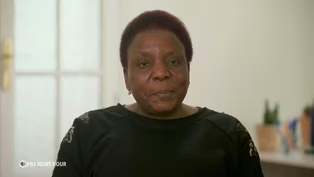
A Brief But Spectacular take on empowering 'soccer grannies'
Video has Closed Captions
Clip: 3/25/2026 | 2m 21s | A Brief But Spectacular take on empowering 'soccer grannies' (2m 21s)

East African asylum seeker deported to Equatorial Guinea
Video has Closed Captions
Clip: 3/25/2026 | 7m 56s | East African asylum seeker deported by U.S. to Equatorial Guinea (7m 56s)

How Australia's social media ban is impacting teens
Video has Closed Captions
Clip: 3/25/2026 | 8m 9s | How Australia's pioneering social media ban is impacting teens (8m 9s)

Iran rejects Trump's ceasefire terms and issues own demands
Video has Closed Captions
Clip: 3/25/2026 | 4m 5s | Iran rejects Trump's ceasefire terms and issues own demands as war continues (4m 5s)

Lebanese emergency workers risk lives to aid civilians
Video has Closed Captions
Clip: 3/25/2026 | 5m 49s | Lebanese emergency workers risk lives to aid civilians during ongoing Israeli attacks (5m 49s)

Meta, YouTube found liable in landmark youth addiction case
Video has Closed Captions
Clip: 3/25/2026 | 7m 38s | Jury finds Meta and YouTube liable in landmark youth addiction case (7m 38s)

Mideast experts on state of Iran war and efforts to end it
Video has Closed Captions
Clip: 3/25/2026 | 7m 23s | Mideast experts analyze state of Iran war and diplomatic efforts to end it (7m 23s)

News Wrap: Democrat wins election in Mar-a-Lago's district
Video has Closed Captions
Clip: 3/25/2026 | 4m 23s | News Wrap: Democrat wins Florida state House seat in district home to Mar-a-Lago (4m 23s)
Where talks to fund DHS stand as shutdown drags on
Video has Closed Captions
Clip: 3/25/2026 | 3m 42s | Where talks to fund DHS stand as shutdown reaches 40 days (3m 42s)
Providing Support for PBS.org
Learn Moreabout PBS online sponsorship
- News and Public Affairs

Today's top journalists discuss Washington's current political events and public affairs.

- News and Public Affairs

FRONTLINE is investigative journalism that questions, explains and changes our world.












Support for PBS provided by:
Major corporate funding for the PBS News Hour is provided by BDO, BNSF, Consumer Cellular, American Cruise Lines, and Raymond James. Funding for the PBS NewsHour Weekend is provided by...