
Preview | State of Change: Living with Water
Preview: Special | 1mVideo has Closed Captions
How communities are returning waterways to a natural state to address the impacts of climate change.
Learn how NC communities have increased their resilience to climate change by returning waterways to a natural state. Stories include how Battleship North Carolina modified its marshy surroundings to adapt to rising sea levels, how Conserving Carolina is working to restore floodplains in western NC and how the Coharie tribe is reconnecting with the river they’ve lived on for centuries.
Problems playing video? | Closed Captioning Feedback
Problems playing video? | Closed Captioning Feedback
State of Change is a local public television program presented by PBS NC
State of Change is part of the Pulitzer Center’s Connected Coastlines reporting initiative. For more information, go to https://pulitzercenter.org/connected-coastlines.
Preview | State of Change: Living with Water
Preview: Special | 1mVideo has Closed Captions
Learn how NC communities have increased their resilience to climate change by returning waterways to a natural state. Stories include how Battleship North Carolina modified its marshy surroundings to adapt to rising sea levels, how Conserving Carolina is working to restore floodplains in western NC and how the Coharie tribe is reconnecting with the river they’ve lived on for centuries.
Problems playing video? | Closed Captioning Feedback
How to Watch State of Change
State of Change is available to stream on pbs.org and the free PBS App, available on iPhone, Apple TV, Android TV, Android smartphones, Amazon Fire TV, Amazon Fire Tablet, Roku, Samsung Smart TV, and Vizio.
- Water gives and it takes.
It is the source of life for everything around us.
On the other hand, we know that it can create violent floods and disaster.
- During Helene, the water was 12 to 15 feet above our heads right here.
- We had flooding events 147 days of the year.
If people can't get to our ship, then our business model is threatened.
- The storms had downed trees.
The overpopulation of beavers had dammed up the run.
The water wasn't flowing.
- The only way to tackle these kind of big picture problems is from a holistic view.
We decided to do nature-based infrastructure.
- We're just trying to mimic a natural process and recognize that that is the best approach.
We're still on the banks of the Kahar River.
We love it.
We're going to take care of it.
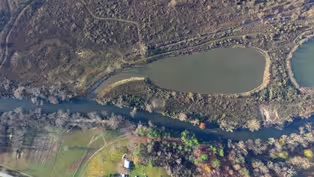
The French Broad River: Fixing the Floodplains
Video has Closed Captions
Clip: Special | 8m 50s | Restored floodplains absorb and hold water, building resilience to climate change in Western NC. (8m 50s)
Providing Support for PBS.org
Learn Moreabout PBS online sponsorship
- Science and Nature

Explore scientific discoveries on television's most acclaimed science documentary series.

- Science and Nature

Capturing the splendor of the natural world, from the African plains to the Antarctic ice.











Support for PBS provided by:
State of Change is a local public television program presented by PBS NC
State of Change is part of the Pulitzer Center’s Connected Coastlines reporting initiative. For more information, go to https://pulitzercenter.org/connected-coastlines.